What Is Funnel Analysis: Mobile App Guide 2026
Learn what is funnel analysis and why it's critical for mobile apps in 2026. This guide covers design, metrics, examples, & tools for growth teams.
Downloads look healthy. Store conversion seems acceptable. UA keeps sending traffic. But retention is soft, first purchase is inconsistent, and nobody on the team agrees on where users are getting stuck.
That's the moment stakeholders often start pulling screenshots from three dashboards, arguing in Slack, and shipping random fixes. Product blames traffic quality. Growth blames onboarding. Engineering blags instrumentation debt. Monetization points at the paywall. Sometimes everyone is partly right.
What is funnel analysis? In practice, it's the discipline of mapping a user journey into a sequence of observable steps so you can see where progress stops, where friction appears, and what to change next. For mobile apps and games, that matters more than in web-only products because the journey spans client events, OS dialogs, deferred deep links, identity states, store billing, entitlement sync, and cross-platform runtimes like Unity or React Native.
A good funnel isn't a dashboard artifact. It's an operating system for action. It starts with clean instrumentation, moves through analysis, and ends with remediation through experiments, in-app experiences, messaging, offer changes, or billing fixes. If your onboarding is weak, your funnel should expose it. If Android drops harder than iOS at purchase confirmation, your funnel should isolate it. If a liveops event boosts engagement but hurts monetization later in the loop, your funnel should make that visible before the next content drop.
Why Your App Is Leaking Users and How to Fix It
Most mobile teams don't have a traffic problem first. They have a visibility problem inside the product.
Users install. Some open once and disappear. Others get through your first-run flow but never complete the core action that makes the app valuable. In games, players may clear the tutorial and then vanish before the first meaningful economy interaction. In subscription apps, users may reach the paywall but never complete purchase, or complete purchase and then fail to reach the value moment that justifies renewal.
That leak usually sits in places teams don't inspect carefully enough:
- Permission requests too early: Push, tracking, contacts, photos, and notifications are often asked before the user sees value.
- Broken cross-platform parity: iOS has one onboarding path, Android another, and Unity builds a third variant with slightly different event names.
- Store and billing ambiguity: The paywall looked fine, but purchase success, restore, entitlement grant, and premium screen access weren't tracked as a connected journey.
- Overbuilt reports: Teams spend weeks building dashboards and still can't answer why users failed to move forward.
If your first-run experience feels vague, it usually helps to revisit your mobile app onboarding flow before you add more acquisition spend.
Funnels expose the leak
A funnel turns a blurry complaint like “engagement is low” into a sequence you can inspect. Example: app_first_open -> onboarding_started -> account_created -> tutorial_completed -> first_core_action -> day_two_returned.
That sequence gives product, growth, engineering, and data a shared object to discuss. Instead of debating the whole business, the team can ask a sharper question: Which step loses users, for which segment, on which platform, after which app version?
Practical rule: If a funnel step doesn't suggest a likely owner and a possible fix, it's probably too vague.
Fixing leaks starts with scope
Start with one journey that matters. Don't model the whole app on day one. Choose a path that sits close to value or revenue, instrument it cleanly, validate that events fire consistently, and only then add depth.
What works is boring. Clear event contracts, platform parity, identity consistency, and a short list of high-signal steps.
What doesn't work is also boring. Tracking everything, renaming events every sprint, and calling a chart “analytics maturity” while nobody uses it to ship changes.
Understanding the Core Concepts of a Funnel
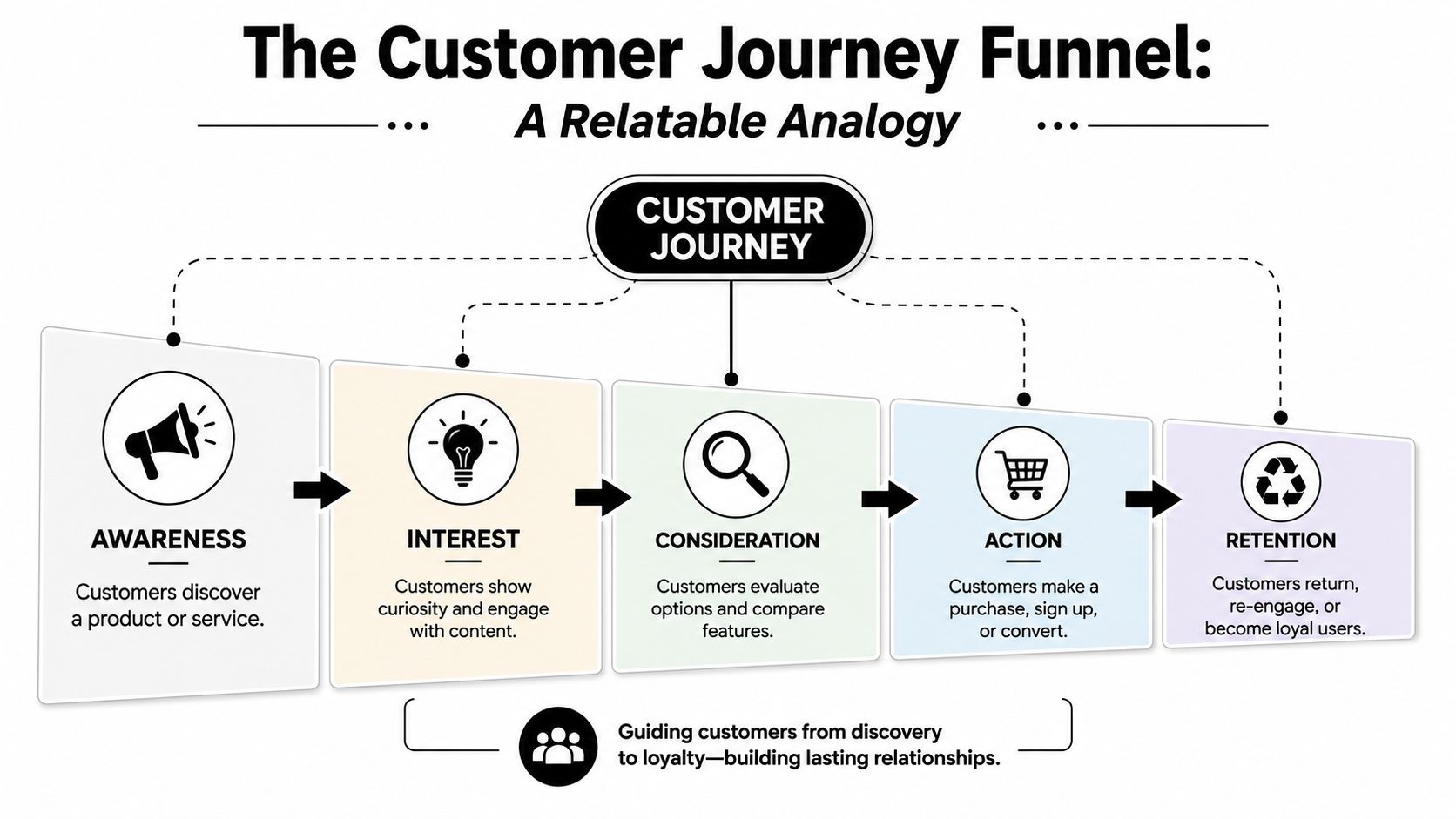
A funnel is easier to understand if you stop thinking about analytics tools and think about a coffee shop.
A customer walks in, reads the menu, joins the line, pays, and comes back another day. Some leave after looking at the board. Some stand in line and quit when it feels slow. Some buy once and never return. The shop owner wants to know where people bail out and why.
That's the same logic inside a mobile app.
Stages are the steps that matter
A stage is a meaningful user action in a journey. Not every event deserves to be a stage. “Screen viewed” can matter, but only when it marks progress toward a goal.
For a mobile app, stages often look like this:
| Funnel goal | Useful stages |
|---|---|
| Onboarding | first open, onboarding start, account creation, tutorial complete, first core action |
| Purchase | offer viewed, paywall shown, product selected, purchase initiated, purchase completed, entitlement active |
| Game retention | session start, tutorial complete, first match or level complete, reward claimed, next session return |
A stage should mean one of two things. The user moved forward, or the user hit a gate.
Conversion and drop-off are the basic signals
Conversion is movement from one stage to the next. Drop-off is where users stop progressing through that sequence.
You don't need advanced modeling to get value from this. If many users reach a paywall but fewer complete purchase, there's friction in the monetization flow. If many users buy but don't receive premium access, the issue may be entitlement handling, receipt validation, client refresh, or state propagation rather than offer design.
A funnel is just a structured story about a user trying to get something done.
Funnels simplify reality on purpose
Real user journeys aren't neat. People background the app, reinstall, switch devices, lose connectivity, skip steps, restore purchases, and resume later. Games add more complexity with content cadence, liveops moments, and alternate progression paths.
That's why the best funnels are not exhaustive maps. They are deliberate simplifications. A useful funnel leaves detail out so the team can identify the few moments that deserve intervention.
When teams ask what is funnel analysis, the simplest answer is this: it's a way to make user progress inspectable.
How to Design and Instrument Actionable Funnels
The hard part isn't drawing a funnel. The hard part is instrumenting one that survives real production conditions across iOS, Android, React Native, Flutter, Unity, and Unreal.
Start with the business question
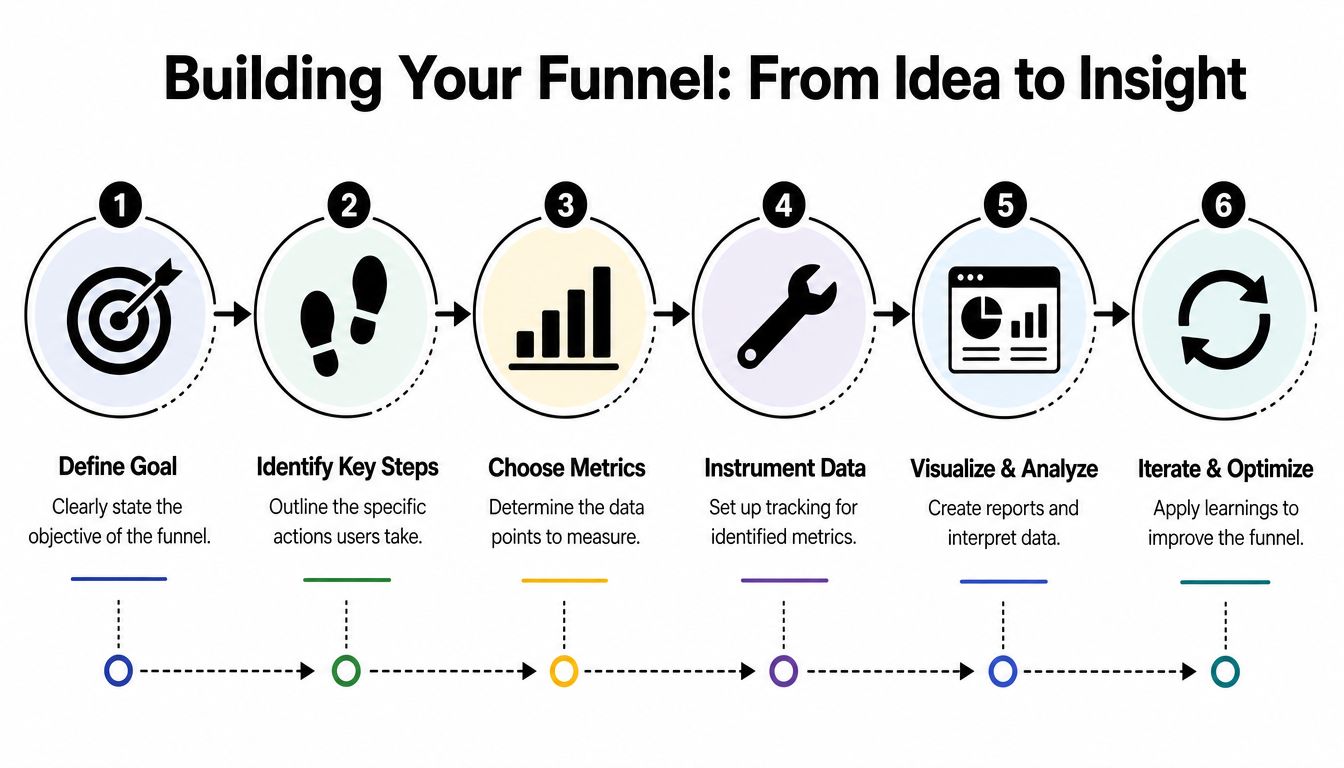
Pick one goal with a clear outcome:
- Activation: Can a new user reach the first meaningful action?
- Monetization: Where does the purchase path break?
- Adoption: Do users discover and use the feature you shipped?
- Retention: What sequence predicts return behavior in the core loop?
If the question is broad, the funnel will be noisy. “Improve retention” is too broad. “Measure whether new players who complete the tutorial and claim the starter reward return to the next session” is workable.
Define an event contract before you ship code
Write the funnel as an event spec. Not in someone's head. In a real shared document. Include:
- Event name
- Trigger condition
- Required properties
- Identity state
- Platform notes
- Expected order
- Owner
For example:
| Event | Trigger | Required properties |
|---|---|---|
paywall_viewed |
paywall becomes visible to user | placement, offer_id, variant_id, platform |
purchase_started |
store purchase flow initiated | product_id, paywall_id, placement |
purchase_completed |
store confirms successful purchase | product_id, transaction_state, source |
entitlement_activated |
premium access granted in app | entitlement_id, source_provider |
That last line matters. Many teams stop at purchase success and miss the actual insight.
Keep event names consistent across runtimes
Here, teams waste months.
If iOS fires tutorial_complete, Android fires onboarding_tutorial_finished, and Unity sends tutorialDone, you don't have a funnel. You have translation overhead disguised as analytics.
Use one schema everywhere possible:
- Snake case for event names
- Stable semantic names
- Shared property keys
- Controlled value lists for things like placement, source, platform, and experiment variant
For mixed stacks, define one source of truth and wrap the platform SDKs against that schema. React Native and Flutter teams should avoid letting each feature squad invent event names inside JS or Dart without governance. Unity and Unreal teams should be especially strict because game codebases tend to accumulate event drift fast.
For teams tightening this up, a dedicated guide to app analytics implementation helps avoid the usual SDK and taxonomy mistakes.
Decide where the event should fire
Client-side events are fine for UI progression. Server-side events are better for durable state changes such as subscription sync, entitlement grants, and backend-confirmed rewards. Often you need both.
A practical split looks like this:
- Client events: screen shown, button tapped, tutorial step completed, offer selected
- Server events: purchase validated, subscription renewed, entitlement changed, account linked
- Reconciled state: user-level truth used for funnel analysis and segmentation
Implementation advice: Don't let billing state live only in the client if you plan to analyze monetization funnels seriously.
Later in the build, add a visual validation pass.
Instrument for action, not for archives
Modern mobile teams increasingly want more than event collection. They want to detect a drop-off and respond inside the product without waiting for an app release. That's why the most effective instrumentation plans connect analytics to in-app surfaces, experiments, campaigns, billing state, and entitlement logic.
That doesn't mean ripping out your stack. Provider-agnostic setups often work best. You may keep existing analytics, billing, or attribution tools and still define a cleaner funnel layer above them. The point is to make events useful enough that product and growth can act on them quickly.
Key Metrics and Analysis Techniques That Matter
A funnel chart by itself is only the beginning. The useful work starts when the team asks better questions of the data.
Look at step-to-step movement, not only total completion
The overall completion view is handy, but it can hide the underlying issue. You need to inspect each transition.
Ask these questions:
- Where is the first major break? Early friction often points to onboarding, permissions, signup, or intent mismatch.
- Where is the last major break? Late-stage friction usually points to paywall copy, store flow, pricing confusion, technical purchase issues, or trust.
- Does the sequence make sense? If users appear to skip a critical stage, your instrumentation or identity stitching may be wrong.
A clean funnel review usually includes both user counts and transition logic, even if the exact percentages aren't the focus.
Add time-to-complete
A user who completes a funnel slowly can still indicate friction.
Examples:
- An onboarding flow that technically completes but takes too long may be over-explaining the product.
- A purchase path with long delays between paywall view and purchase start can signal hesitation.
- A game progression funnel with long pauses between reward claim and next session may indicate weak motivation or poor pacing.
Time matters because mobile use is fragmented. Users get interrupted constantly. A funnel that works only when someone has patience and stable attention is fragile.
Segment aggressively
Here, teams typically discover the ultimate answer.
A single aggregate funnel can look acceptable while one platform, one country, one campaign, or one app version is failing. Segment by things the team can act on:
| Segment type | What it can reveal |
|---|---|
| Platform | iOS and Android differences in UI, billing, permissions, or performance |
| Runtime | Native versus React Native, Flutter, Unity, or Unreal implementation gaps |
| App version | Regressions introduced by a release |
| Acquisition source | Intent mismatch from paid channels or creators |
| Geography | Localization issues, payment method fit, price presentation, or legal gating |
| New versus returning | Whether the problem is activation or re-engagement |
| Subscriber state | Whether active, lapsed, restored, or trialing users behave differently |
For a broader framework on what teams usually monitor around these journeys, this guide to mobile app engagement metrics is useful context.
One warning: Segment after you trust the base funnel. If your event schema is unstable, segmentation will create false precision.
Pair funnels with supporting evidence
Funnels tell you where. They rarely tell you why on their own.
To diagnose root cause, combine funnel analysis with:
- session replay
- support tickets
- crash and ANR monitoring
- experiment assignments
- remote config history
- billing and entitlement logs
- liveops schedules in games
If Android users abandon after purchase_started, inspect billing flow logs before redesigning the paywall. If onboarding completion drops after a release, check whether the release introduced a blocking bug before rewriting copy. Good teams don't treat funnel analysis as a decorative chart. They use it as a triage system.
Practical Funnel Examples for Apps and Games
Theory gets useful when you can lift the pattern and apply it to your own product.
New user onboarding funnel
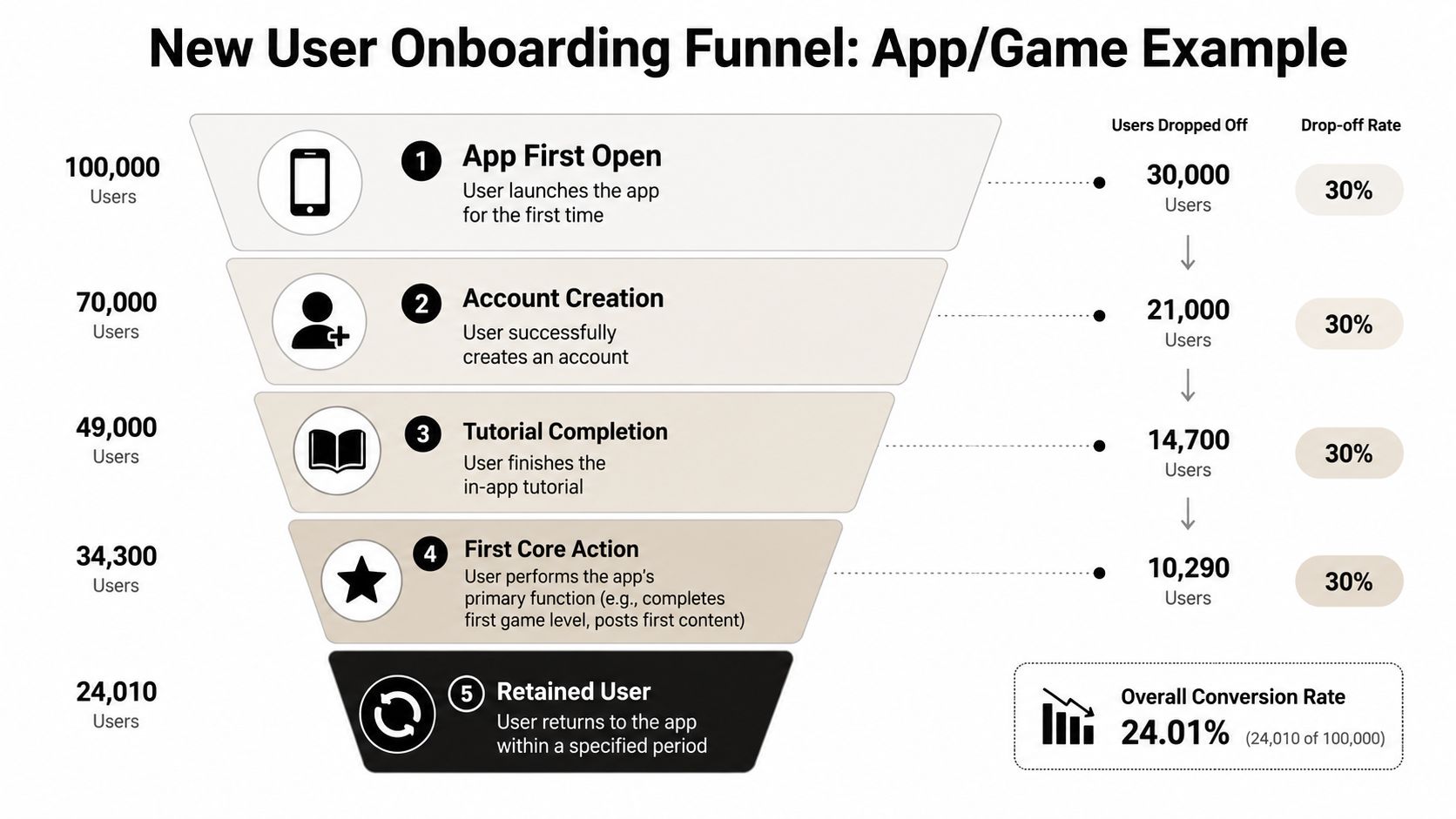
A strong onboarding funnel doesn't just check that screens were shown. It confirms the user reached a value moment.
A practical sequence:
app_first_openonboarding_startedaccount_createdorguest_session_startedtutorial_completedfirst_core_actionreturned_next_session
For a habit app, first_core_action might be logging the first entry. For a creator tool, it might be publishing the first item. For a game, it could be completing the first non-tutorial level.
What good looks like is qualitative. Users move through without long pauses, and most drop-off happens in understandable places. What bad looks like is easier to spot. Users stall before account creation because signup appears too early. Or they complete the tutorial but never do the core action, which means the tutorial taught mechanics without creating motivation.
In-app purchase funnel
Subscription and IAP funnels need more rigor because billing and entitlement states sit across client and store systems.
A reliable sequence often looks like this:
| Stage | Event example | Why it matters |
|---|---|---|
| Offer exposure | paywall_viewed |
Confirms the user actually saw the offer |
| Intent | product_selected |
Distinguishes interest from passive exposure |
| Transaction start | purchase_started |
Marks handoff to store flow |
| Transaction success | purchase_completed |
Confirms store-level completion |
| Access granted | entitlement_activated |
Confirms the user received what they paid for |
Many teams get sloppy when analyzing “paywall conversion” using only a paywall impression and a purchase callback, then miss failures in restore handling, pending transactions, backend validation, or entitlement sync. Paywalls matter, but they are only one component in the monetization path.
If a user paid and didn't unlock, that's not a conversion problem. That's an operations problem.
Core loop retention funnel for a game
Games need funnels that reflect the loop, not just installs and purchases.
A common pattern is:
session_starteddaily_reward_presenteddaily_reward_claimedmatch_or_level_startedmatch_or_level_completednext_session_started
This kind of funnel is useful around liveops, battle pass prompts, limited-time events, and economy changes. If reward presentation is high but claim is weak, the offer or placement may be unclear. If claim is strong but next-session return softens, the reward may create a spike without supporting progression.
For Unity and Unreal titles, I'd strongly recommend separating gameplay telemetry from growth funnel events while keeping a shared identity layer. That keeps high-volume game events from drowning the actionable path analysis product and monetization teams need.
From Analysis to Action Common Mistakes and Next Steps
The biggest mistake teams make is treating funnel analysis like a reporting ceremony. They review the chart, agree there's a leak, and then move on without changing the product experience that caused it.
Mistakes that burn time
Some failures are technical. Others are organizational.
- Vague steps: “Engaged user” isn't a step. It's a label pretending to be an event.
- No owner per stage: If nobody owns the transition from paywall to purchase, it won't improve.
- Ignoring segmentation: Aggregate funnels hide platform-specific failures and release regressions.
- No experiment link: Teams see a drop but can't connect it to the variant, campaign, or liveops change that caused it.
- Client-only truth for revenue: Purchase states drift, restore logic gets missed, and entitlement issues become invisible.
Remediation should be immediate
Once you find friction, the next move should be concrete.
If users drop before account creation, test a guest path. If players finish the tutorial but don't start the first real level, shorten the tutorial and place the reward after the first win instead of before. If purchase initiation is healthy but completion is weak, inspect pricing presentation, product ordering, legal copy placement, and store callback handling.
A good remediation loop usually includes:
- State the observed break in one sentence.
- Form a narrow hypothesis about why it happens.
- Ship a targeted change through an experiment, remote config, or in-app experience.
- Measure the same funnel again with the same event definitions.
- Keep the win only if downstream quality holds, not just the local step.
Teams get into trouble when they optimize one step and damage the next one.
Use in-app experiences to recover drop-offs
Not every leak needs a code release. Some leaks need a better intervention.
Examples:
- Users who viewed a feature announcement but didn't try the feature can get a contextual walkthrough later.
- Users who hit a paywall and left can receive a different offer placement or timing on the next session.
- Lapsed subscribers can see a retention screen tied to billing state rather than a generic upsell.
- Players who churn after an event tutorial can receive a simplified return flow with a clear reward.
That's why the best funnel systems are tied to experimentation, messaging, offers, and entitlement-aware targeting. Analytics without remediation is just observation.
Choosing Your Funnel Analysis and Growth Toolkit
Tool choice changes how quickly your team can move from leak detection to remediation.
Three common approaches
| Approach | Strengths | Weaknesses |
|---|---|---|
| DIY pipeline | Maximum control, custom schemas, flexible warehousing | Slow setup, high maintenance, weak usability for product and growth teams |
| Stitched stack | Best-of-breed tools for analytics, messaging, experiments, billing, and attribution | Identity drift, event mismatch, extra vendor overhead, slower iteration |
| Integrated platform | Faster path from instrumentation to action, shared context across analytics and experiences | Requires careful evaluation of fit, workflow, SDK coverage, and interoperability |
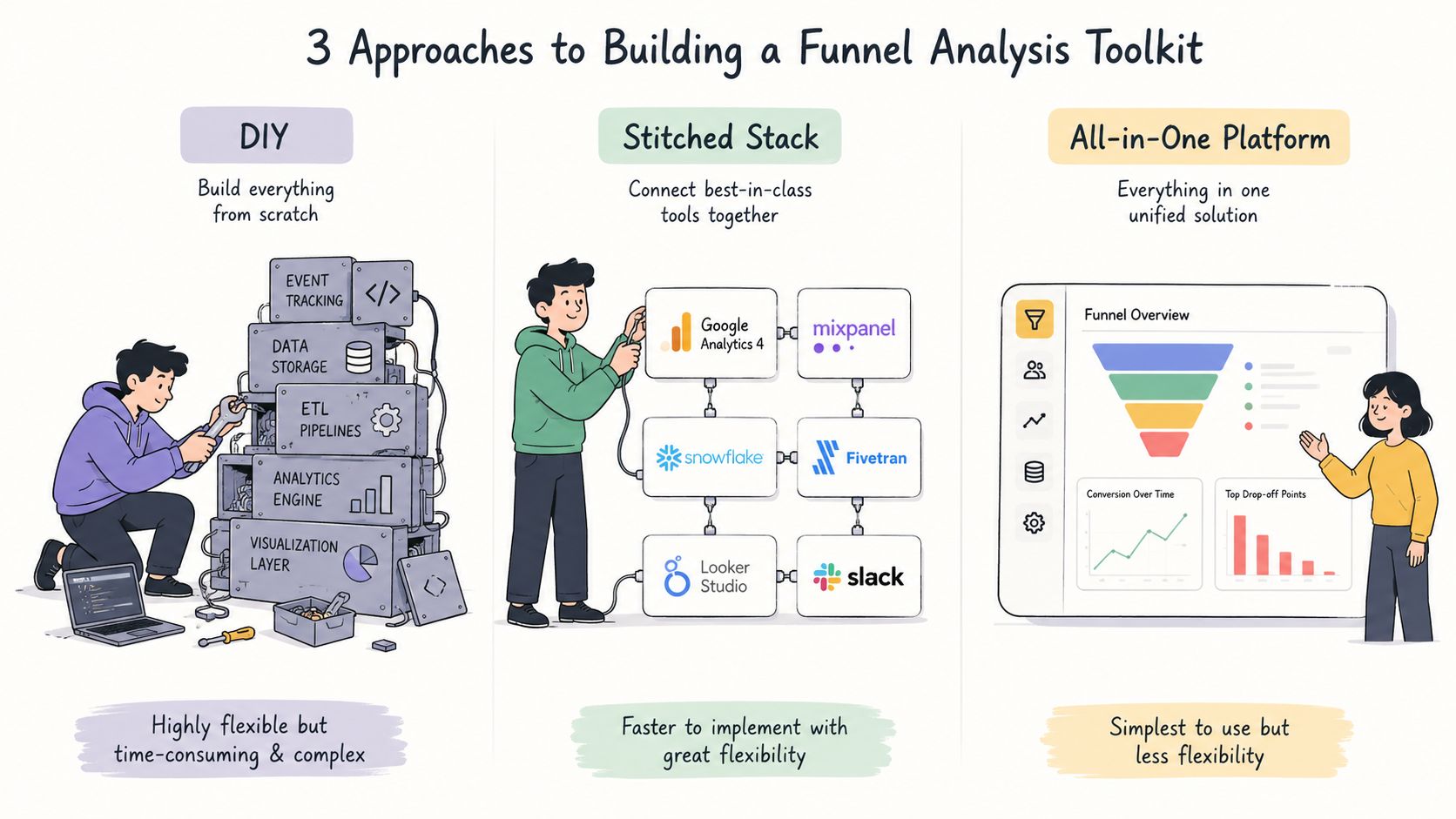
DIY works for teams with strong data engineering resources and patience. It often breaks down when product, growth, and monetization need to ship changes quickly without waiting on analytics backlog.
A stitched stack is common in mobile. One tool for product analytics, another for attribution, another for paywalls, another for messaging, another for billing or entitlements. This can work well, but only if the team is disciplined about event contracts, identity resolution, and ownership. Otherwise, every funnel review turns into reconciliation work.
An integrated platform is strongest when you want analytics to behave like a live operating layer rather than a passive dashboard. The best versions are provider-agnostic, support cross-platform runtimes including iOS, Android, React Native, Flutter, Unity, and Unreal, and can work with your existing billing and data providers instead of forcing a rip-and-replace. That matters for subscription apps and games that already rely on StoreKit, Google Play Billing, RevenueCat, or internal backend logic. It also matters that billing and entitlement infrastructure doesn't come with a revenue-share fee attached to your purchase data.
If your team wants funnels that don't stop at reporting, Nuxie is worth a close look. It's an AI-native platform for mobile apps and games that combines in-app experiences, experimentation, analytics, billing, entitlements, and growth workflows in one provider-agnostic system. Teams use it to instrument journeys, analyze drop-off, test fixes, ship onboarding flows, surveys, feature announcements, liveops moments, and paywalls without waiting for app releases across iOS, Android, React Native, Flutter, Unity, and Unreal.