Game LiveOps: A Guide for Mobile Game Teams in 2026
Master game liveops. This guide explains core systems, metrics, and implementation patterns for mobile games on Unity & Unreal to boost retention and revenue.
Mobile teams still talk about LiveOps as if it starts after launch. That framing is outdated. In practice, Game LiveOps is now the operating layer that decides whether players stay long enough to care about your economy, your events, or your offers at all.
The clearest proof is financial. Mobile games using LiveOps generate 30 times more revenue on average than titles that don't, every title in the global top 10 by mobile game revenue is LiveOps-supported, and 84% of all mobile in-app purchase revenue worldwide in 2024 came from games using live-ops, according to Game World Observer's reporting on Sensor Tower data. That doesn't describe a nice-to-have post-launch function. It describes the commercial model of the category.
For technical, product, growth, and game teams, the implication is simple. Stop treating LiveOps like a content calendar bolted onto the side of the game. Build it as a retention engine, a decision system, and a release system that can move across iOS, Android, React Native, Flutter, Unity, and Unreal without waiting on store review every time you need to react.
The Multi-Billion Dollar Reason for Game LiveOps
A small share of players drives the business in free-to-play. The teams that keep those players engaged, session after session, usually win more revenue without relying on constant paid acquisition.
That is the economic case for Game LiveOps.
The point is not just that live-operated games make more money, as noted earlier. It is why they do. Revenue in mobile rarely comes from a one-time content drop or a launch spike. It comes from repeated returns, timely prompts, and systems that give players a reason to act now instead of later. Good LiveOps turns retention into a repeatable operating model.
In older mobile models, LiveOps often meant weekly events, holiday calendars, and store refreshes. That still has a place, but the center of gravity has shifted. Modern LiveOps is less about keeping the schedule full and more about shaping the next session: which objective appears, which reward is surfaced, when difficulty eases, when an offer should wait, and when a player needs a social or competitive reason to come back tonight.
That change has real production consequences. Teams no longer need only content planners. They need release control, segmentation, economy tuning, experimentation discipline, and clear decision rights between product, design, analytics, and engineering. If those functions are disconnected, the team reacts slowly and usually overcorrects after the damage is already visible in retention and conversion.
What the economics look like in practice
The commercial upside comes from operating on shorter loops.
A team that can adjust event rewards, reorder missions, suppress a bad offer, or target a win-back trigger within hours protects more value than a team waiting on the next client build. In practice, the biggest gains often come from many small interventions rather than one major update. Better first-week pacing. Smarter segmentation. Fewer dead sessions. More relevant reasons to return.
Three patterns show up consistently:
- Retention creates monetization capacity: Players who come back frequently generate more chances for progression, social competition, ad views, and purchases.
- Operational speed protects revenue: If a feature underperforms for three days before anyone can change it, the loss is already booked.
- Moment-to-moment relevance beats calendar volume: Ten events do not help if the player sees the wrong one, at the wrong time, with the wrong reward pressure.
Practical rule: Build LiveOps to influence the next player session, not just next month's content plan.
This is particularly important in a games market that remains both large and crowded. Static games are not only competing on art direction, IP, or user acquisition efficiency. They are competing against products that adjust daily, learn from behavior quickly, and treat engagement as an operating system rather than a post-launch service.
What Is Game LiveOps and Why Is It Essential
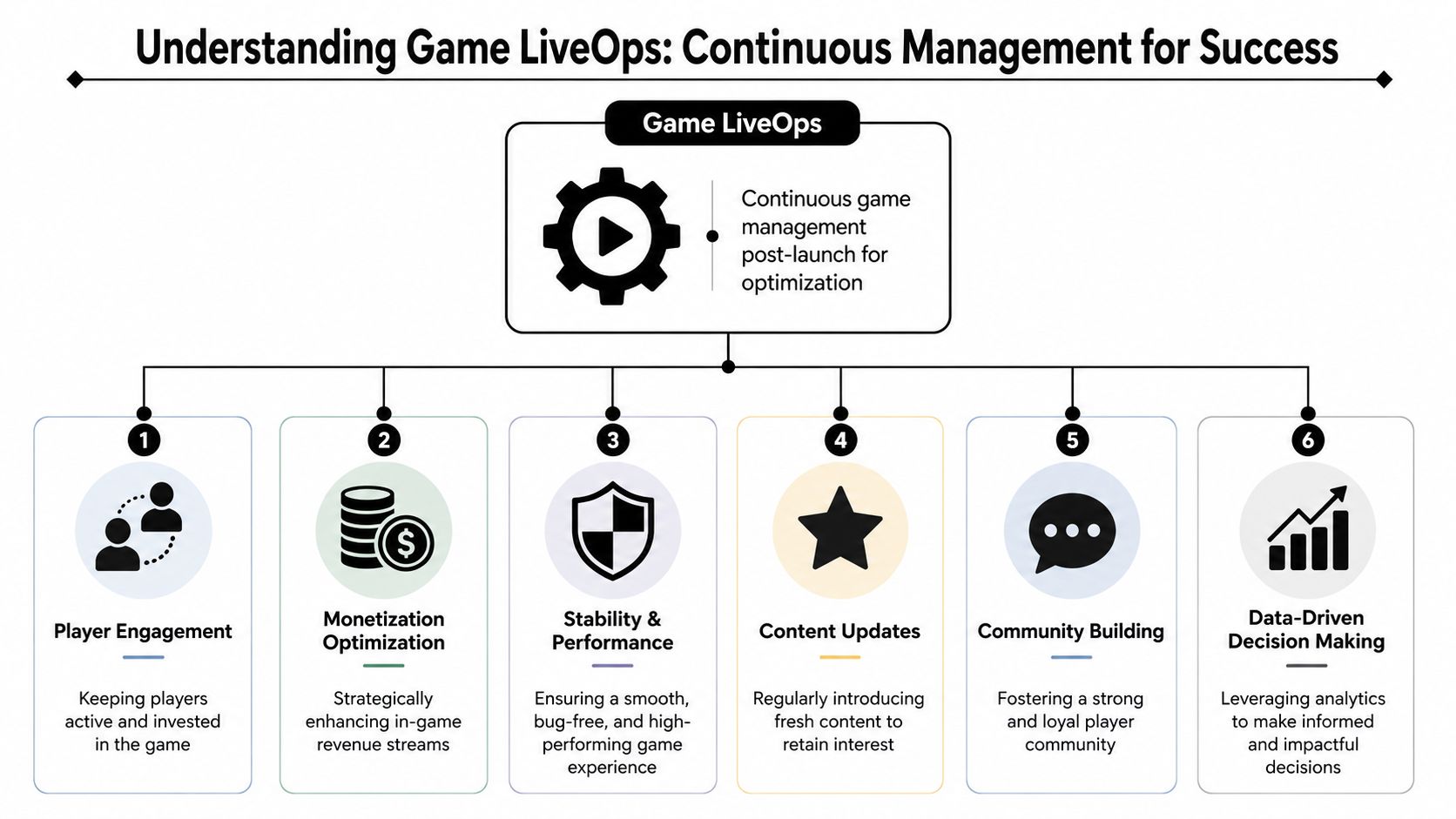
Game LiveOps is the operating layer that keeps a game responsive after launch. It covers the systems and habits a team uses to change content, tune progression, adjust rewards, target offers, react to player behavior, and fix weak points without waiting for a full client release.
That definition used to be enough. It is not enough now.
For years, LiveOps was treated as post-launch support: run a weekend event, rotate the shop, send a push, patch a balance issue. Modern mobile teams use it very differently. LiveOps now drives retention session by session. The job is no longer just to keep the calendar full. The job is to make the next session feel relevant, well-paced, and worth returning to.
That shift changes what teams build. Appointment mechanics still matter. Daily resets, battle passes, timed events, and seasonal content still create rhythm. But retention usually breaks earlier and at a smaller scale than the monthly roadmap suggests. It breaks in a bad difficulty spike, an empty mid-session reward loop, a stale mission set, a mistimed offer, or a player returning to nothing that fits their state. LiveOps exists to correct those moments fast.
A traditional shipped game depends heavily on what was in the box at launch. A LiveOps game depends on how well the team can keep the experience adaptive after launch through events, economy changes, segmentation, messaging, and progression tuning.
LiveOps is an operating model
Teams often label one group as “LiveOps” while the rest of the product still works on static release logic. That setup rarely holds for long. Design plans too far from real player behavior. Engineering gates every meaningful change behind a build. Growth schedules promos with little connection to gameplay state. Community and support hear pain first, but the response loop is too slow to save the session that went wrong.
The stronger model is cross-functional and operational:
- Design creates systems with variables that can be tuned safely after release.
- Engineering exposes the flags, parameters, and hooks needed for remote changes. Teams that need a practical model for this usually start with a remote config setup for live game tuning.
- Product measures success through retention quality, not content output alone.
- Growth aligns offers and messaging with player context, not just campaign dates.
- Analytics supports decisions that can be acted on the same day.
Why it became necessary
The importance of LiveOps stems from the reality that mobile games do not win by being finished. They win by continuing to feel responsive.
Players keep asking a short set of questions: What should I do right now? Is progress still fair? Is there a reason to come back tonight? Did the game notice how I play, or is it serving the same loop to everyone? LiveOps answers those questions through systems, not promises.
The practical trade-off is that more control also creates more ways to make mistakes. A team can over-segment, flood players with events, or chase short-term revenue with reward pressure that damages progression trust. Good LiveOps is not constant activity. It is selective intervention with clear intent.
The best-operated games feel alive because they adapt at the level players experience: the next session, the next store view, the next mission chain, the next return moment after a lapse. That is why LiveOps moved from a support function to the primary retention engine.
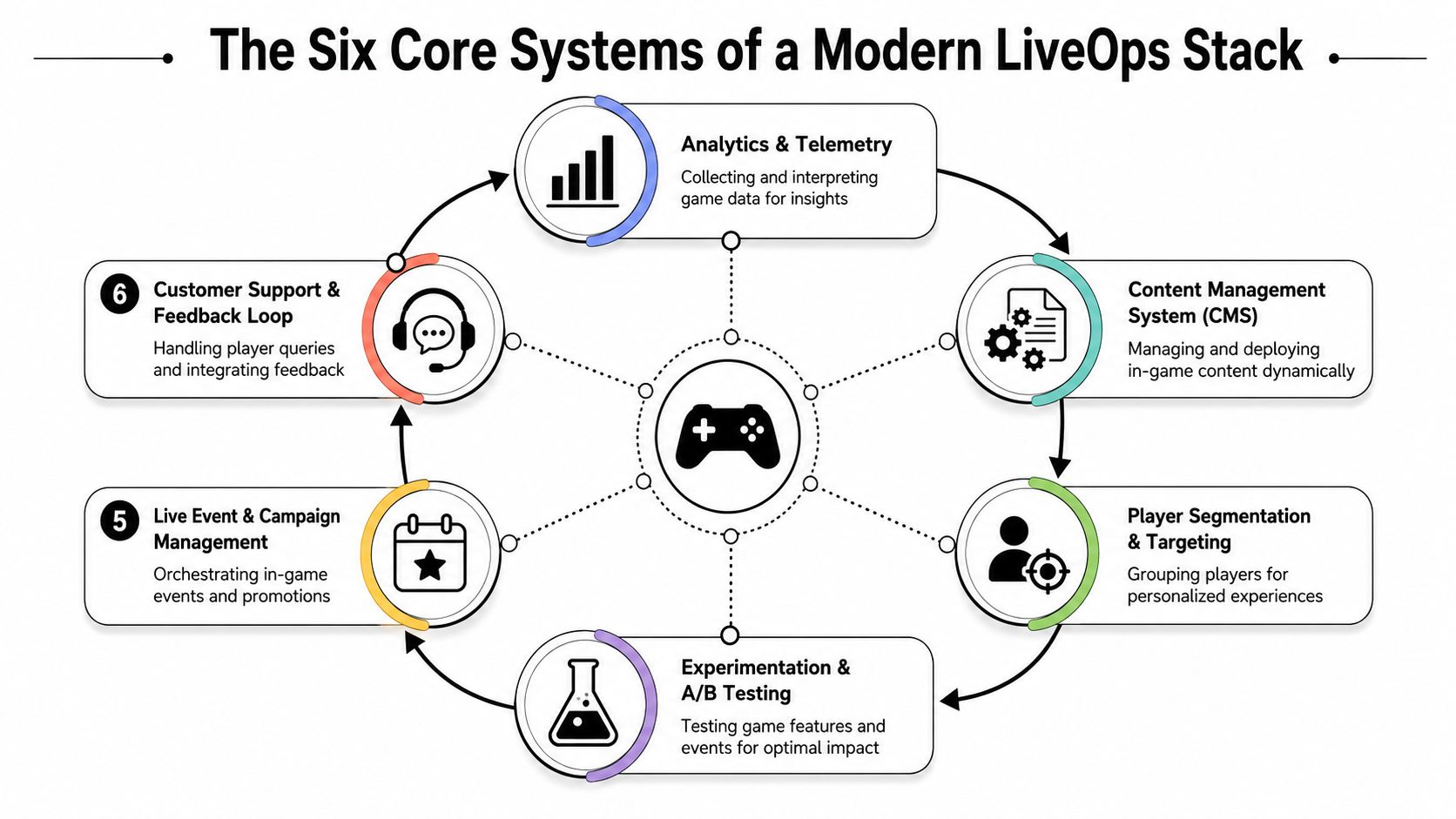
The Six Core Systems of a Modern LiveOps Stack
A modern LiveOps stack is less about one tool and more about whether the operating model is coherent. Teams usually fail here in one of two ways. They either buy point solutions that don't talk to each other, or they overbuild custom infrastructure before they've learned how they intend to operate.
The better approach is to define the six systems your game needs, then decide which pieces you'll build, which you'll buy, and which need to remain provider-agnostic.
Content pipeline and CMS
Your content pipeline determines whether the team can ship moments quickly or whether every update becomes an engineering task. A proper CMS lets operators prepare assets, copy, rewards, event cards, and storefront content without rebuilding the app.
A key aspect is that LiveOps primarily involves operational throughput. If every banner, tournament card, quest label, or store module depends on a client update, the team loses the timing advantage that makes LiveOps useful in the first place.
Remote configuration
Remote config is the hinge point of the whole stack. According to SplitMetrics' LiveOps guide, integrating a CMS with remote configuration infrastructure lets teams air-deliver assets and game parameters without App Store binary updates, and that architecture can increase retention and monetization velocity by up to 30% by allowing instant adjustment of in-game economy variables based on telemetry data.
That capability changes how teams work. Instead of scheduling fixes around store approval, they can tune:
- Drop rates
- XP multipliers
- Offer visibility
- Difficulty thresholds
- Event activation rules
- Paywall variants
If you're comparing implementation paths, this breakdown of remote config alternatives to Firebase is useful because the primary decision isn't just feature parity. It's whether the system can support product, growth, and game teams working from the same operational surface.
A short demo helps make the stack more concrete.
Experimentation and segmentation
A/B testing in games often gets reduced to paywall tests. That's too narrow. In practice, teams should experiment across event timing, quest structure, shop presentation, resurfacing prompts, progression pacing, reward framing, and reactivation offers.
Segmentation belongs here because a test without audience logic produces weak learning. A new-player experiment should rarely share the same success criteria as an endgame monetization test. Likewise, non-payers, lapsed users, and highly engaged payers shouldn't all see the same interventions.
Event scheduling and campaign orchestration
Scheduling sounds administrative until a live game starts overlapping events badly. Then it becomes obvious how much player experience depends on timing discipline.
A strong campaign layer handles:
| System | What it controls | Why it matters |
|---|---|---|
| Event windows | Start and end timing | Prevents dead periods and accidental overlap |
| Eligibility | Who can enter | Keeps content relevant |
| Dependencies | What enables what | Stops conflicting flows |
| Regional rollout | Market-specific timing | Avoids one-size-fits-all scheduling |
Telemetry and analytics
Telemetry isn't just for dashboards. It tells operators whether the current state of the game is healthy. Good event instrumentation should answer practical questions fast: who entered, who progressed, where they stalled, whether rewards were claimed, and whether the event improved downstream behavior.
Ultimately, many teams discover they don't have a LiveOps problem. They have an observability problem.
Entitlements and payments
The last system is usually discussed too late. Entitlements and billing logic sit underneath subscriptions, offers, bundles, premium content grants, and purchase recovery. If they're brittle, the game can't personalize safely.
For mobile teams, this has to work cleanly across iOS, Android, React Native, Flutter, Unity, and Unreal, not just for storefront transactions but for entitlement state, purchase data, and experiment-aware offer delivery. Native mobile stacks still offer the highest platform fidelity on iOS and Android, while cross-platform frameworks can trade some native behavior for consistency, as discussed in Mobisoft's comparison of Flutter, React Native, and native apps. Unity also supports embedding as a library inside native iOS and Android apps, which is useful when a game or interactive module sits inside a broader mobile product, as shown in Unity's explanation of Unity as a Library.
Practical LiveOps Implementation Patterns for Mobile
A good LiveOps workflow should let a team launch a weekend moment without opening a release branch. That's the bar. If a producer needs engineering for every timed change, the stack is still too rigid.
Consider a common scenario: a surprise weekend tournament intended to lift session depth among players who were active recently but haven't engaged with competitive modes.
Pattern one for a timed gameplay event
Start with the event shell. Define the tournament start window, eligible cohorts, ruleset, rewards, and fallback behavior if the event underperforms. Then wire the game client so the mode can appear or disappear based on remote flags rather than hardcoded visibility.
In Unity, that usually means exposing the mode entry point, reward tables, and economy variables to a configuration layer. In Unreal, the same principle applies, though teams often push more logic into backend services or data tables. In React Native and Flutter, the pattern is similar for companion experiences, event hubs, stores, or meta layers around the game. The app renders the shell, while the operational system controls content and state remotely on iOS and Android.
A lightweight launch sequence often looks like this:
- Gate access first: Turn on the event only for the target segment.
- Tune rewards second: Set XP, currency, or drop table changes through config.
- Instrument every step: Track entry, first match, reward claim, and exit.
- Prepare a rollback path: If progression feels too punishing, disable or retune without a binary update.
If a live event can't be rolled back quickly, it isn't ready.
Pattern two for offers, paywalls, and messaging
Gameplay events are only half the job. Operators also need to attach contextual offers without making the game feel predatory. That might mean showing a starter bundle after a player nearly completes the tournament, or testing a different paywall after a high-intent moment.
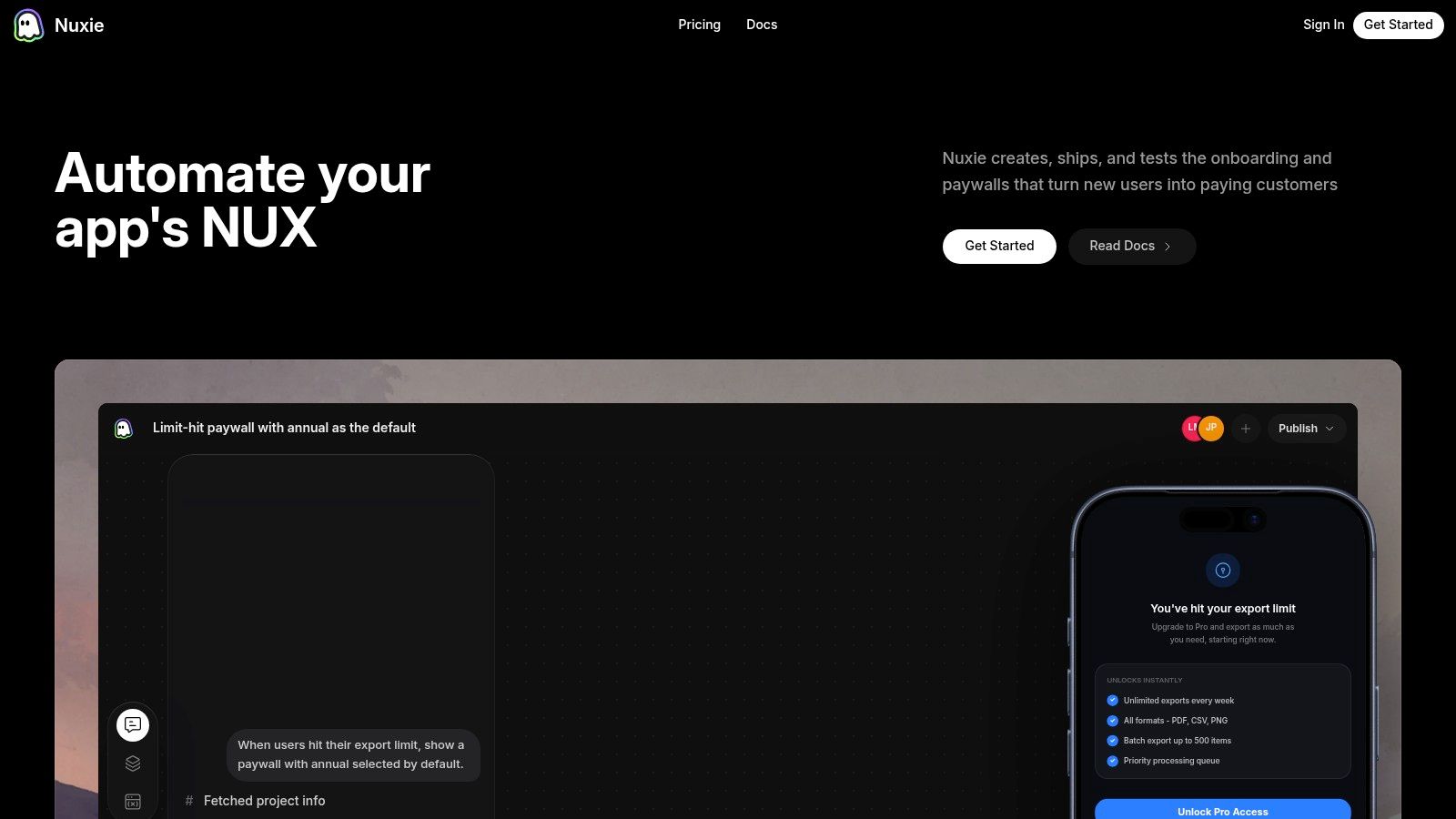
Paywalls are one important use case here, not the entire system. The same orchestration layer should also handle onboarding flows, feature callouts, reward screens, and retention prompts. That's especially useful when teams want one delivery model across native apps, cross-platform shells, and engine-driven game surfaces.
For practical mobile teams, the cleaner pattern is:
- Use gameplay signals as triggers: Don't show an offer because the calendar says so. Show it because the player hit a meaningful moment.
- Keep offer logic separate from client releases: Price presentation, copy, bundles, and eligibility should be remotely controlled.
- Coordinate messaging with state: If a player already bought, claimed, or progressed, don't keep pushing the same prompt.
- Support existing providers where needed: Billing and entitlement systems often need to work alongside StoreKit, Google Play Billing, RevenueCat, or internal services.
For teams building richer in-app surfaces around these moments, this guide to in-app messaging patterns for mobile products is a useful reference because the same delivery logic applies to event cards, reward announcements, surveys, and offer prompts.
Pattern three for mixed tech stacks
Many studios don't have a single stack. They have a Unity game client, a native account app, maybe a React Native shell for growth surfaces, and billing logic spread across providers. That's normal.
The practical goal isn't stack purity. It's operational consistency. The event should launch once, targeting should evaluate once, analytics should reconcile once, and entitlement state should remain trustworthy no matter where the player enters the experience.
Key Metrics and Runbooks for Measuring Success
A small change in session quality can move retention more than another calendar event ever will. That is why strong LiveOps teams track what happens inside the session, not just who came back the next day.
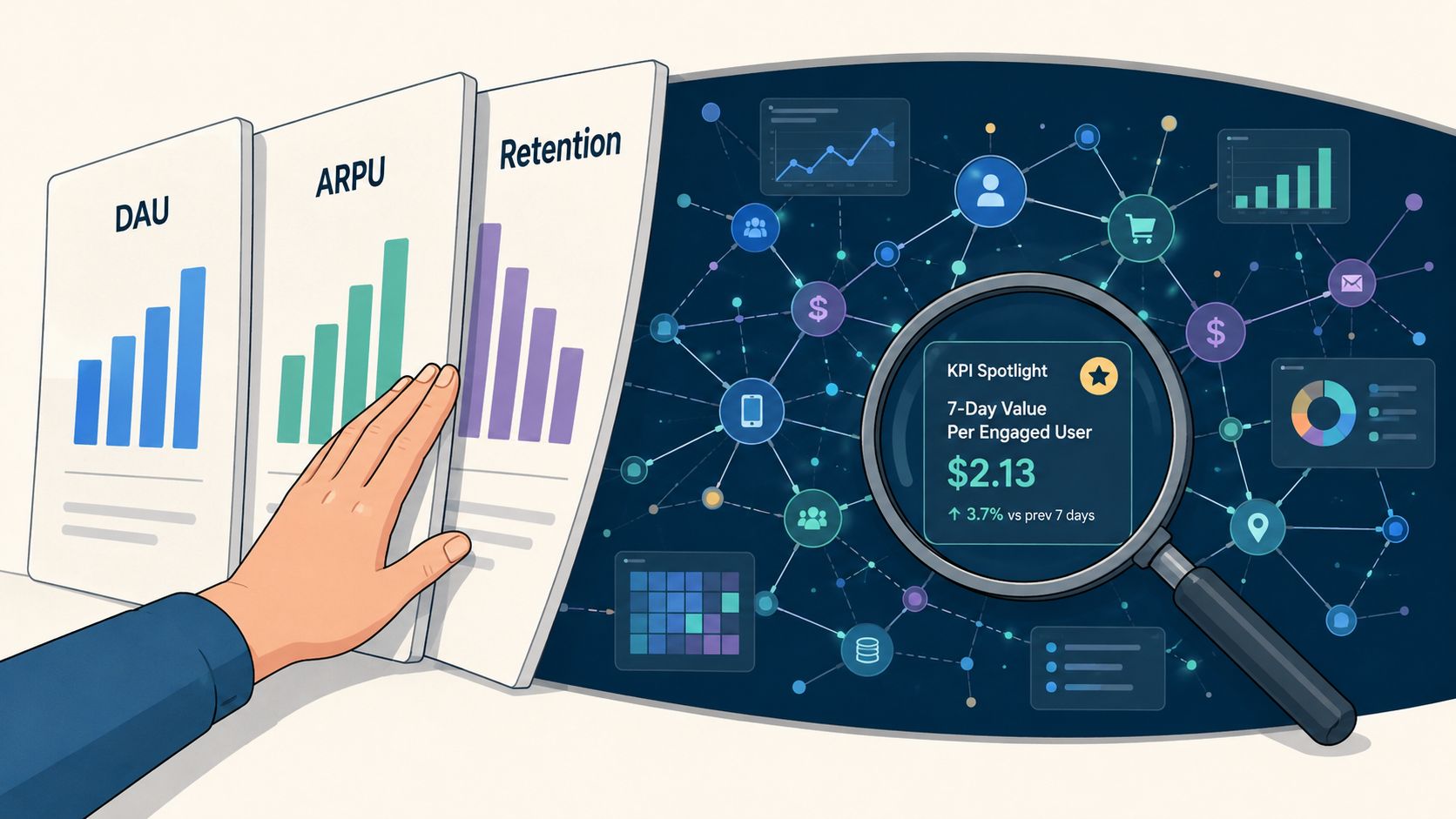
DAU, WAU, MAU, ARPU, ARPPU, LTV, and payer rate still matter. They are useful business outputs. They are weak operating signals when a producer needs to decide whether an event is helping the core loop, interrupting it, or pushing monetization too early.
Modern LiveOps now carries more of the retention load than it did a few years ago. The job is no longer just to keep the content calendar full until the next update ships. The job is to create momentum inside ordinary play sessions, then repeat that momentum often enough that returning feels natural. Teams that still measure LiveOps like a post-launch service function miss the essential question. Is the player finding another reason to continue right now?
Measure session health, not just return rates
Game Design Bites argues that LiveOps now centers on moment-to-moment retention, and notes that early session experience is often decisive in whether players stay, as discussed in its analysis of retention-oriented LiveOps.
That changes the scorecard.
Useful session-health metrics include:
- Early-session drop-off points: where players exit before they reach a satisfying action, reward, or progression beat
- Time to first meaningful action: how long it takes to get from app open to actual play, visible progress, or a claim worth noticing
- Event participation depth: whether players only tap into the event or continue through multiple steps
- Session momentum markers: sequences like win, reward, upgrade, mission progress, and re-entry into play
- Offer timing quality: whether the prompt appears after intent is clear, instead of interrupting it
- Recovery rate after friction: whether players resume progress after a fail state, empty reward, long load, or rejected offer
These metrics are more diagnostic than top-line return rates. If D1 is soft, the team still needs to know why. Did the event front-load too much explanation? Did the reward ladder start too far away? Did the offer appear before the player had any reason to value it? Those are LiveOps decisions, not abstract retention problems.
Build runbooks before the event goes live
A runbook is a pre-decided response to a known signal. Without one, teams burn the first day of an event debating whether the problem is messaging, economy tuning, targeting, or reward structure. By then, the window that mattered is usually gone.
A practical runbook table might look like this:
| Signal | Likely issue | Immediate action |
|---|---|---|
| High event entry, weak completion | Rules or difficulty feel punishing | Reduce progression friction or shorten the path to the first payoff |
| Good participation, short sessions | Rewards fail to create momentum | Add a near-term milestone, stronger claim visibility, or faster follow-up task |
| Offer views high, conversion weak | Timing or value framing is off | Retest trigger timing, bundle framing, or eligibility |
| Returning players ignore event hub | Event relevance is unclear | Retarget entry messaging based on player state, mode history, or progression stage |
The best runbooks also assign owners. Product tunes rewards. Design adjusts thresholds. CRM changes entry messaging. Analytics validates whether the fix improved depth or only increased clicks. That division matters because LiveOps problems often look similar on a dashboard and require different interventions.
Teams running event messaging, triggers, and follow-up journeys across push, inbox, and in-session surfaces usually need one operating layer for all of it. A mobile app marketing automation workflow for triggered player messaging helps centralize those responses so the team is not patching together event logic in one tool, offers in another, and re-engagement flows somewhere else.
Common LiveOps Pitfalls and How to Avoid Them
The biggest LiveOps failures usually don't come from the wrong dashboard or a missing feature flag. They come from breaking player trust.
That often starts with a false sense of success. Revenue spikes look good in the weekly review, so the team assumes the operation worked. Meanwhile, the game is getting noisier, progression feels more conditional, and players are engaging less cleanly with the core loop.
Aggressive monetization that weakens the game
Juego Studios states the principle plainly: “progression should be achievable without payment” and “a non-paying player should be able to reach the same endpoints, it just takes longer”, in its guide to building a LiveOps strategy for games.
That's the right line. If spending becomes the only credible path to keep up, the economy stops feeling optional and starts feeling coercive. Players notice quickly. So do community channels, support tickets, and long-term payer behavior.
A better operating model separates:
- Acceleration from exclusion
- Convenience from necessity
- Prestige from power walls
Calendar overload
Many teams mistake activity density for engagement strategy. They stack events, missions, offers, bonus tracks, and seasonal prompts until the game starts reading like a dashboard instead of a world.
The result is confusion. One event cannibalizes another. Players stop understanding what matters today. The team also loses the ability to learn, because too many overlapping interventions muddy the signal.
A simple fix works surprisingly well:
- Name the primary action of the week: Decide what behavior you want most.
- Support it with fewer secondary beats: Don't ask for five kinds of attention at once.
- Watch for participation decay and shorter sessions: Those are pacing warnings, not just content issues.
- Rotate pressure: If every week is urgent, none of it feels special.
Players can handle complexity. They usually won't tolerate clutter.
Treating non-payers as dead weight
This mistake shows up in design reviews more than anyone admits. A segment doesn't spend, so the team deprioritizes its experience. That's shortsighted.
Non-payers still shape matchmaking, social density, guild health, event participation, and community energy. They also become future payers more often when the game remains fair, legible, and emotionally rewarding. A LiveOps program that only speaks to current payers eventually shrinks its own top of funnel inside the game.
Conclusion Building Your LiveOps Flywheel
The strongest LiveOps teams don't run isolated events. They build a flywheel.
The loop is straightforward. Instrument the game well. Launch configurable experiences. Watch live behavior closely. Adjust pacing, rewards, visibility, and offers while the moment still matters. Feed those learnings back into the next event, the next onboarding improvement, the next economy adjustment, and the next monetization test.
That flywheel works only when systems connect. Content has to ship without store delay. Experiments have to reach the right segment. Analytics has to explain behavior at the session level, not just in weekly rollups. Billing and entitlements have to remain reliable across iOS, Android, React Native, Flutter, Unity, and Unreal. And the team has to protect trust while it monetizes.
Building all of that from scratch is possible. It's also slow, operationally expensive, and easy to fragment across too many tools.
Nuxie helps mobile app and game teams run this kind of LiveOps operation without stitching together a brittle stack. It's an AI-native mobile growth platform for in-app experiences, experimentation, analytics, billing, entitlements, and growth across iOS, Android, React Native, Flutter, Unity, and Unreal. Teams can use it for paywalls, but also for onboarding, retention moments, surveys, feature announcements, personalized screens, and live game events. Because Nuxie is provider-agnostic, it can work with existing tools and data providers, and it doesn't charge a revenue-share fee for billing or entitlement data.