Subscription Management Solutions: A Mobile Team's Guide
A guide to subscription management solutions for mobile teams. Learn to evaluate, integrate, and migrate your stack beyond simple billing for iOS and Android.
You ship an app update. The paywall looks right. StoreKit and Google Play Billing both return successful purchases in test. Then production starts doing what production does.
A user upgrades on iOS, but the entitlement webhook lands late. Another restores purchases on Android, but analytics still shows them as free. Growth wants to compare paywall variants, product wants cohort-level retention, finance wants confidence in recurring revenue, and engineering is stuck reconciling receipts across app stores, backend jobs, SDKs, and dashboards that disagree with each other.
That's the main reason teams start looking at subscription management solutions. The problem usually isn't “we need billing.” The problem is that billing, entitlements, experiments, analytics, and in-app experience delivery were built as separate systems, so every plan change or failed renewal becomes an integration problem.
The Hidden Costs of a Disjointed Subscription Stack
Most mobile teams don't start with a clean subscription architecture. They accumulate one. Native app code handles purchases, a backend service tracks access, a third-party tool renders paywalls, a data warehouse tries to normalize events, and someone on the team becomes the human bridge between App Store, Google Play, Stripe, support tickets, and dashboards.
That patchwork works for a while. Then edge cases pile up. Grace periods don't line up with your access logic. Intro offers and win-back offers create state transitions nobody modeled clearly. Support can't answer “why did this user lose premium?” without asking engineering to trace a receipt chain.
The hidden cost isn't just bugs. It's coordination debt.
Where teams actually lose time
A disjointed stack creates friction in places that don't show up in a simple feature checklist:
- Engineering loses focus: developers spend time on receipt validation quirks, webhook retries, and entitlement backfills instead of product work.
- Growth loses speed: marketers can't easily connect paywall variants, onboarding paths, and downstream subscription outcomes.
- Product loses confidence: teams stop trusting a single source of truth for who should have access and why.
- Support loses context: agents see refund requests, renewal issues, and restore-purchase complaints without enough system visibility.
Practical rule: If three teams use different tools to answer “is this user subscribed right now?”, you don't have a tooling problem. You have a systems design problem.
That's why subscription management solutions have become infrastructure, not a nice-to-have add-on. The global subscription management software market was valued at USD 8.33 billion in 2025 and is projected to reach USD 20.83 billion by 2032, growing at a CAGR of 14%. That growth reflects a shift toward automating the consumer lifecycle, including recurring billing and payment processing.
For mobile teams, the takeaway is simple. A subscription stack stops being “just monetization tooling” once subscriptions become a core revenue path. At that point, the stack needs to behave like production infrastructure.
What Modern Mobile Subscription Management Really Means
A lot of teams still evaluate subscription management solutions as if they're shopping for a billing wrapper. That view is outdated for mobile apps and games.
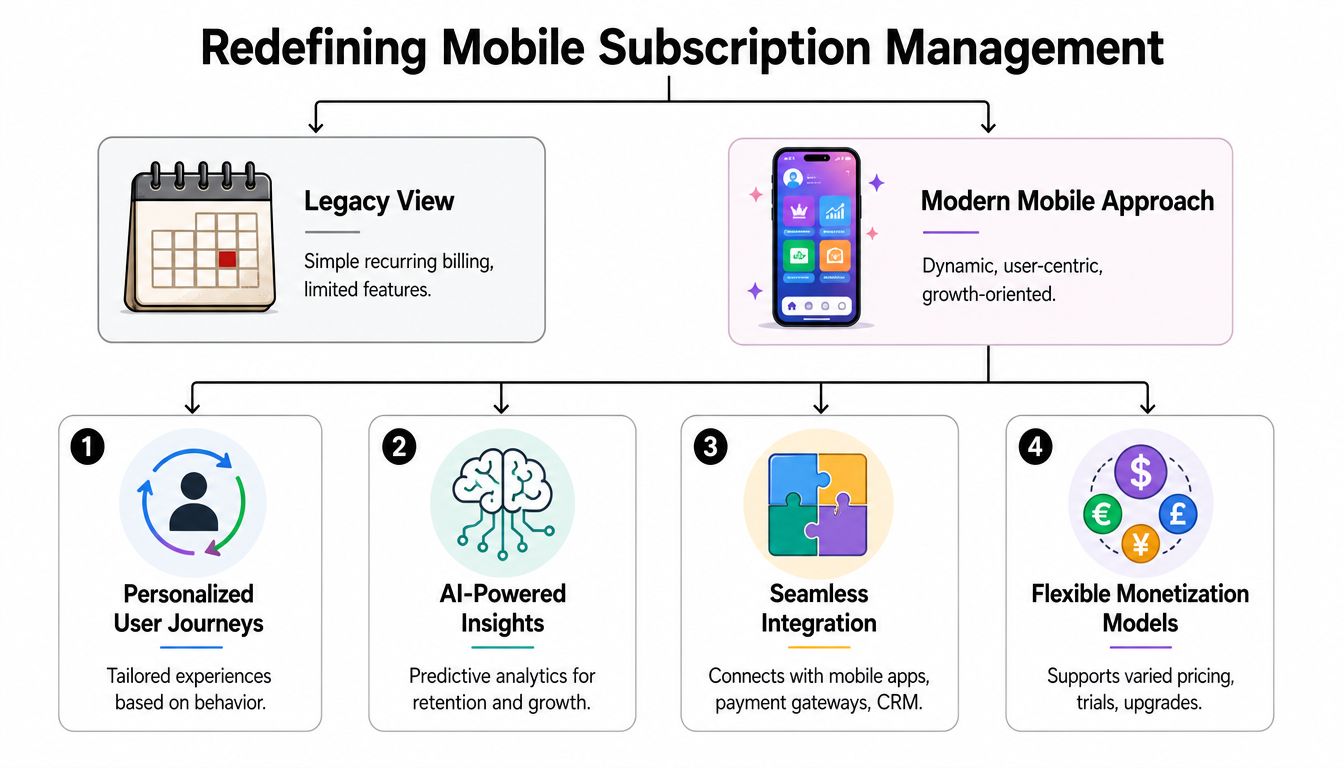
Modern mobile subscription management is really a growth system. Billing matters, but so do paywall delivery, entitlement state, experiment design, segmentation, onboarding, retention offers, analytics, and the ability to change user journeys without waiting for an app release. If those pieces live in separate products, the team ends up stitching business logic together by hand.
Billing alone doesn't solve mobile monetization
Legacy platforms were built around invoices, payment schedules, and account administration. That's useful in SaaS and enterprise commerce. It's not enough for a mobile team trying to answer questions like:
- Which onboarding branch produces better paid conversion?
- Should the paywall vary by acquisition source or in-app behavior?
- How do we keep entitlement state correct when the device is offline?
- Can React Native and Flutter apps share the same monetization logic without duplicating work?
- Can Unity or Unreal titles trigger subscription-aware liveops moments inside the game loop?
Those are product and runtime questions, not just finance questions.
The RevenueCat replacement gap is real
A lot of teams, especially indie and mid-market mobile teams, hit the same wall. They want billing sync and entitlement infrastructure, but they also want more control over experiments, analytics, and in-app experiences. They don't want revenue-share economics attached to core subscription data, and they don't want to bolt five separate vendors together to get one coherent user journey.
One useful signal comes from the underserved indie side of the market. Data indicates that 68% of indie mobile developers face challenges with manual subscription state reconciliation, resulting in 15–20% revenue leakage from synchronization failures. The same source notes that many enterprise tools lack native support for on-device targeting or Rive-powered paywalls, both of which matter for mobile retention.
Teams usually don't replace a subscription vendor because the first purchase flow is broken. They replace it because everything around the purchase flow stays fragmented.
That's the gap technical teams should pay attention to. A modern platform should support iOS and Android first, but it also needs to meet teams where they build: React Native, Flutter, Unity, and Unreal. It should handle paywalls as one use case, not as the whole product.
A strong mobile-first approach treats subscription state as one layer in a broader system. The other layers are experimentation, experience delivery, analytics, and entitlement enforcement. If one of those layers is weak, the whole stack becomes harder to trust.
Core Components of a Subscription Platform
When teams compare subscription management solutions, they often compare product pages instead of architecture. A better approach is to break the platform into the parts that matter in production.
Billing engine and plan logic
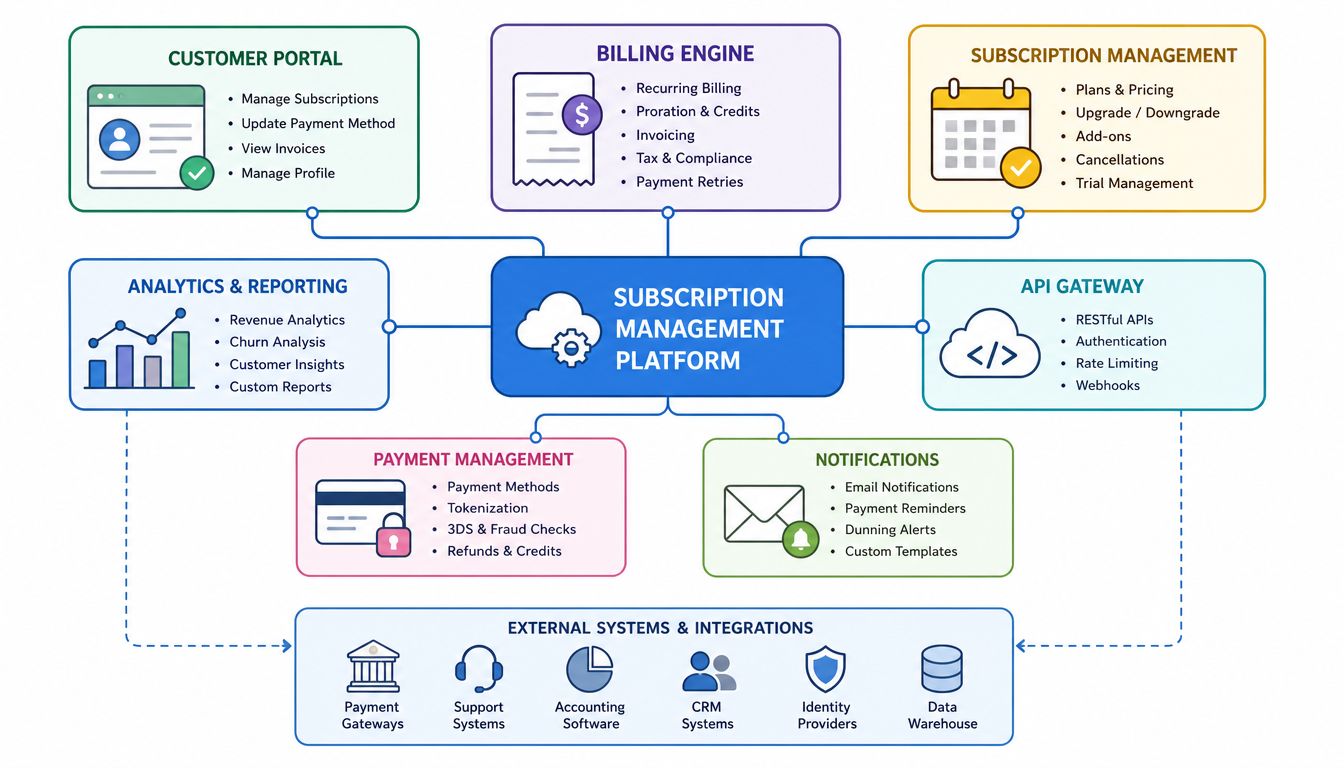
The billing engine is where pricing rules become executable logic. It needs to support more than a simple monthly auto-renew. Real systems deal with upgrades, downgrades, trials, intro pricing, usage-based add-ons, tiered plans, family access, and one-time purchases that coexist with subscriptions.
Weak implementations show up fast. If your team has to hardcode proration logic or manually reconcile plan changes, the platform isn't carrying its weight. Salesforce notes that subscription management software automates the revenue lifecycle by handling recurring billing and subscription changes, which can reduce manual operational overhead by 30-40% in enterprise settings by automatically calculating prorated charges for mid-cycle upgrades and downgrades.
For mobile teams building or reviewing architecture, it helps to see how a dedicated mobile billing system handles purchase flows and plan changes across app stores and app-level logic.
Entitlement service and source of truth
Billing tells you what was purchased. Entitlements tell the app what the user can access right now.
That sounds simple until you deal with expiration, refunds, grace periods, pauses, restores, upgrades, and temporary desync between device state and backend state. A good entitlement service makes these transitions explicit. It stores durable state, not just raw transaction history.
What works:
- Server-side entitlement decisions: the app can cache and render state, but the backend should remain authoritative.
- Clear state modeling: active, trialing, grace period, expired, revoked, refunded, paused.
- Fast restore paths: users don't care which store event arrived late. They care whether premium became available.
What doesn't:
- Client-only assumptions: trusting the device as the sole source of truth creates support pain.
- Store-specific logic spread across the app: it makes Android and iOS divergence harder to test.
- Analytics as entitlement storage: event tools aren't access-control systems.
Field note: The most expensive subscription bug usually isn't a failed charge. It's granting the wrong access state and discovering it after users complain.
Dunning, self-service, and analytics
Failed payments are often considered too late. Dunning isn't glamorous, but it's part of retention. If a renewal fails, the system should trigger retries, messaging, and state updates without making the user experience feel broken.
Self-service matters too. Even in mobile-first products, users need sane paths for managing plans, restoring access, and understanding what they bought. Support volume climbs when account actions are opaque.
Then there's analytics. The platform should help teams inspect conversion, churn patterns, plan mix, retention cohorts, experiment outcomes, and entitlement anomalies in the same operational context. Metrics like MRR, churn rate, CLV, and NRR matter, but only if the underlying subscription state is reliable.
The core idea is straightforward. Billing, entitlements, retries, and analytics shouldn't be separate islands. They should behave like one system.
Understanding the Integration and Data Flow
The hardest part of subscription management solutions usually isn't picking one. It's making the data flow reliable across mobile clients, app stores, backend services, and analytics.
The cleanest implementations are event-driven. Not because “event-driven” sounds modern, but because subscription state changes are already events. A purchase completes. A renewal fails. A refund posts. A grace period starts. An entitlement expires. Treating those as first-class events leads to fewer blind spots than periodic polling and ad hoc sync jobs.
What the end-to-end flow should look like
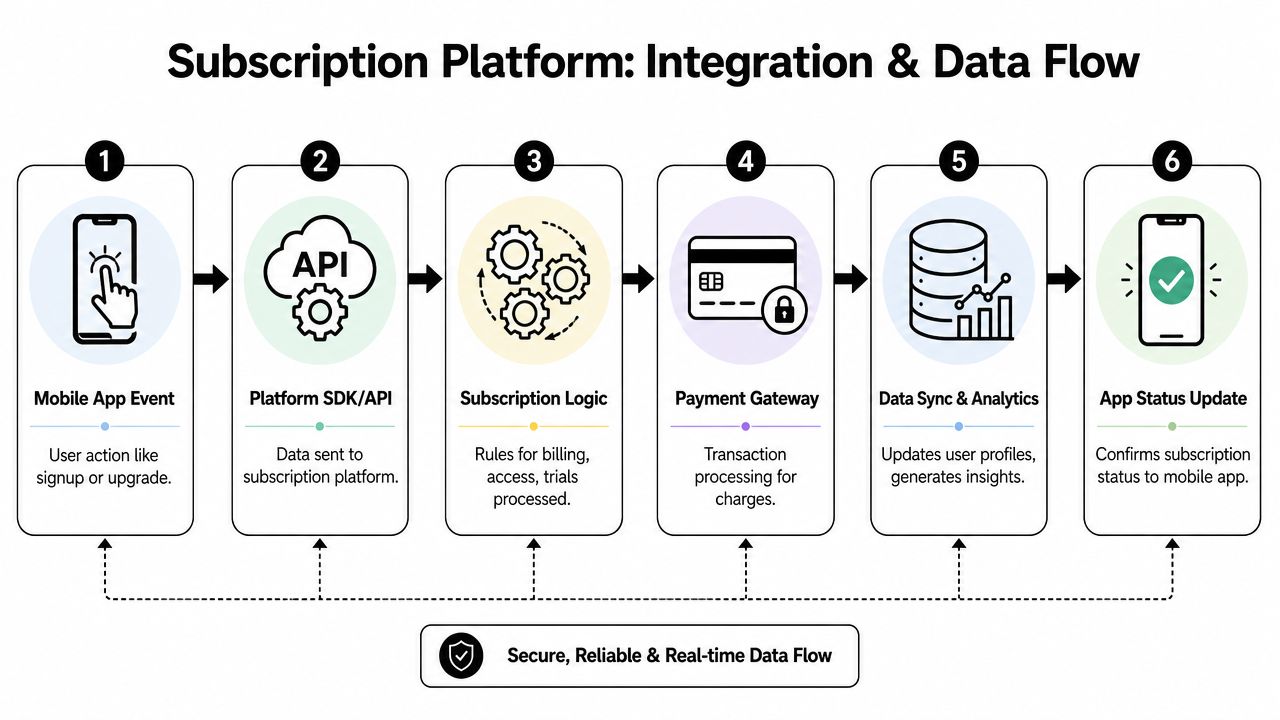
A practical mobile flow usually works like this:
The user initiates a purchase in the app. On iOS this often starts with StoreKit. On Android it runs through Google Play Billing. In React Native and Flutter, the SDK layer wraps those store interactions. In Unity and Unreal, purchase events need to bridge into the game runtime without blocking the player experience.
The client sends purchase context to your backend or subscription platform. That may include receipt data, product identifiers, app user identifiers, device metadata, and experiment context such as which paywall or offer the user saw.
Store notifications and webhooks update authoritative state. App Store Server Notifications and Google Play Real-Time Developer Notifications are critical here. Client callbacks alone aren't enough.
The entitlement service evaluates access. It decides what the user can use now, what changed, and whether any fallback behavior should apply.
Analytics and growth systems record the outcome. Here, teams should join purchase state with campaign, experiment, and lifecycle data.
The app receives the updated status. The app should be able to refresh access quickly, including after restore flows and account switches.
Why event-driven architecture tends to win
Polling creates lag and operational ambiguity. It also pushes teams toward brittle “eventually maybe consistent” behavior in places where users expect immediate answers.
The better pattern is to break subscription lifecycle events into isolated services or handlers. Billing state changes shouldn't require the same deployment unit as paywall rendering logic. Entitlement calculations shouldn't be tightly coupled to analytics ingestion. That separation improves fault isolation and lets the system recover gracefully when one downstream consumer is delayed.
A concrete benchmark from production-oriented architecture work is useful here. Event-driven architectures using tools like AWS EventBridge can reduce latency in subscription state updates by 25-35 milliseconds and improve fault isolation, allowing systems to handle over 10,000 concurrent subscription events per second without cascading failures.
Integration mistakes that create bad data
Teams run into the same failure patterns repeatedly:
- Treating client success as final truth: the app says “purchase successful,” but refund, renewal, or restore events later invalidate that assumption.
- Skipping idempotency planning: duplicate notifications happen. If handlers aren't idempotent, state drifts.
- Overloading one backend service: purchase validation, entitlement updates, analytics fan-out, and messaging all in one path creates fragile coupling.
- Ignoring framework differences: Flutter and React Native can share monetization abstractions, but the native bridge still matters. Unity and Unreal need careful handling around lifecycle timing and network interruptions.
Keep the client responsible for experience, not for canonical subscription truth. That one boundary decision prevents a lot of debugging later.
How to Evaluate Subscription Management Solutions
Most vendor comparisons are too shallow. They focus on checkout screens, dashboards, or whether a tool “supports subscriptions.” That's not enough for a mobile team deciding what will sit in the middle of revenue, access control, and lifecycle growth.
A better evaluation starts with one question: what are you optimizing for over the next product cycle? Speed to launch, lower integration burden, ownership of data, freedom to swap providers, fewer fees tied to gross revenue, or a broader mobile growth stack. Different teams will rank those differently, but the ranking needs to be explicit.
The criteria that matter in practice
For mobile teams, these are usually the make-or-break factors:
| Criteria | What to Look For | Why It Matters |
|---|---|---|
| Pricing model | SaaS pricing, infrastructure pricing, or revenue-share terms | Revenue-share can become expensive as subscription volume grows and can distort long-term cost planning |
| Provider agnosticism | Ability to work with StoreKit, Google Play Billing, internal systems, and existing analytics tools | You don't want one vendor forcing a rewrite of your stack |
| Entitlement flexibility | Clear support for restores, trials, grace periods, refunds, and cross-device state | Access-control bugs are more painful than billing bugs |
| Experiment support | Native A/B testing for paywalls, offers, and in-app journeys | Monetization and growth decisions need fast iteration |
| Analytics depth | Purchase, retention, cohort, and journey analytics in the same workflow | Teams need to connect monetization to behavior, not inspect it in isolation |
| SDK coverage | iOS, Android, React Native, Flutter, Unity, and Unreal support | Framework gaps turn into duplicate work for engineering |
| Data portability | Export access, event access, and a sane path to migrate away later | Good tooling shouldn't trap your data |
| Operational maturity | Webhooks, retries, docs, test environments, observability | You need production behavior, not demo behavior |
One area gets underestimated constantly: SDK support across frameworks. Cross-platform frameworks like Flutter and React Native can save an estimated 200 hours of manual duplication work compared to native development, so a platform with weak cross-platform support creates drag right where teams expect efficiency.
Fair product comparisons beat category slogans
If you're comparing tools such as RevenueCat, app-store-native implementations, billing-focused vendors, and broader growth platforms, don't reduce the decision to “buy vs build.” A hybrid approach is often taken. Teams will buy infrastructure in some layers and build app-specific logic on top.
That's why provider-agnosticism matters. A strong option should be able to coexist with your current setup during migration, integrate with existing analytics and experimentation workflows, and avoid forcing a full cutover on day one. If you're actively reviewing options in that category, this overview of a RevenueCat alternative for mobile teams is a useful comparison lens.
Decision shortcut: Don't choose the platform with the most features. Choose the one that creates the fewest irreversible constraints.
A fair evaluation also means being honest about your app type. A content subscription app, a utility app, and a Unity game with liveops moments don't have the same needs. The right platform should support your present architecture without boxing in your monetization roadmap.
Nuxie An AI-Native Growth and Subscription Platform
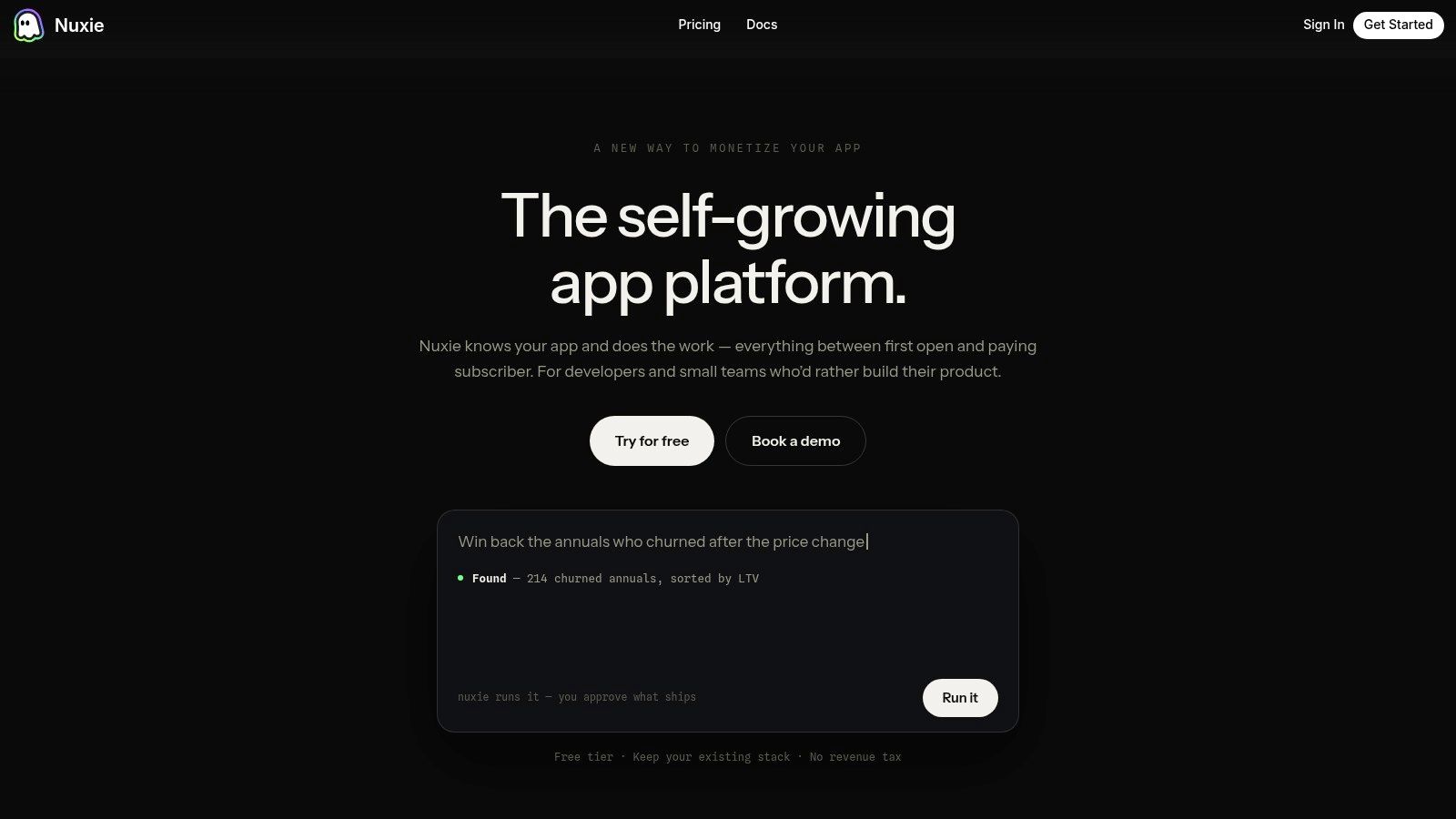
One category shift worth paying attention to is the move from point solutions toward integrated mobile growth platforms. That's where Nuxie fits.
Instead of treating subscription management as a narrow billing layer, Nuxie combines in-app experience delivery, experimentation, analytics, billing, purchase data, and entitlement infrastructure in one mobile-first system. Paywalls are part of that stack, but they're not the whole story. Teams can also build onboarding quizzes, surveys, feature announcements, retention offers, personalized screens, and game liveops moments without waiting for app releases.
Why the architecture is different
The most practical difference is that Nuxie is provider-agnostic. It can work alongside existing tools or replace parts of the stack over time. That matters for teams that already use StoreKit, Google Play Billing, RevenueCat, Superwall, or internal systems and don't want to rip everything out just to modernize one layer.
It also doesn't charge a revenue-share fee for billing and entitlement data. For teams that expect subscription revenue to scale, that pricing posture changes the buy decision. You're not attaching a growing skim to core purchase state just because you want decent subscription infrastructure.
Where it fits for technical mobile teams
Nuxie is built for mobile delivery realities, not just dashboard usage. It supports iOS, Android, React Native, Flutter, Unity, and Unreal. That means the same platform can serve a native app team, a cross-platform product team, and a game studio without forcing each one into a separate monetization stack.
A few parts of the product stand out for practitioners:
- Collaborative flow editor: useful for designing connected journeys, not just isolated paywalls.
- AI-native growth agent: helps teams explore experiments, targeting, and lifecycle opportunities without bouncing across disconnected tools.
- On-device targeting and offline-ready delivery: important when runtime responsiveness matters.
- Rive-powered interactions and remote publishing: lets teams ship richer in-app surfaces without app-store release cycles.
- Billing and entitlement infrastructure: can act as the subscription backbone while still working with external providers.
If you want the implementation specifics, Nuxie's purchases and subscriptions documentation shows how the monetization layer connects to the broader platform.
The broader point is this. For mobile teams, especially ones managing subscriptions inside a larger growth stack, the best platform often isn't the one that only does billing well. It's the one that keeps billing, experiences, analytics, and entitlement state connected.
Your Migration Checklist and Strategic Next Steps
If your current setup is a mix of app-store code, a billing SDK, a paywall tool, analytics events, and internal patches, migration should start with clarity, not with implementation.
A practical migration checklist
- Audit the current source of truth: list every system that stores subscription, receipt, entitlement, and paywall data.
- Map event ownership: identify where purchase creation, renewal, refund, restore, and expiration events enter your stack.
- Define entitlement states: write down the exact access rules before moving platforms. Don't rely on tribal knowledge.
- Preserve historical context: decide what purchase and experiment history you need available after migration.
- Test all non-happy paths: restores, upgrades, downgrades, billing failures, grace periods, account changes, and offline app sessions.
- Plan framework-specific rollout: native iOS and Android can move differently from React Native, Flutter, Unity, or Unreal clients.
- Align stakeholders early: product, growth, engineering, finance, and support all need to agree on the new source of truth.
What to do first
Start with the seams that currently break most often. For some teams that's entitlement sync. For others it's fragmented experiment data or the inability to change paywalls without shipping a new build.
Don't migrate everything at once unless your current stack is unsalvageable. A phased approach usually works better. Stabilize purchase and entitlement state first. Then layer in experimentation, in-app experiences, and analytics workflows around it.
The strongest mobile subscription systems don't treat billing as a back-office function. They treat it as part of the product runtime.
That's the strategic shift. The best subscription management solutions for mobile teams aren't just charge engines. They're the operating layer for access, monetization, experiments, and lifecycle growth.
If your team wants a provider-agnostic, no-revenue-share way to unify in-app experiences, analytics, experimentation, billing, and entitlements across iOS, Android, React Native, Flutter, Unity, and Unreal, take a look at Nuxie. It's built for mobile apps and games that need more than a billing wrapper.