Build & Manage a Mobile Billing System: 2026 Guide
Master mobile billing system build, migration, and management. This guide covers core components, architectures, and an evaluation checklist for apps.
Nuxie pricing reviewed October 6, 2026. Creation credits have separate plan charges. The revenue fee is waived when monthly attributed revenue is at most $10,000; above that threshold, 1% applies to the full adjusted net amount. See current Nuxie pricing.
Most mobile teams don't fail at billing because StoreKit or Google Play Billing are impossible to use. They fail because the system around those APIs is fragmented.
A common setup looks fine on a slide. The app talks to Apple and Google. A paywall tool controls pricing screens. An analytics SDK tracks events. A backend validates receipts. Support handles refunds manually. Product asks for one clean answer to a simple question: “Does this user have access right now?” Nobody can answer without checking three dashboards and some logs.
That disconnect is expensive. Engineers ship platform-specific purchase logic into feature code. Growth teams can't reliably connect offer exposure to verified entitlement state. Game teams struggle to keep liveops rewards aligned with subscription access. When something breaks, users see the worst version of your product. The paywall says one thing, the store says another, and the app presents a third state.
This is happening while mobile payment behavior has become normal consumer behavior, not an edge case. Fiserv's benchmark study reported that mobile bill pay usage by consumers grew by 22%, 54% of billers offered it in some form, and 42% of people were using smartphones to pay bills. That matters because users already expect mobile-first billing flows to work cleanly, with minimal friction and immediate confirmation.
A good mobile billing system isn't just a payment connector. It's the layer that keeps purchase state, entitlements, experiments, analytics, and user experience in sync across iOS, Android, React Native, Flutter, Unity, and Unreal. Once teams treat billing as infrastructure instead of a checkout button, monetization gets easier to operate and much easier to grow.
Introduction The Hidden Costs of a Disconnected System
The hidden cost usually shows up after launch. Purchases go through, but the user doesn't gain access. Restores work on iOS, but not on Android. Intro offers are visible in one paywall variant and missing in another. Finance sees recognized revenue one way, support sees another, and product can't tell whether churn came from pricing, failed renewals, or entitlement lag.
Where teams usually get stuck
The pattern is predictable:
- Store logic leaks into app features: Premium screens check product IDs directly instead of stable entitlement names.
- Analytics tracks intent, not truth: Teams log
purchase_startedandpaywall_viewed, but not a normalized verified state. - Experimentation runs blind: A/B tests compare paywall layouts without controlling for active subscription status, grace periods, refunds, or restores.
- Support becomes your reconciliation layer: Users send screenshots because your systems don't agree on what they own.
None of that feels catastrophic during early development. It becomes painful when you add more than one platform, more than one offer type, or more than one team touching monetization.
Practical rule: If entitlement logic lives in the client and reporting lives somewhere else, you don't have a billing system. You have a chain of assumptions.
Why this is now a core product system
For subscription apps, media products, and games with recurring value, billing affects much more than revenue collection. It controls onboarding branches, premium feature access, retention offers, cancellation interception, cross-device restores, and support workflows.
The global market context reinforces why this matters operationally. Grand View Research's mobile payments market outlook estimated the global mobile payment market at USD 88.50 billion in 2024 and projected USD 587.52 billion by 2030, a 38.0% CAGR from 2025 to 2030. The same source notes mobile payment infrastructure has become a major transaction category, not a side feature.
When billing is disconnected, every one of those user journeys becomes slower to ship and harder to trust. When it's unified, the same purchase event can update access, trigger messaging, feed analysis, and inform the next experiment without custom glue code everywhere.
What a Modern Mobile Billing System Actually Is
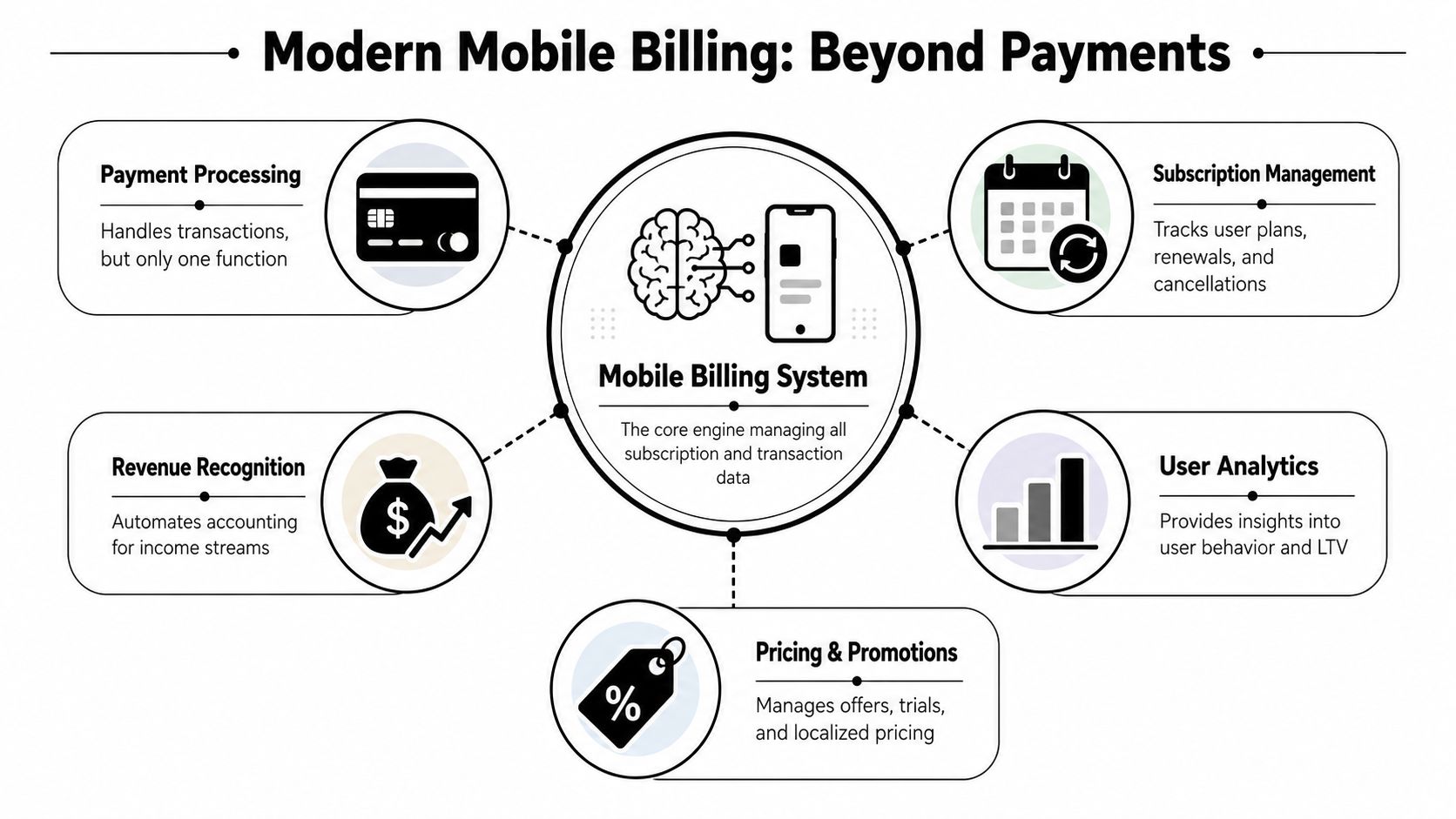
A modern mobile billing system is best understood as an abstraction layer for value inside your app.
Your feature code shouldn't care whether a user purchased through Apple, Google, a restored transaction, a family-sharing path, or a recovery flow after a grace period. It should ask one question: what entitlements does this user have right now, and why?
From payment method to state system
Older discussions about billing focus on charging the card or completing the in-app purchase. That's too narrow for how mobile products operate.
Industry guidance on electronic bill presentment and payment describes the shift well. The challenge has moved toward omnichannel presentment and back-office accuracy, framing mobile billing as a workflow and data-infrastructure problem that requires synchronized data across channels to reduce errors and improve cash flow.
That maps directly to app monetization. In practice, a mobile billing system should do four things well:
- Normalize purchase inputs from stores and payment providers.
- Resolve them into verified entitlement state your app can trust.
- Distribute that state consistently to app sessions, backend services, analytics, and support tools.
- Preserve auditability so teams know why access changed.
The universal adapter model
The most useful mental model is a universal adapter.
Apple App Store products and Google Play products are implementation details. Your business logic shouldn't branch on monthly_premium_ios_v7 versus sub_premium_gp_baseplan_a. It should map both to something stable like premium_access.
That sounds simple, but it changes the whole system design:
- Product managers can rename packages or test packaging without rewriting entitlement checks.
- Engineers can ship a single premium gate across native and cross-platform clients.
- Growth teams can compare experiments against the same access model.
- Support teams can explain a user's state from verified events instead of store screenshots.
The job of a mobile billing system isn't to tell you what was offered. It's to tell you what was verified.
That's why good systems become central to experimentation. A paywall test only matters if the downstream entitlement, analytics, and lifecycle messaging all use the same truth source. Otherwise you're optimizing impressions while access state drifts underneath.
The Core Components of a Growth-Ready System
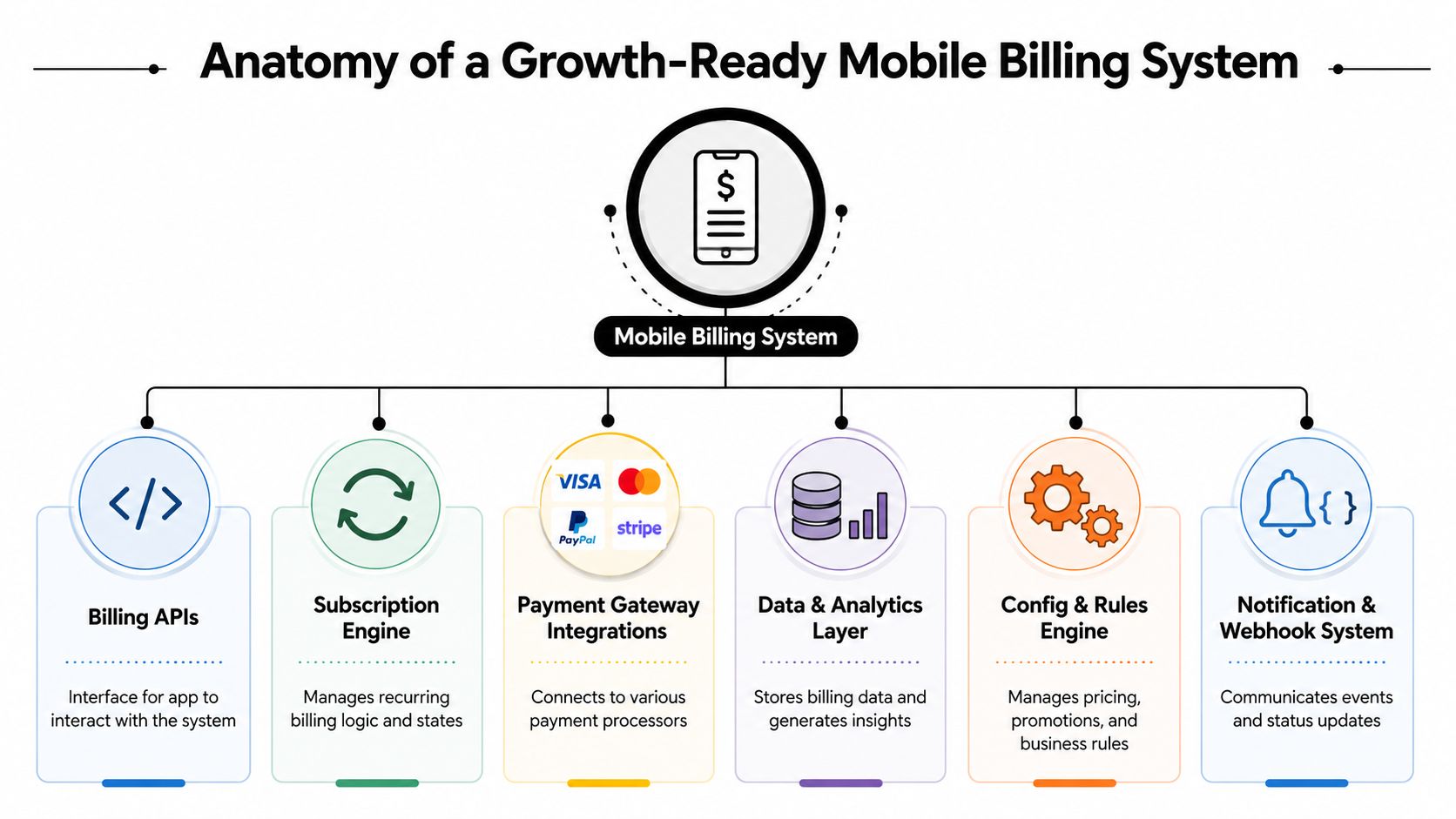
Growth-ready billing looks less like a checkout SDK and more like a compact monetization stack. The strongest systems borrow from convergent billing design, where many usage and payment signals are normalized before they drive customer state.
Ericsson's overview of convergent billing describes platforms built to ingest voice, data, content, and other usage types into a unified flow for rating, invoicing, and balance management. Mobile apps and games don't need telecom-scale complexity, but the architectural lesson is the same. One user can have multiple purchase paths, multiple plans, and multiple entitlement triggers. You want one system deciding access.
Billing APIs and state sync
The first layer is the integration surface.
On iOS, that means StoreKit-facing purchase and restore flows. On Android, Google Play Billing equivalents. On React Native, Flutter, Unity, and Unreal, it means a wrapper that feels native to each runtime but resolves into the same backend state model.
What matters isn't just initiating purchases. It's syncing all of these reliably:
- Purchase attempts
- Verified transactions
- Renewals and non-renewals
- Refunds and revocations
- Grace periods and billing issues
- Promo and intro offer outcomes
- Restore events
If your app SDK only exposes “buy” and “restore,” you'll still end up building the hard parts yourself.
For teams evaluating implementation details, Nuxie's purchases and subscriptions documentation is the kind of reference worth comparing against your current setup. The key question is whether the system models verified lifecycle state cleanly across platforms.
Entitlement management as the source of truth
This is the part many teams underbuild.
Entitlements should be modeled from verified store state, not user intent. A tap on “Continue” doesn't grant access. A pending purchase doesn't grant access. A locally cached receipt that hasn't been validated recently shouldn't grant new access either.
Use stable internal entitlement names such as:
premium_accessfor your main subscription accesspro_toolsfor a higher-value feature bundleseason_passfor a time-bound game entitlementremove_adsfor a durable non-consumable
Then map store products to those entitlements centrally. Your app UI can branch on entitlement state instead of platform-specific SKUs.
Analytics and experiments tied to billing truth
A billing system becomes a growth engine when purchase state joins user behavior in the same model.
That's where teams should track relationships like:
| Signal | Why it matters |
|---|---|
| Paywall exposure | Tells you who saw an offer |
| Purchase start | Captures intent and funnel drop-off |
| Validation result | Separates failed UX from failed payment |
| Entitlement activation | Marks actual unlock |
| Renewal state changes | Drives retention messaging |
| Restore success | Shows cross-device continuity quality |
Embed that into experimentation. A good paywall test doesn't stop at conversion UI. It asks whether the offer produced durable entitlement activation, lower support friction, cleaner restores, and better downstream retention behavior.
A practical walkthrough helps here:
Resilience and security controls
The last layer is operational resilience.
A production-grade system should include:
- Pending states: Don't grant paid access from unverified purchases.
- Retry pipelines: Validation failures need retries, not silent drops.
- Cached last-known entitlements: Let users keep previously verified access during temporary outages where appropriate.
- Restore visibility: Surface restore and support paths inside the app.
- Kill switches: If remote monetization logic misbeaches, fall back to a safe paywall or a minimal local configuration.
A billing stack becomes growth-ready when it's boring under stress. That's a compliment.
Common Architectures and Integration Patterns
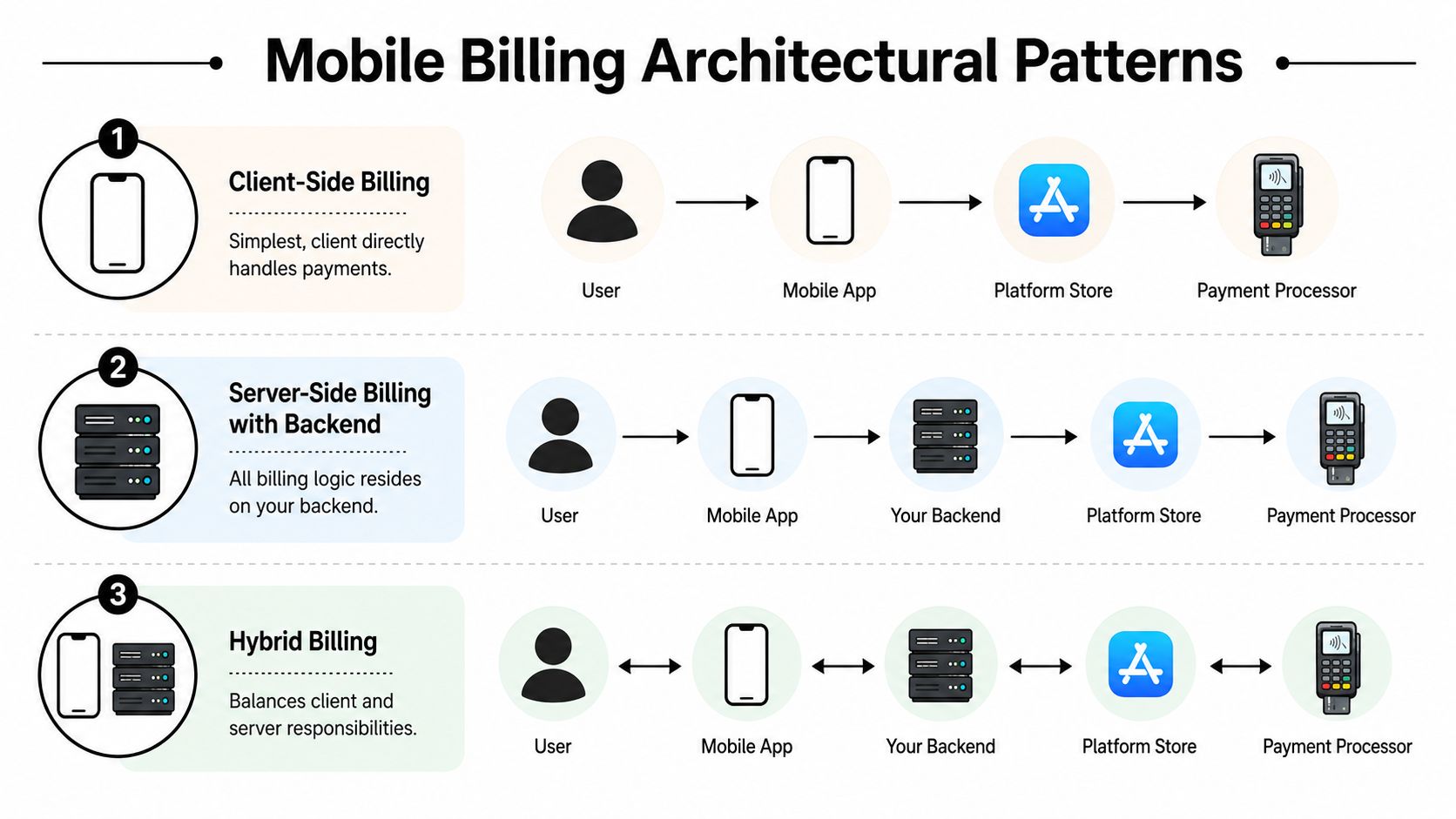
The choice often boils down to three patterns. None is universally wrong. The problem is that teams often keep the simplest one long after their product has outgrown it.
Client-side only
This is the fastest way to ship version one. The app starts the purchase, reads the local transaction result, and updates UI state directly.
That can work for prototypes or very small apps, but the weaknesses show up quickly:
- Security is weaker: The client is too close to the entitlement decision.
- State gets fragmented: iOS and Android logic diverge fast.
- Restores become inconsistent: Device changes and reinstall flows expose gaps.
- Analytics loses trust: You can log intent immediately, but verified truth arrives unevenly.
This pattern also makes support painful. When someone says they paid but didn't gain access, the evidence is scattered across device logs and store screenshots.
Client-side billing is easy to demo and hard to operate.
Server-side validation
This is the standard serious implementation.
The app initiates the purchase. The store returns transaction data. Your backend validates that data, resolves entitlement state, stores audit history, and sends the answer back to the app. Webhooks and store notifications keep the backend updated after renewals, cancellations, and refunds.
This architecture is more secure and easier to reason about. It's also where teams discover they've signed up to maintain a lot more than receipt verification:
- queueing and retries
- webhook idempotency
- cross-platform state normalization
- support tooling
- backfills and historical reconciliation
- outage handling and cached fallback behavior
Hybrid managed model
Often, the best balance is hybrid. The app uses an SDK for purchase flows and runtime access checks. A managed backend handles validation, normalized lifecycle state, webhooks, and integrations. Your own systems still receive events and can keep internal ownership of user state where needed.
That split works because it matches where complexity resides. Client code should stay focused on purchase UX, restore flows, and rendering the right screen. Backend logic should own verification, reconciliation, and durable history.
Architecture guidance for telecom billing platforms emphasizes separating mediation, rating, invoice, and related layers for modular growth, microservices scalability, and real-time decision-making, noting that billing latency directly affects service activation and revenue assurance. Mobile app monetization isn't identical, but the design lesson is directly applicable. Separate the layers that need to scale or fail independently.
What to optimize for
Use this quick decision lens:
- Choose client-heavy if you're validating an idea and can tolerate manual cleanup.
- Choose server-side if you need tight control and already have backend capacity.
- Choose hybrid if you want fast implementation without turning your app team into a billing operations team.
The right pattern is the one that keeps entitlement truth centralized while letting product and growth move quickly.
How to Choose Your Path Build Buy or Hybrid
The primary decision isn't “Do we need billing infrastructure?” You do. The decision is where you want to own complexity.
Build in-house
Building from scratch makes sense when billing is strategically core, your backend team is strong, and you're comfortable owning the operational burden for years.
You'll control data models, entitlement logic, support tooling, webhook handling, and provider integrations. You'll also own every migration, every platform policy change, every restore edge case, and every discrepancy between what the user sees and what the store later confirms.
This path is strongest when you already think in platform terms, not feature terms.
Buy a full-stack billing provider
Buying gets you speed. That matters when the team is small or launch timelines are tight.
The trade-off is usually less flexibility around data flow, internal ownership, and how billing state connects to the rest of your growth stack. Some teams also outgrow the idea that monetization infrastructure should be inseparable from a single commercial provider.
A fair comparison is useful if you're evaluating alternatives to an all-in-one billing vendor. This Adapty alternative comparison is worth reading not as a pitch, but as a checklist for what flexibility should look like in practice.
Hybrid platform
Hybrid is the practical middle path. You keep a provider-agnostic entitlement model and decide where each responsibility belongs.
That approach is attractive when you want to:
- Keep existing store integrations: No forced rip-and-replace on day one.
- Add experimentation on top: Paywalls are important, but they're only one surface.
- Avoid revenue-share coupling on billing data: Your infrastructure shouldn't get more expensive just because your app succeeds.
- Support multiple runtimes cleanly: Native mobile and game engines rarely fit a one-size-fits-all SDK story.
Mobile Billing System Evaluation Checklist
| Evaluation Criteria | Build (In-House) | Buy (e.g., RevenueCat) | Hybrid (e.g., Nuxie) |
|---|---|---|---|
| Initial setup speed | Slowest | Fastest | Fast |
| Control over entitlement model | Highest | Moderate | High |
| Ongoing maintenance burden | Highest | Lowest | Moderate |
| Flexibility with existing providers | Highest | Varies | High |
| Cross-platform consistency | Depends on team discipline | Usually good | Usually good |
| Experimentation integration | Custom work | Varies by product scope | Strong if designed for growth workflows |
| Risk of vendor lock-in | Lowest | Highest | Lower |
| Cost predictability | Team-cost heavy | Vendor-model dependent | More flexible |
| Best fit | Large infra-capable teams | Fast-moving small teams | Teams that want speed and control |
A useful litmus test is simple. If your paywall, entitlement, analytics, and messaging stacks can't share the same verified purchase truth without duct tape, your current path won't scale cleanly.
Actionable Implementation and Migration Guide
The cleanest implementation starts with a rule many teams learn too late: never let store product IDs become your business model.
Model your business around stable internal entitlements and let stores remain fulfillment channels.
For new apps
If you're starting fresh, define entitlements before you define screens.
Examples:
premium_monthlyandpremium_annualare productspremium_accessis the entitlementcoin_pack_largeis a consumable productvip_passis a renewable entitlementremove_adsis a durable entitlement
That gives you room to change packaging, pricing, and experiments without rewriting app logic.
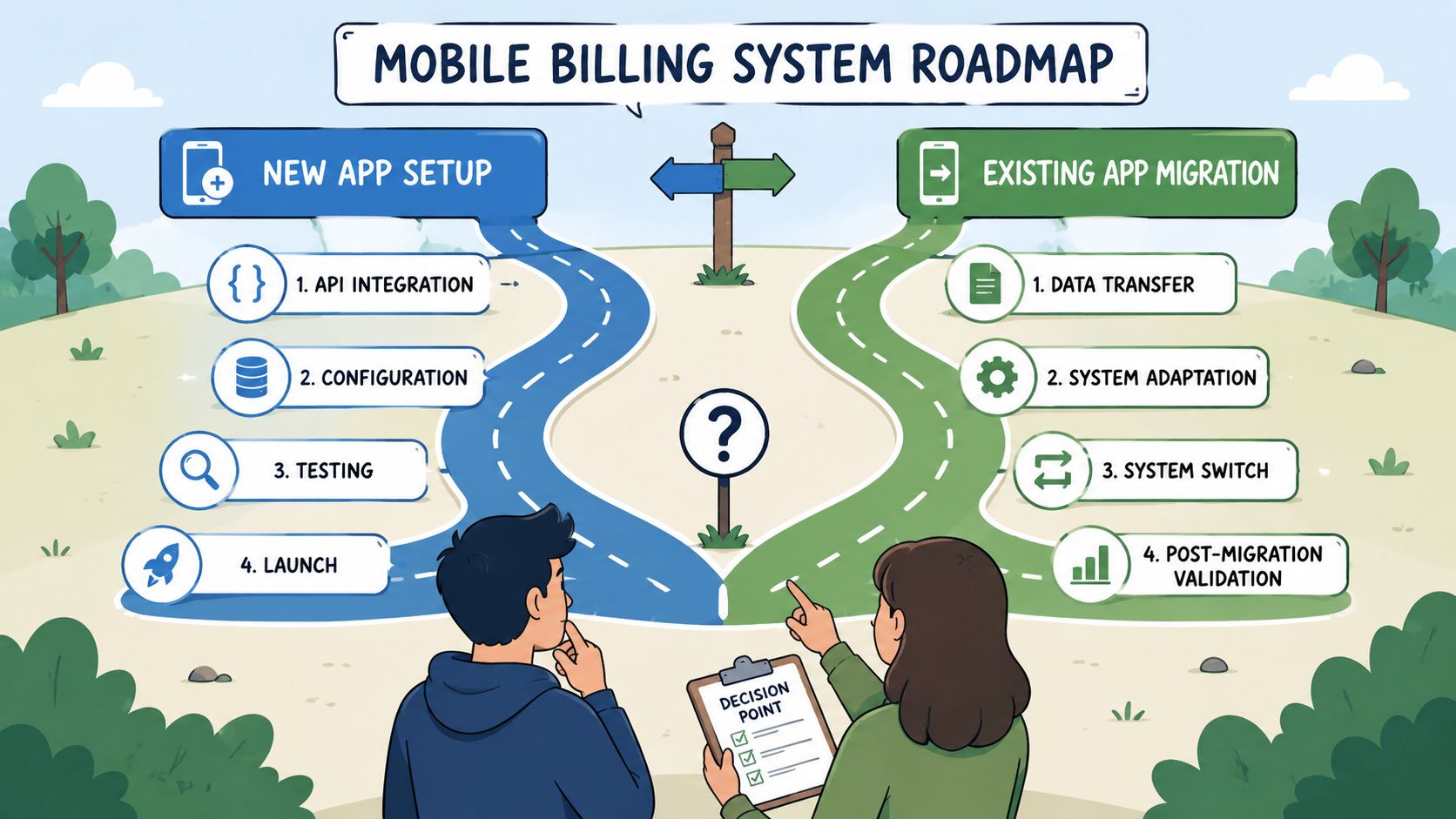
For implementation, keep the client responsibilities narrow:
- Render offers based on remote config or a paywall definition.
- Initiate purchase or restore through platform APIs or your SDK.
- Show pending states while verification completes.
- Read entitlement state from a single normalized source.
- Branch feature access on entitlement state, not SKU.
This pattern works across iOS and Android, and it adapts well to React Native, Flutter, Unity, and Unreal because your access checks remain platform-neutral.
For teams migrating from homegrown billing
Homegrown systems usually need migration in two passes.
First, redirect validation to the new backend or abstraction layer while keeping existing client purchase flows intact. Don't refactor every premium screen at once. Stabilize the truth source first.
Second, replace direct SKU checks in app code with entitlement checks. This is the step that removes long-term complexity. Until you do it, every promo, refund, restore, and product rename keeps leaking into feature logic.
Migrate your unlock rules before you redesign your paywalls. Clean state beats prettier purchase UI.
For teams already using another provider
If you already use a billing platform, you don't necessarily need an all-or-nothing migration. There are two sensible paths.
- Replace the billing backend if you want to own more of the data model, reduce coupling, or avoid pricing tied to monetization volume.
- Ingest existing purchase and entitlement data if your main gap is experimentation, analytics, in-app journeys, or cross-surface personalization.
That's especially useful for teams that want billing parity while layering smarter monetization flows on top of it. In practice, paywalls become one node in a larger system that includes onboarding, retention screens, win-back offers, content gating, and liveops moments.
Operational Best Practices and FAQs
Production billing fails at the edges, not the happy path. These are the operational questions teams should settle early.
How should we handle taxes promos refunds and special store cases
Let the stores manage store-managed complexity, then model entitlements from verified store state.
That means your system should correctly reconcile refunds, grace periods, family sharing, intro offers, promo redemptions, and territory-specific pricing changes based on what the store confirms. Don't infer access from what the user tried to buy. Infer it from what the platform verified and what your backend normalized.
What fail-safe should we use when purchase verification is delayed or fails
Use a pending state, not a premature activation.
A safe fallback path includes:
- Keep the user pending: Don't grant paid access from an unverified purchase.
- Retry validation: Treat transient failures as operational events.
- Expose restore and support paths: Don't make users guess what to do next.
- Cache last verified entitlement: Preserve previously confirmed access when appropriate.
- Maintain a kill switch: If a billing-dependent flow breaks, fall back to a safe paywall or minimal access logic.
What should we measure
If you don't have approved production numbers to publish, focus on instrumentation.
Track:
- Purchase validation latency
- Webhook-to-entitlement update time
- Restore latency
- Entitlement read latency at flow entry
- Validation and webhook error rate
- Cached fallback behavior during provider outages
Those metrics tell you whether users experience billing as instant, trustworthy, and reversible when something goes wrong.
How do we maintain parity across iOS and Android
Map Apple and Google products to stable internal entitlements, normalize subscription states, and branch app flows on entitlement state instead of platform-specific product IDs.
Test restores on both platforms. Reconcile cancellations, refunds, and grace periods in one normalized model. If churn analysis is part of your retention stack, this subscriber churn rate guide is useful context for interpreting what happens after entitlement changes, especially when cancellation and access-end timing don't align cleanly.
The cleanest cross-platform billing systems don't pretend iOS and Android are identical. They hide those differences behind one entitlement model.
If you want a mobile billing system that connects purchases, entitlements, analytics, experiments, paywalls, and in-app experiences under its published pricing, take a look at Nuxie. It works across iOS, Android, React Native, Flutter, Unity, and Unreal, and it can sit alongside your current tools or replace parts of the stack over time.