
Mobile App Growth Guide 2026: Strategies & Insights
Discover strategies for mobile app growth: acquisition, activation, retention & monetization. Build a durable engine for 2026.
Most advice on mobile app growth still starts in the wrong place. It starts with installs, channel mix, creative testing, and media efficiency, as if the main problem is getting people into the app. The challenge isn't typically getting people into the app. The hard part is turning a fresh install into a user who understands the product, comes back, and eventually pays.
That acquisition-first playbook breaks down even faster when product, growth, and engineering operate on different release cycles. Marketing can buy traffic today. Product can't always ship a better first-session experience today. Revenue teams can't always change a paywall, entitlement rule, or retention offer without waiting for review queues and app releases. That gap is where a lot of growth work dies.
The better model is activation-led and remotely configurable. Build the path from first open to first value. Instrument it well. Personalize it on-device. Then use experiments, entitlement data, and lifecycle messaging to keep improving the whole journey across iOS, Android, React Native, Flutter, Unity, and Unreal. That's the shape of a modern mobile app growth engine.
Rethinking Mobile App Growth Beyond Acquisition
The mobile market is huge, but that's exactly why shallow growth strategies fail. The global mobile application market reached USD 330.61 billion in 2025 and is projected to hit USD 1,230.23 billion by 2035, growing at a CAGR of 14.04%, according to TST Technology's mobile app market statistics. Bigger markets attract more teams, more budgets, and more competition for attention.
If your app leaks users in the first session, buying more installs just scales the leak.
Why the old model wastes budget
A lot of teams still optimize around top-of-funnel visibility because it's easier to measure and easier to explain in a weekly meeting. Installs go up. Traffic looks healthy. Campaigns seem to be working. Then the same users never finish onboarding, never reach the core loop, and never become economically meaningful.
That's the leaky bucket problem in practice. It's not a metaphorical issue. It's an operating model issue.
Three patterns show up repeatedly:
- UA leads product: paid teams scale faster than onboarding quality improves.
- Analytics are shallow: teams know where users drop, but not what to change in-app without a release.
- Retention is treated as a downstream problem: someone plans to fix it later, after acquisition scales.
Practical rule: Don't increase paid volume until you can explain, with confidence, what a successful first session looks like and how you're measuring it.
What a stronger growth model looks like
A healthier mobile app growth strategy starts with one question: what action tells you the user has experienced real value? For a fintech app, that might be funding an account or completing a first transfer. For a fitness app, it could be finishing the first program setup. For a game, it might be reaching the first meaningful progression point and understanding the reward loop.
Once that activation event is defined, the rest of the funnel becomes more honest. You stop celebrating downloads that never convert into engagement. You start looking at onboarding friction, session timing, permission sequencing, feature discovery, paywall placement, and churn triggers as one connected system.
The shift that matters in 2026
The teams that are compounding growth now aren't just buying users better. They're tightening the connection between analytics, experimentation, lifecycle delivery, and monetization. They're also removing release-cycle friction from growth work itself.
That matters because the winning move often isn't “launch another campaign.” It's “change the first-session experience today,” “show a different offer to this segment,” or “announce the right feature at the right moment inside the app.” Acquisition still matters. It just shouldn't be the center of the strategy.
The Modern Mobile Growth Stack Explained
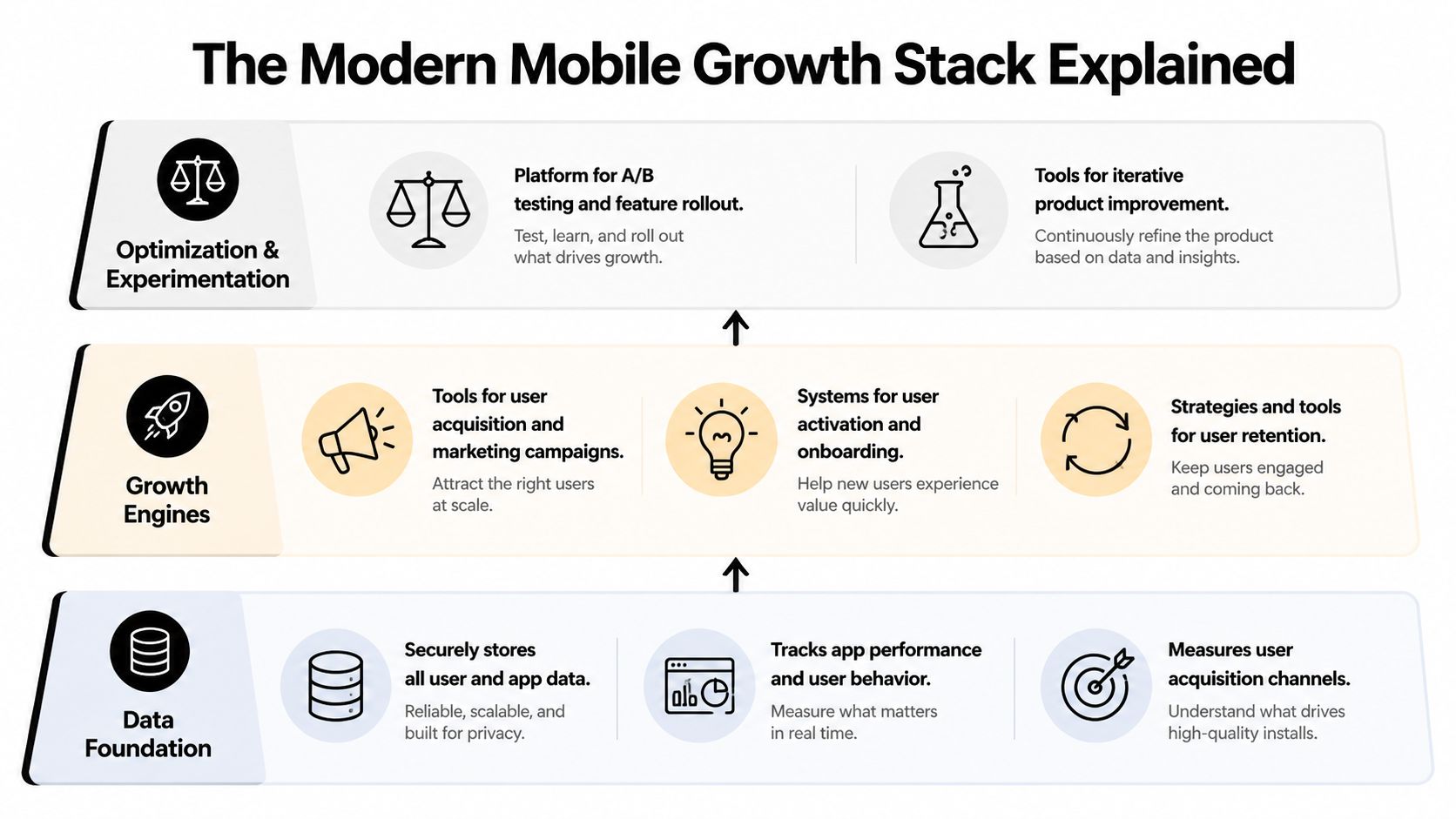
Many teams talk about funnels and loops. Fewer teams have the stack required to run them well. A modern mobile app growth stack is less about any single tool and more about how four layers work together: data foundation, decisioning, delivery, and monetization state.
Here's a visual model of that stack.
Data foundation first
If your event model is messy, every growth layer above it gets weaker. You need clean identity, session events, activation milestones, purchase events, entitlement state, and campaign exposure data. This doesn't mean tracking everything. It means tracking the events that support decisions.
In practice, the foundation usually includes:
- Product analytics: tools like Amplitude, Mixpanel, Firebase, or a provider-agnostic analytics workspace.
- Attribution inputs: channel and acquisition metadata from platforms such as Adjust or AppsFlyer.
- Billing and subscription data: StoreKit, Google Play Billing, RevenueCat, or direct purchase pipelines.
- Experiment exposure logging: a durable record of who saw what, when, and under which conditions.
If those data sets live in separate silos, teams spend more time reconciling than improving.
The growth engine is what users actually feel
This is the layer many teams underinvest in. They have analytics, maybe a CRM, maybe a paywall vendor, but no unified way to design and ship in-app experiences without code work.
That growth engine should handle things like:
| Capability | What it does | Why it matters |
|---|---|---|
| Onboarding flows | Guides users to first value | Reduces first-session confusion |
| Feature announcements | Introduces relevant functionality | Improves discovery without release notes |
| Retention offers | Intervenes when behavior weakens | Gives churn-risk users a reason to stay |
| Paywalls and upgrade screens | Converts intent into revenue | Lets teams test timing, copy, and package design |
| Surveys and quizzes | Collects declared intent | Personalizes downstream journeys |
| Liveops moments | Runs time-based or behavior-based events | Keeps apps and games dynamic |
For mobile teams, this needs to work in-app, not only through push or email. Generic push messaging is too blunt for many moments. You often need contextual UI, local targeting logic, and delivery that still works when connectivity is unreliable.
The best lifecycle intervention often isn't a notification. It's the right screen, shown to the right user, at the right moment inside the app.
Experimentation and entitlement are separate disciplines
A lot of teams treat A/B testing as button-color optimization. That's not the important part. Real mobile experimentation is about controlling exposure, isolating audience segments, and measuring downstream effects on activation, retention, and monetization.
Entitlement management is a different but related layer. It answers questions such as:
- Does this user have premium access?
- Did their subscription sync correctly across devices?
- Which offer should they see, based on billing state?
- How should the app behave if a billing provider changes?
That's why teams benefit from a platform that can work alongside existing tooling instead of forcing a rip-and-replace. A provider-agnostic setup lets product, growth, and engineering keep StoreKit, Google Play Billing, RevenueCat, or other systems where they make sense, while still unifying analytics, experimentation, entitlement logic, and in-app delivery.
What to look for in a practical stack
When evaluating a stack, ask operational questions, not brand questions.
- Can growth ship without waiting for a binary release?
- Can product and revenue teams target based on on-device behavior and billing state?
- Can the system support apps and games across native and cross-platform runtimes?
- Can analytics, experiments, entitlement data, and in-app surfaces be analyzed together?
If the answer is no, you don't have a growth stack. You have a collection of disconnected tools.
Nailing User Activation and Onboarding
The first session decides more than many acknowledge. A user doesn't need a complete tour. They need a fast path to value, with as little irrelevant friction as possible. That's why sustainable growth requires focusing on activation first, not acquisition, because activation creates the biggest impact for growth while retention most improves acquisition economics, as explained by Business of Apps on activation-first mobile growth.
This is the onboarding flow teams should carefully think about.
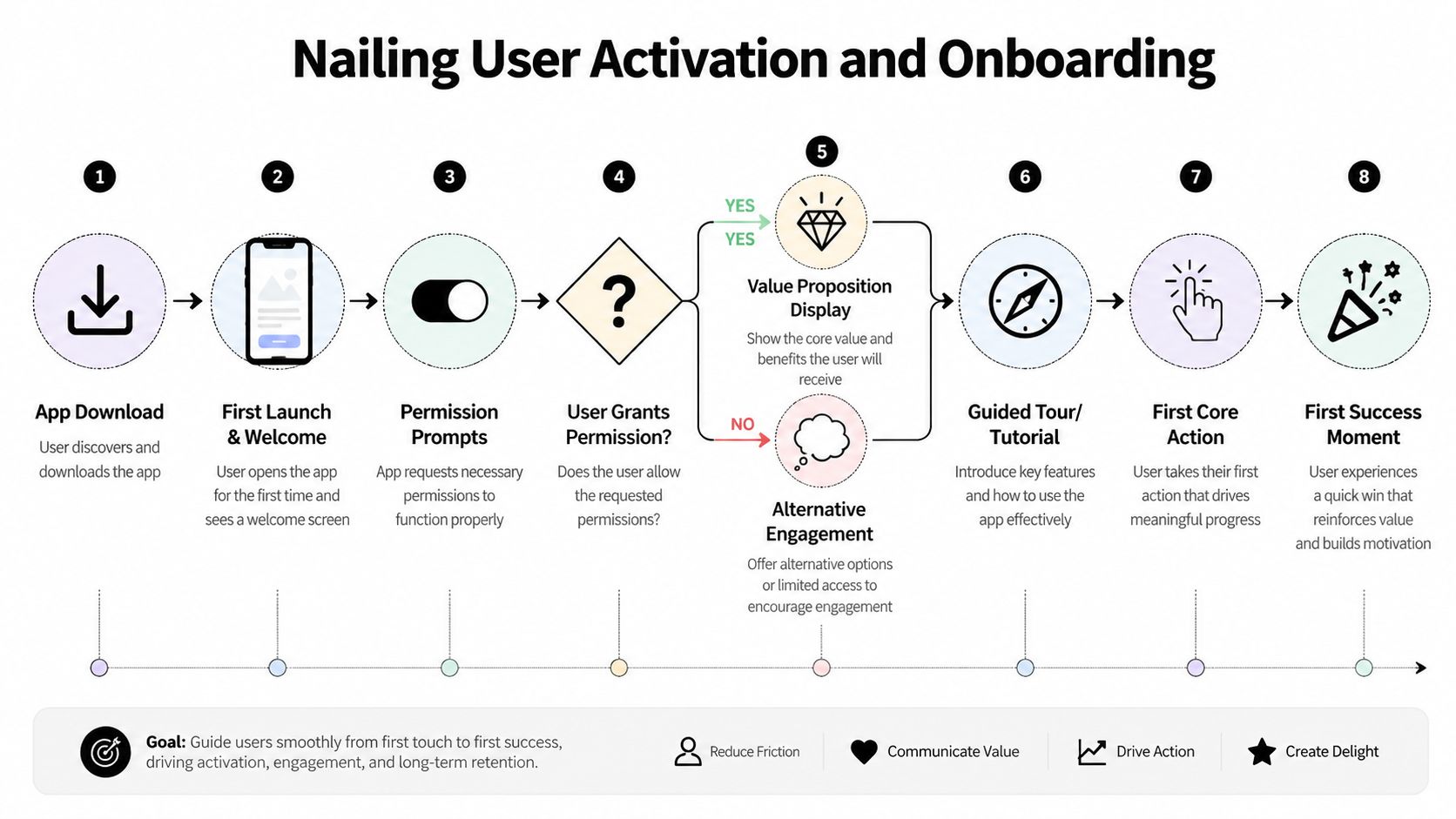
Define activation as a user outcome
Most onboarding fails because the team never agreed on what activation means. “Completed signup” is rarely enough. “Opened the app twice” isn't useful. Activation should represent the first moment the user gets the product.
Examples look different by category:
- Subscription productivity app: user creates a first workspace and completes a useful action.
- Fintech app: user links an account, finishes setup, and sees immediate functional value.
- Mobile game: user reaches a progression milestone that reveals the core reward loop.
- Publisher app: user selects interests and consumes content aligned with those preferences.
The onboarding flow should point directly toward that moment. Anything else is decoration.
Personalization beats generic walkthroughs
Static tutorials are easy to ship and easy to ignore. Personalized onboarding works better because it narrows the path. If the app serves multiple jobs-to-be-done, use a lightweight onboarding quiz or intent screen to route users into different experiences.
That can shape:
- which feature gets introduced first
- what copy appears in welcome screens
- when to ask for permissions
- what paywall or plan positioning appears later
- which lifecycle messages the user sees after session one
A good onboarding quiz doesn't collect demographic trivia. It collects routing data. The answers should change the product journey immediately.
For a deeper breakdown of patterns that hold up in production, this guide on mobile app onboarding best practices is worth keeping next to your event schema and activation dashboard.
Permission timing matters more than permission count
Many teams still front-load notification, tracking, location, camera, and contacts prompts because they want all capabilities enabled early. That usually hurts activation. The user hasn't earned enough confidence in the product yet.
A better sequence is contextual:
- Start with product value
- Ask for the permission only when its use is obvious
- Offer an alternate path if the user declines
- Re-prompt later in a more relevant moment
If a permission is required, explain the immediate benefit inside the app before handing control to the system prompt.
Here's a strong way to audit onboarding quality:
| Question | Weak answer | Strong answer |
|---|---|---|
| What is activation? | A vague engagement event | A precise value event |
| Why do we ask this permission now? | Because growth wants it | Because the next action requires it |
| What changes by persona? | Mostly copy | The flow, sequence, and surfaces |
| How do we improve it? | Wait for a release | Iterate via remote config and experiments |
This walkthrough shows the design problem clearly.
What actually improves first-session performance
The best activation work usually comes from repeated small fixes, not one big redesign.
- Compress time to first value: remove optional fields, unnecessary account steps, and dead-end screens.
- Use contextual callouts: introduce features where they're needed, not in a front-loaded carousel.
- Instrument cohorts tightly: compare onboarding variants by install cohort and first-session behavior.
- Treat onboarding as a product system: copy, state, UI, experiments, permissions, and paywall timing all interact.
“Aha” moments don't happen by accident. Teams design them, sequence them, and keep refining them.
Driving Long-Term Retention and Engagement
A user activates on day one. That doesn't mean they've formed a habit. Retention is where teams either connect the journey or let it fragment into random pushes, disconnected promos, and feature releases nobody notices.
The useful question isn't “how do we send more messages?” It's “what should the app do when this specific user shows signs of slowing down?”
A retention story that reflects real app behavior
Take a user who completed onboarding in a subscription habit app. In week one, they use the core feature regularly. In week two, session frequency drops. In week three, they open the app but skip the action that usually predicts return behavior.
A weak setup responds with the same generic push everyone gets.
A stronger setup does three things inside the product:
- shows a relevant in-app prompt tied to the feature they used most
- surfaces a limited retention offer only if billing state and behavior justify it
- delays broad upsell messaging until the user either re-engages or clearly enters a monetization-ready path
That's closer to how good retention systems work. They respond to behavior, not calendar schedules.
Why remote-configured delivery changes the game
One of the most useful ideas in current mobile growth practice is the need to monetize momentum instead of installs without app releases. Clarion Tech's perspective on mobile strategy points to on-device targeting and offline-ready delivery as the way teams can deploy paywalls, retention offers, and feature announcements without waiting for new app submissions.
That changes the retention playbook materially.
If growth and product can remotely control:
- eligibility rules
- message timing
- campaign creative
- upgrade surfaces
- feature announcements
- game liveops moments
they can react while the signal is still useful.
Users don't churn on a reporting schedule. Teams need systems that can respond before the next release train leaves the station.
What good engagement looks like after activation
For apps, retention often comes from relevance. For games, it often comes from cadence and progression. Both benefit from the same operating principle: keep the next meaningful action visible and easy to take.
Here are retention interventions that tend to work better than generic broadcast messaging:
- Behavior-based feature announcements: introduce something new only to users whose past actions suggest likely interest.
- At-risk user rescue flows: trigger in-app guidance, softer offers, or saved-state reminders when users stall.
- Liveops and time-bound events: useful in games, but also effective in utility or content apps when tied to habit loops.
- Offline-ready surfaces: preload important experiences so they still render well when connectivity is inconsistent.
A practical playbook for this sits in these mobile app retention strategies, especially if your current lifecycle setup depends too heavily on push.
The retention stack should support nuance
Retention usually breaks when the team can't segment with enough precision. “All trial users,” “all non-payers,” or “all dormant users” are blunt buckets. Better targeting uses a mix of behavioral state, entitlement state, recent campaign exposure, and platform constraints.
For example:
| Scenario | Better intervention | Poor intervention |
|---|---|---|
| User explored premium features but didn't buy | Show contextual value recap with tailored offer | Repeated full-screen paywall every session |
| User stopped after feature confusion | Launch a guided tip tied to that screen | Send a discount unrelated to the problem |
| User returns after inactivity | Present a concise “what's new” path | Dump them into the same home screen with no context |
The objective isn't to message more. It's to reduce the gap between what the user needs next and what the app shows next.
Optimizing Monetization with Smart Paywalls
Paywalls matter, but most paywall discussions are too narrow. Teams debate copy, pricing cards, trial badges, and close-button timing while ignoring the bigger system around them. A paywall is one monetization surface inside a broader engine that includes segmentation, experiment design, billing state, entitlement logic, and post-purchase handling.
That matters because the commercial stakes are already large. In the first half of 2025, AI-enabled apps generated nearly $1.9 billion in in-app purchase revenue, and the broader mobile market saw approximately $41 billion in consumer spending in Q2 2025, up 11.5% year over year, according to Sensor Tower's State of Mobile 2025. Monetization optimization isn't cosmetic work.
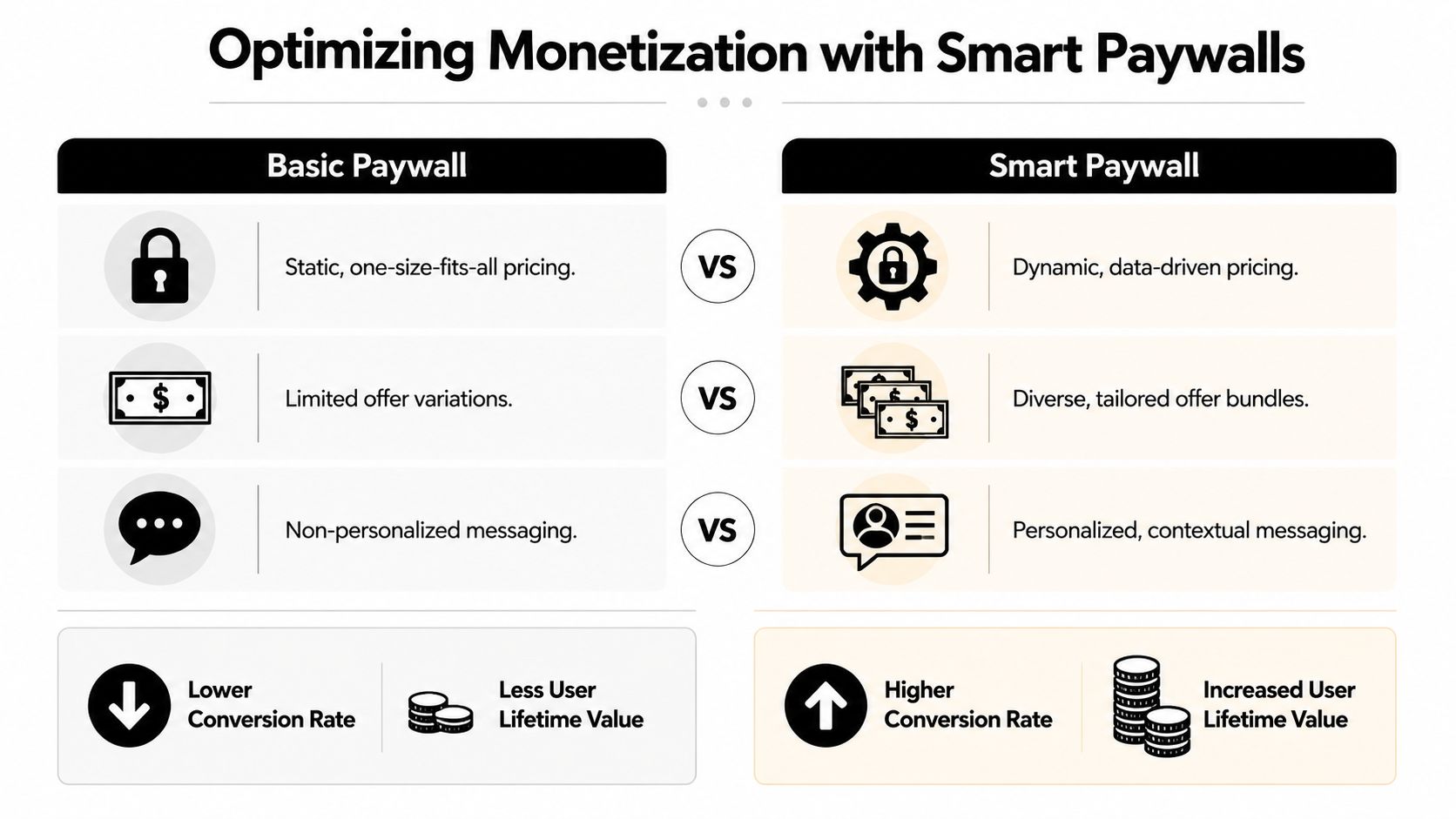
What separates a smart paywall from a static one
A basic paywall is usually a fixed screen shown to everyone at roughly the same moment. A smarter paywall adapts based on context.
That context includes:
- acquisition source
- declared intent from onboarding
- product usage depth
- trial eligibility
- subscription history
- entitlement status
- device and platform constraints
The screen design still matters. So does pricing presentation. But targeting and timing usually decide whether the user sees the paywall as relevant or premature.
How to test paywalls without fooling yourself
Many paywall tests are badly framed. Teams compare Variant A vs Variant B, get a directional result, and ship a winner without accounting for audience differences, sample contamination, or post-purchase effects.
A stronger approach uses a structured test plan:
- Hold timing constant when testing copy
- Hold offer structure constant when testing layout
- Separate first-time exposures from repeat exposures
- Measure downstream behavior, not just immediate purchase starts
- Use entitlement-aware rules so active subscribers never see broken prompts
Good paywall work also needs a clear taxonomy. “Paywall conversion” can mean tap-through, trial start, purchase completion, or retained subscriber status. Teams need to define those states before reading results.
For a practical testing workflow, this guide to mobile paywall A/B testing is useful because it treats paywalls as part of a broader monetization system, not as isolated screens.
Operator note: If you can't connect paywall exposures to billing outcomes and entitlement state, you're not running monetization experiments. You're only comparing UI variants.
Entitlements are the hidden foundation
Many teams encounter infrastructure friction. Billing data can come from StoreKit, Google Play Billing, RevenueCat, or another provider. The monetization layer still needs one reliable answer to a basic question: what should this user have access to right now?
That's why provider-agnostic entitlement infrastructure is valuable. It lets teams keep existing billing flows where needed, sync subscription and purchase data, and power in-app decisions without locking the whole growth stack to a single vendor.
A few criteria matter in practice:
| Decision area | What you need |
|---|---|
| Billing integration | Works with existing provider data, not only one stack |
| Entitlement state | Accurate, queryable, and available in-app |
| Experiment support | Can target based on purchase and subscription status |
| Commercial model | Doesn't penalize data usage through revenue-share on billing and entitlement data |
That last point is often overlooked. If a platform takes a revenue-share fee for billing or entitlement data, teams become more cautious about routing monetization logic through it. A neutral model gives product and revenue teams more freedom to analyze and act on purchase behavior.
Paywalls are important, not sufficient
Paywalls are one important use case. They aren't the entire monetization strategy. Teams also need upsell prompts, downgrade handling, win-back offers, plan education, trial-state messaging, and post-purchase journeys that confirm value fast.
The best monetization systems connect those moments instead of optimizing each one in isolation.
Implementing a Cross-Platform Growth Engine
Cross-platform growth work sounds simple until you ship it. Native iOS and Android already differ in UI conventions, billing flows, permission models, and release processes. Add React Native, Flutter, Unity, and Unreal, and every “just launch the same campaign everywhere” request starts to collide with runtime reality.
A workable growth engine has to abstract those differences without flattening the product into the lowest common denominator.
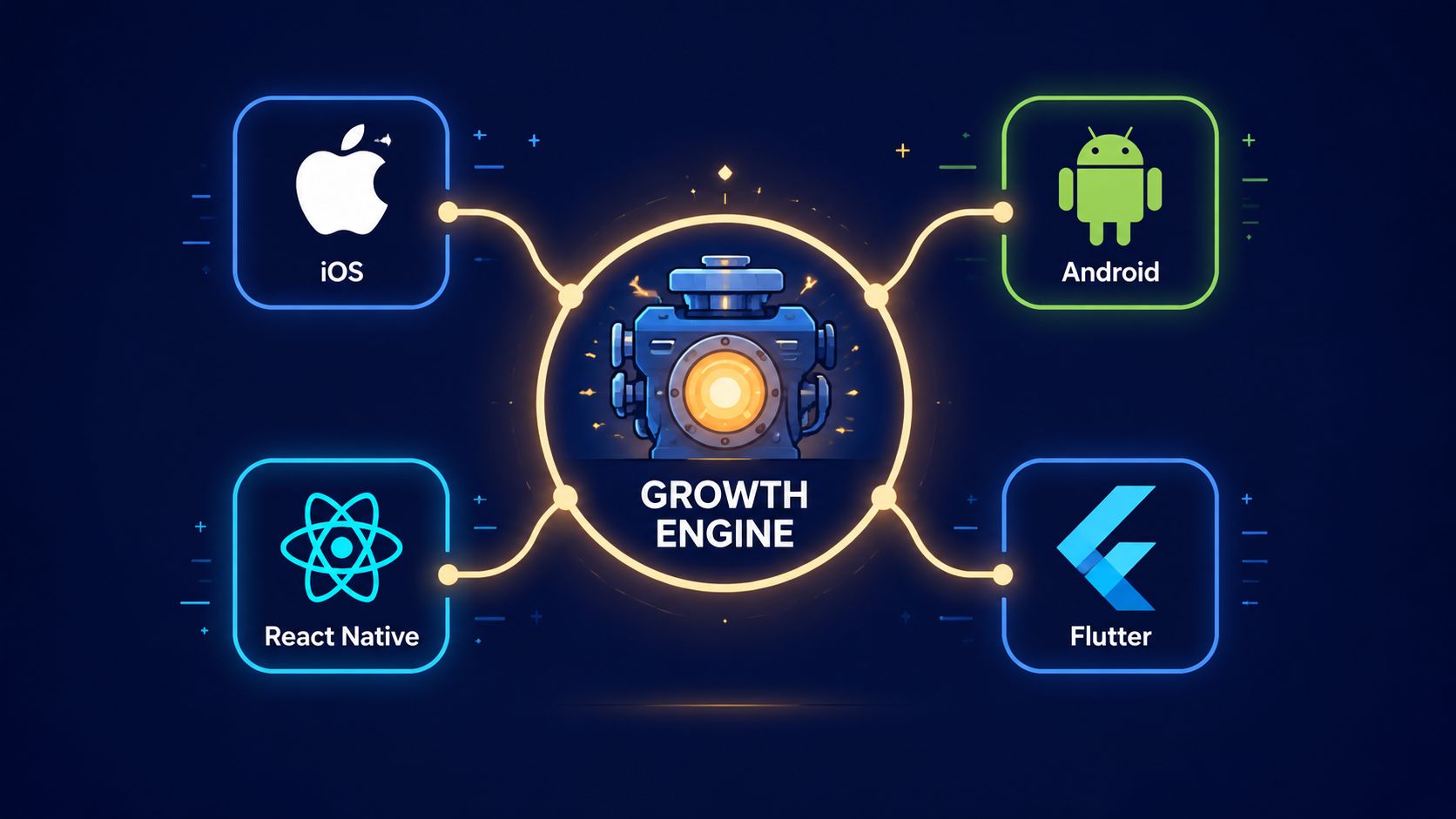
Native, hybrid, and engine-based apps have different constraints
iOS and Android teams can often insert native surfaces with strong platform fidelity, but they still need consistency in targeting logic, analytics, and experimentation. React Native reduces duplication, though teams still run into native module complexity when growth features depend on billing, entitlements, and lifecycle events.
Flutter is a different case. Flutter bypasses native platform widgets entirely by drawing every pixel through its own rendering engine, which creates UI consistency but means apps don't automatically inherit native behavior, as explained in Mobisoft's comparison of Flutter, React Native, and native apps. That has direct implications for in-app growth surfaces. Your platform needs to understand Flutter's rendering model, not assume it can drop in a native widget and get matching behavior.
Unity and Unreal introduce another layer. In games, growth surfaces may need to coexist with custom render loops, scene state, liveops logic, and virtual economy rules. Standard app tooling often struggles there.
There's also a practical warning for general app teams. A Reddit discussion on Unity for mobile app development argues that Unity is generally not recommended for standard mobile app development because its rendering and UI model aren't designed to behave like native apps. For special cases, especially advanced game liveops or non-native interactive experiences, that trade-off can still make sense.
What unified implementation should actually provide
A unified SDK layer matters because it reduces duplicated engineering and keeps campaign logic portable. The goal isn't to erase platform differences. It's to make them manageable.
A strong cross-platform setup should give teams:
- Consistent APIs: event logging, targeting, experiments, and campaign publishing should feel similar across runtimes.
- Shared campaign definitions: one onboarding flow or announcement should be portable with minimal platform-specific work.
- Platform-aware rendering: surfaces should respect native expectations where appropriate and custom runtimes where necessary.
- Common analytics semantics: exposure, conversion, billing, and entitlement events should map cleanly across iOS, Android, React Native, Flutter, Unity, and Unreal.
Comparison by platform reality
| Platform | Typical strength | Typical growth challenge |
|---|---|---|
| iOS native | Platform polish, direct access to native APIs | Release-cycle friction for iterative growth work |
| Android native | Flexibility and broad device coverage | More device variance and UI edge cases |
| React Native | Shared codebase with native escape hatches | Native bridging for billing, analytics, and performance-heavy moments |
| Flutter | Strong UI consistency | Custom rendering requires tailored experience delivery |
| Unity | Excellent for games and liveops-heavy interaction | Poor fit for standard native-style app UX |
| Unreal | Advanced interactive and 3D experiences | Higher complexity for standard growth tooling |
Why provider-agnostic matters here too
Cross-platform teams usually already have existing systems in place. They might use Firebase for analytics, RevenueCat for subscriptions, StoreKit and Google Play Billing directly for some products, or custom game backends for economy and entitlements.
A provider-agnostic growth layer works better than a platform that forces a full migration. It can sit across existing tools, ingest data from them, and let growth teams design, test, and ship in-app journeys without rebuilding the stack around one vendor's worldview.
For mobile app growth, that flexibility is often the difference between adoption and endless integration delay.
Your Path to a Connected Growth Strategy
The old acquisition-first model survives because it's simple to explain. More spend, more installs, more volume. But mobile app growth stops being durable when the rest of the journey is disconnected. You can't buy your way past weak activation, vague entitlement logic, static paywalls, or a retention system that depends on the next app release.
The better model is connected. Product defines activation clearly. Engineering instruments the right state and event flows. Growth operates through remote-configurable in-app surfaces instead of relying on blunt broadcast channels. Revenue teams test paywalls and offers in the context of actual user behavior. Cross-platform teams use one operational layer that works across iOS, Android, React Native, Flutter, Unity, and Unreal.
Three principles hold up across almost every category:
Build around user state, not channel state
Install source matters, but it's only the start. Key decisions come from what the user has done, what they're eligible for, and what they need next.
Treat release independence as a growth capability
If the team can't change onboarding, retention offers, feature announcements, or paywall logic without shipping a new binary, iteration stays too slow.
Unify analytics, delivery, and monetization logic
When campaign exposure, product behavior, billing state, and entitlements live in different systems, teams move slower and trust results less.
Connected growth systems don't just measure the journey. They let teams change the journey while it's still happening.
The teams that win over the next few years won't necessarily be the ones with the biggest acquisition budget. They'll be the teams that can connect first-session value, long-term engagement, monetization state, and cross-platform delivery into one operating model.
Nuxie brings that operating model together in one place. It's an AI-native mobile growth platform for apps and games that combines in-app experience design, experimentation, analytics, billing, entitlement infrastructure, and a collaborative flow editor across iOS, Android, React Native, Flutter, Unity, and Unreal. Teams use it to ship onboarding quizzes, surveys, feature announcements, retention offers, liveops moments, personalized screens, and paywalls without waiting for app releases. Because it's provider-agnostic, it can work alongside existing tools such as StoreKit, Google Play Billing, RevenueCat, Superwall, and other data providers. It also doesn't charge a revenue-share fee for billing or entitlement data, which makes it practical for teams that want monetization flexibility without handing over a cut of the underlying revenue signals.