
10 Best Mobile App Analytics Tools for 2026
Explore 2026's top mobile app analytics tools for product and growth teams. Compare features, pricing, and use cases for Firebase, Amplitude, Nuxie, and more.
Your team just shipped a major feature, but the dashboard is a sea of confusing metrics. Installs moved, a few engagement charts look healthy, and someone on growth is asking whether the release improved revenue. Nobody can answer with confidence because the data is fragmented across product events, attribution, crash logs, and billing.
That's the problem with most mobile app analytics tools. They collect data, but they don't always help teams connect product changes to business outcomes. You need to know where users drop off, which features drive retention, how campaigns affect behavior, and whether monetization changes are helping or hurting. Mobile app analytics is the systematic practice of collecting and analyzing user interactions inside apps, including installs, session length, retention, in-app events, churn, lifetime value, and revenue (Singular's definition of mobile app analytics).
The category keeps getting more important. One market forecast values the global mobile app analytics tool market at approximately $9.81 billion in 2026 and projects it to reach $23.74 billion by 2031 at a 19.32% CAGR over that period (Mordor Intelligence app analytics market report). Another analysis places the market at approximately $15 billion in 2025 and projects 18% CAGR through 2033 (Archive Market Research mobile app analytics tool report).
That growth makes sense. Mobile teams now need more than event dashboards. They need a stack that links analytics, experimentation, UX diagnosis, attribution, and monetization. The tools below are the ones technical teams are weighing in 2026 when they want trusted answers instead of more charts.
1. Nuxie
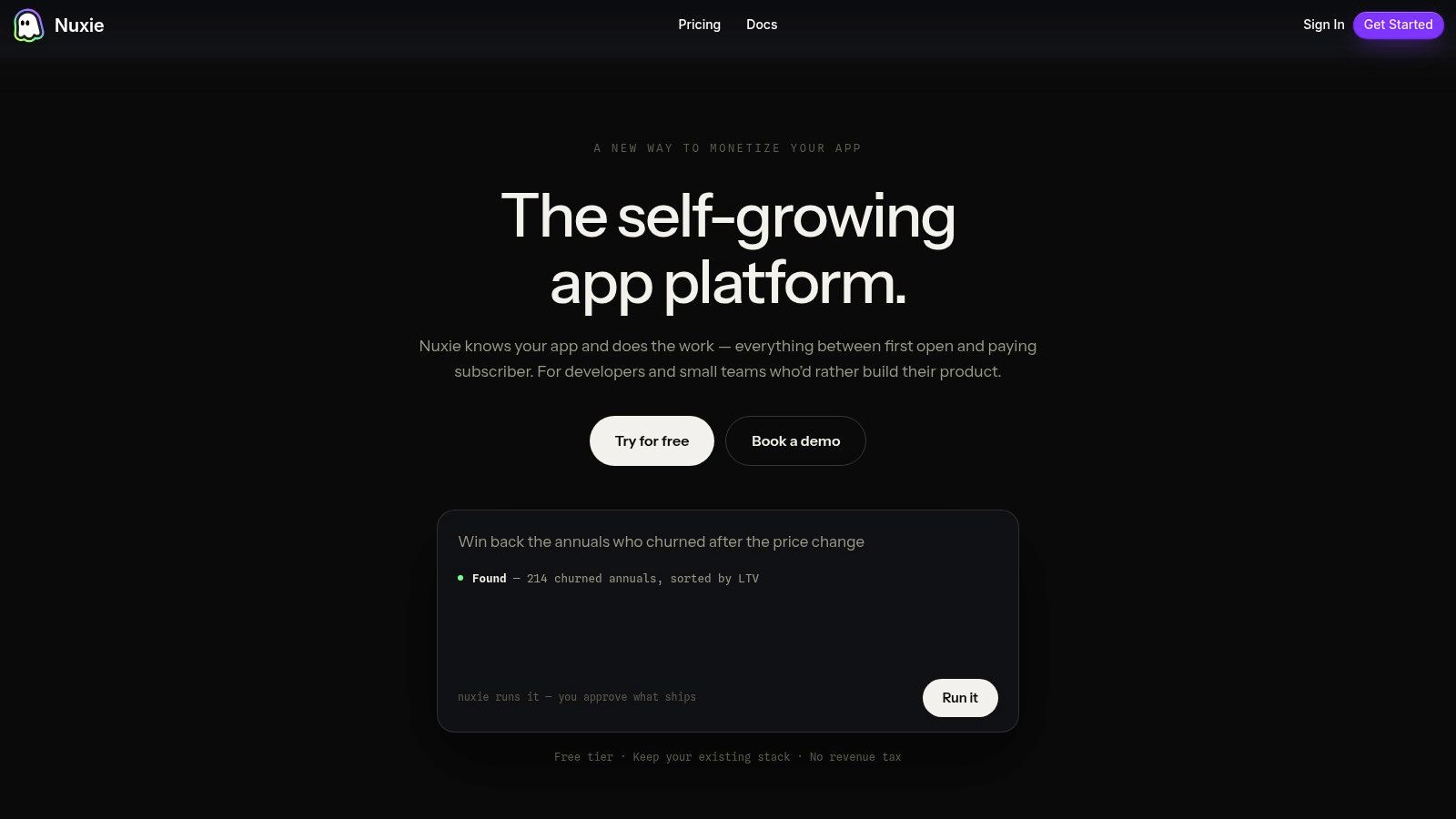
A common mobile growth failure looks like this: the team finds a drop in onboarding completion on Monday, agrees on a fix by Tuesday, and still cannot test it until the next release cycle. By then, the segment has shifted, the hypothesis is stale, and the analytics tool has done its job without helping the team change the outcome. Nuxie is built for that gap.
Nuxie sits in a different category than pure analytics products. It combines analytics, experimentation, in-app experiences, billing, entitlements, and growth workflows in one system. That changes the decision criteria. The question is not only whether the platform can track events correctly. The question is whether the same platform can help the product, growth, and monetization teams ship a response while the signal still matters.
Teams can remotely publish onboarding flows, surveys, feature announcements, paywalls, retention offers, liveops moments, and personalized screens without waiting for another app store release. For iOS, Android, React Native, Flutter, Unity, and Unreal teams, that shortens the loop between diagnosis and action. Engineers spend less time on repetitive release work. Product and monetization teams get more room to test timing, messaging, and offer logic in production.
Where Nuxie stands out
The main differentiator is its provider-agnostic model. Teams can use Nuxie with an existing analytics stack, then expand into more of the runtime if that proves useful. That matters in real environments where replacing Firebase, Amplitude, AppsFlyer, RevenueCat, and an in-app messaging layer all at once is usually unrealistic.
Nuxie also covers billing, subscription sync, purchase data, and entitlements. For teams running subscription apps or games with frequent offer changes, that matters more than another dashboard tab. Revenue experiments often fail in execution, not analysis. If a retention cohort needs a different upgrade path, the team has to change paywall logic, entitlement rules, and targeting together. Splitting those jobs across separate tools usually adds delay, more QA surface area, and harder debugging.
My rule of thumb is simple. If one team owns conversion, retention, and subscription revenue, the stack should connect measurement, experimentation, and monetization closely enough that a hypothesis can become a live test without weeks of coordination.
Nuxie also supports AI-assisted growth workflows, a collaborative flow editor, Rive-powered animations, on-device targeting, offline-ready delivery, and one-tap publishing. Those details matter for game studios and cross-platform app teams because growth surfaces rarely live in one place. They span native screens, store logic, promotions, and personalized moments that need to behave consistently across platforms.
A practical way to evaluate it is as the action layer in your stack, not just another analytics endpoint. Teams that want that operating model can use Nuxie's guide to mobile app analytics fundamentals and stack design as a starting point.
Trade-offs
- Best fit: Teams that need analytics tied directly to in-app UX changes, experiments, and monetization operations.
- Less ideal: Small teams that only need event dashboards, basic funnels, and lightweight reporting.
- Selection note: Verify pricing, reference customers, security reviews, and compliance details during evaluation, especially if billing and entitlement logic will move into the platform.
2. Google Analytics for Firebase
If you need a practical default, Google Analytics for Firebase is still the easiest place to start. It's free at the core, SDK-based, and tightly connected to Firebase products many mobile teams already use. For startups and lean product teams, that combination is hard to beat.
Firebase works best when the main job is collecting events, building audiences, and connecting that data to Remote Config, A/B Testing, Cloud Messaging, and BigQuery. It has strong SDK coverage across iOS, Android, Flutter, and Unity, so it's often the first analytics system a cross-platform app ships with.
What it does well
Google allows up to 500 distinct custom events per project, and the implementation path is straightforward for most apps. Automatic event and user property collection reduce the amount of custom instrumentation you need on day one. If you're already using Firebase Cloud Messaging or Remote Config, audience-based targeting becomes much easier to operationalize.
The weak point is depth. Firebase is strong for broad measurement and activation, but many teams outgrow its reporting layer when they want more flexible behavioral analysis. That's usually when they add BigQuery modeling, or pair Firebase with a dedicated product analytics tool.
Firebase is excellent for collecting data cheaply. It's less excellent at helping every PM answer nuanced behavioral questions without extra modeling work.
Where it fits in a stack
- Good choice for: Early-stage teams, Google Cloud users, Android-heavy apps, and teams that want one integrated SDK path.
- Usually paired with: An MMP for attribution, a session replay tool for visual diagnostics, or a deeper product analytics layer as event volume and analysis needs grow.
- Watch-out: BigQuery export is powerful, but raw-data analysis there introduces its own cost and ownership model.
3. Amplitude
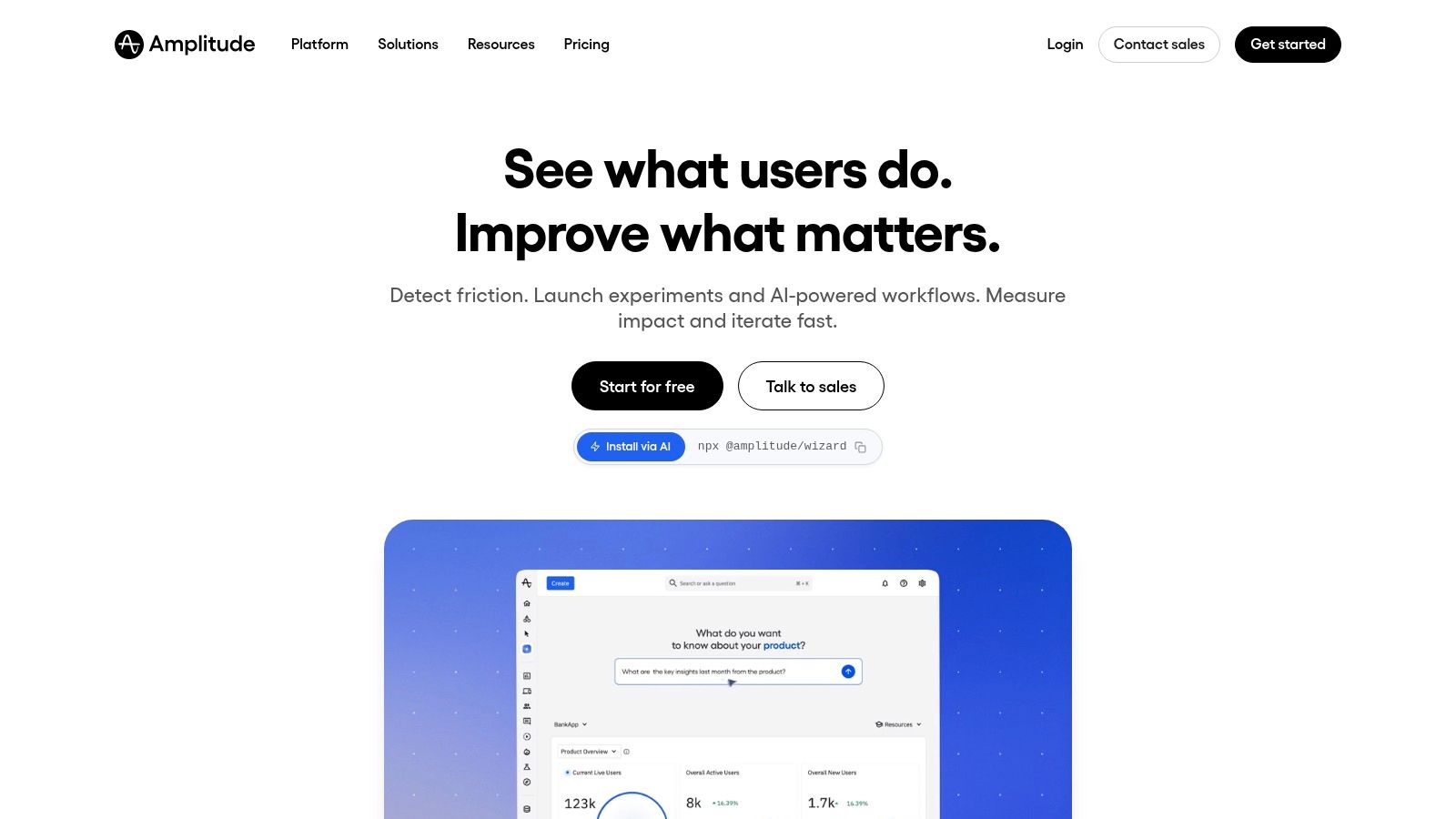
Amplitude is what I'd pick when the product team lives in analytics every day. It's built for funnels, retention, cohorts, journeys, governance, and collaboration. If PMs, growth leads, and data analysts all need to answer their own questions, Amplitude usually holds up better than simpler tools.
Its biggest strength is structure. Teams that define events carefully can move from “what happened?” to “which behavior correlates with retention or conversion?” without constant data-team help. That's why it's often the tool that replaces a basic analytics setup once the org starts taking product instrumentation seriously.
Why teams adopt it
Amplitude handles core behavioral analysis well and extends into experiments, feature flags, and session replay through add-ons. It's also mature on governance, which matters when your app has multiple squads all instrumenting events differently. Without that discipline, mobile app analytics tools become dashboard factories no one trusts.
If your team is actively working on onboarding, upgrade paths, or high-friction flows, Amplitude's strength is the way it supports repeated funnel analysis and cohort slicing. Nuxie's overview of what funnel analysis is and how teams use it maps closely to the kinds of questions Amplitude is good at answering.
Trade-offs in practice
- Strongest fit: Product-led teams that want self-serve analysis and a clear path from free usage to enterprise depth.
- What works: PM-friendly interface, collaboration features, mature integrations, warehouse connectivity.
- What doesn't: Costs can rise as event volume grows, and advanced modules can expand total spend quickly.
Amplitude is rarely the wrong product analytics tool. It's just not always the cheapest answer.
4. Mixpanel
Mixpanel is the tool I see teams choose when they want speed. Not speed of event ingestion. Speed of getting a real answer from the interface. Funnels, cohorts, retention, and signal reporting are easy to explore, and that matters more than feature breadth for many mobile teams.
It's especially good for smaller product and growth teams that don't want analytics to feel like a separate discipline. Mixpanel tends to get adopted quickly because PMs can use it without much ceremony, assuming the event schema is sane.
Best use case
Mixpanel is strong when the team already knows the questions it wants to answer. Where do users fail onboarding? Which feature predicts retention? What's the drop-off between registration and purchase? The UI supports that style of direct exploration better than many heavier platforms.
The free allowance of 1M monthly events also makes it accessible for early products, and the startup-friendly positioning helps. Costs can still compound as volume scales, so it's worth deciding early which events are decision-grade and which are just noise.
A common mistake is over-instrumenting every tap and then paying to store confusion.
Practical fit
- Choose Mixpanel when: You want product analytics with a fast learning curve and strong self-serve reporting.
- Skip it when: You need broader stack consolidation, deep warehouse-centric workflows, or integrated attribution.
- Implementation advice: Start with a small event taxonomy tied to onboarding, activation, retention, and revenue. Add detail only when the team can explain how it will use that data.
5. PostHog
PostHog appeals to engineering-heavy teams for a reason. It combines product analytics, session replay, feature flags, experiments, and data tooling in one open-core stack, and it offers self-hosting for teams that want more control. If your developers care about ownership and extensibility, PostHog usually comes up early.
It isn't the smoothest tool for non-technical users, and that's the trade. You get flexibility and consolidation, but you also inherit more configuration work than with pure SaaS analytics products.
Why technical teams like it
PostHog gives you events, funnels, retention, cohorts, replay, flags, and experiments in a unified environment. That reduces tool sprawl if your team is disciplined enough to manage the setup well. The pricing model is also more transparent than some enterprise products, which helps teams forecast usage before they commit broadly.
The self-hosting option matters for privacy-sensitive teams, but it also means DevOps ownership. If nobody on the team wants to think about infrastructure, cloud configuration, or product-level metering, the theoretical flexibility can become operational drag.
PostHog is powerful when engineers are active stakeholders in analytics. It's much less comfortable when product wants a polished system and engineering wants minimal ownership.
Who should shortlist it
- Best for: Developer-led companies, privacy-conscious teams, startups that want analytics plus flags and replay in one stack.
- Less ideal for: Organizations where PMs need the cleanest possible UX and don't want engineering involved after initial setup.
- Planning note: Costs can be reasonable at first, but replay, feature flags, and warehouse components should be budgeted together, not separately.
6. AppsFlyer

AppsFlyer isn't a substitute for product analytics. It's an MMP, and that distinction matters. If your team spends heavily on user acquisition, needs cross-channel attribution, or has to make sense of privacy-constrained measurement across networks, AppsFlyer belongs in the conversation.
It's built for deterministic and probabilistic attribution, SKAdNetwork support, broad partner integrations, and privacy-focused workflows like clean-room collaboration. Product teams sometimes underrate how different this job is from event analytics until paid acquisition scales and nobody trusts campaign reporting anymore.
What it solves
AppsFlyer is for answering acquisition questions. Which campaign drove the install? Which network produced users with meaningful downstream value? How do you connect marketing spend to LTV signals without relying on a patchwork of ad dashboards?
Those are not questions Amplitude, Mixpanel, or Firebase solve well on their own. Growth teams usually need an MMP plus product analytics, not one or the other. If subscription revenue is a key business model, Nuxie's guide to subscription business metrics is a useful framework for deciding which post-install signals to send back into attribution workflows.
Trade-offs
- Choose AppsFlyer when: UA is material, privacy controls matter, and network coverage is a hard requirement.
- Expect complexity: Advanced privacy features and clean-room workflows take planning.
- Reality check: Pricing is custom and usually tied to conversion volume and feature scope, so forecast your needs before procurement starts.
7. Adjust
Adjust sits in the same strategic category as AppsFlyer, but some teams prefer it because of its flexibility around callbacks, exports, attribution windows, and subscription analytics. If your growth team wants more direct access to measurement data, Adjust is often appealing.
It's a mature MMP with deterministic and probabilistic attribution across iOS, Android, and connected environments, plus SKAdNetwork support, reattribution controls, fraud prevention, and partner integrations. The product tends to feel built for teams that want to tune measurement details, not just consume standard dashboards.
Where Adjust earns its place
Adjust is strong when lifecycle re-engagement matters. Apps with subscription renewals, returning purchasers, and paid remarketing programs often need precise reattribution rules and flexible callback behavior. That's where Adjust can fit well.
Its subscription analytics are also useful for mobile businesses where revenue events need to be part of the measurement story, not a separate finance report. But the trade-off is setup complexity. This isn't the kind of SDK you drop in and forget about.
Practical guidance
- Best for: Growth teams with active acquisition and re-engagement programs.
- What works well: Data openness, mature documentation, flexible attribution controls.
- What to watch: Custom pricing and ongoing maintenance are part of the total cost, not edge considerations.
If your team only needs in-app event analytics, Adjust is overkill. If you're spending seriously on acquisition, it's not.
8. UXCam
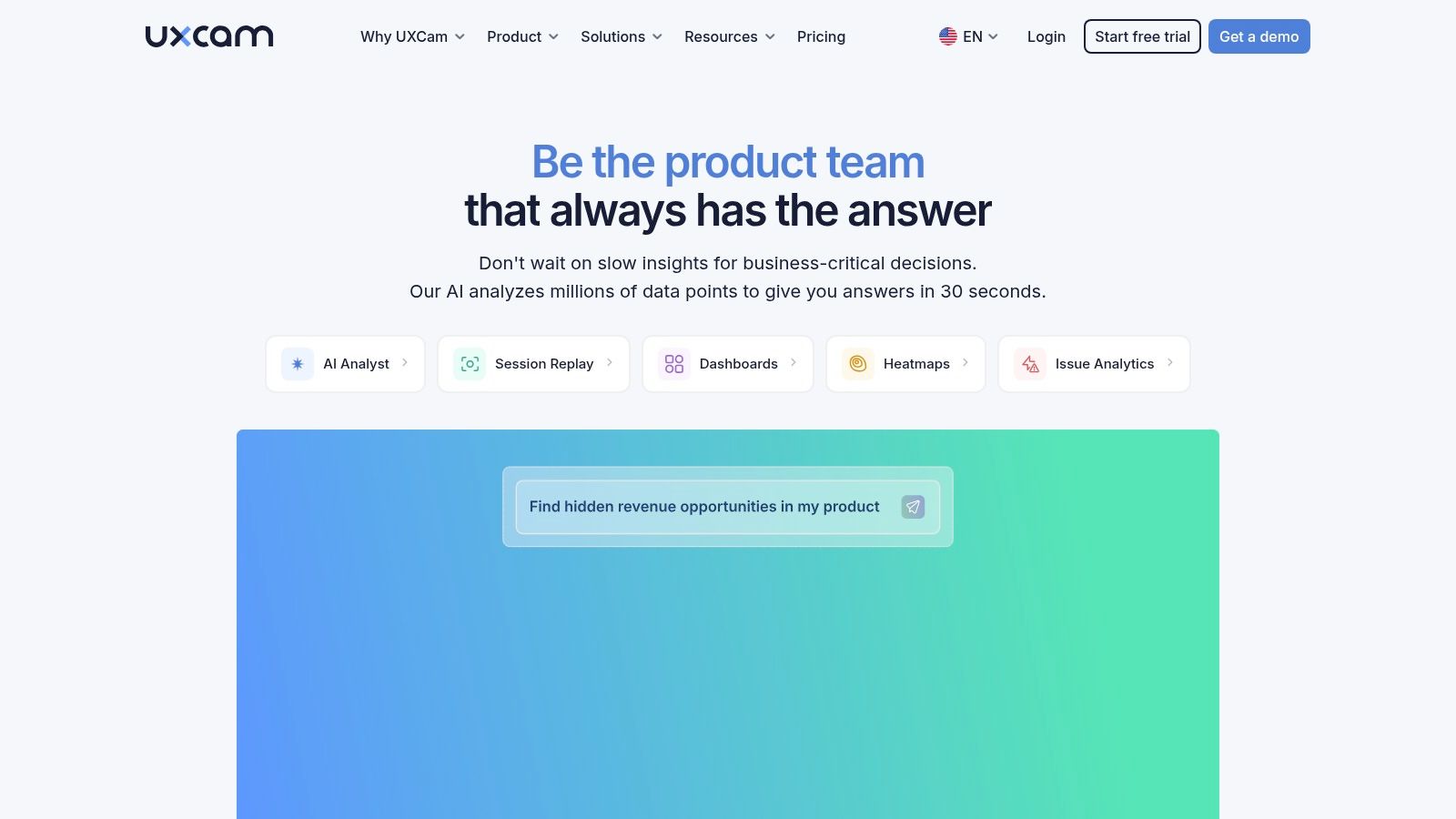
UXCam is the clearest answer to a problem often discovered too late. The charts tell you where users drop off, but not why. UXCam fills that gap with session replay, heatmaps, screen flows, crash signals, UI-freeze detection, and mobile-first behavioral context.
That qualitative layer matters because many teams still run optimization from numbers alone. One industry guide notes a sharp gap between quantitative analytics and qualitative context, and says only about 15% of mature mobile teams integrate session replay tools to diagnose funnel drop-offs (Neel Networks mobile app analytics guide). That's a blind spot, not a nice-to-have omission.
When replay changes the decision
A funnel report may show a drop between registration and first purchase. Replay shows whether users hit a broken keyboard state, a confusing promo-code field, a laggy paywall, or a CTA hidden behind a device-specific layout issue. That's the difference between guessing and fixing.
UXCam works best as a complement to product analytics, not a replacement. Pair it with Mixpanel, Amplitude, Firebase, or PostHog, and you get both the macro pattern and the visual evidence. On its own, replay data can become an expensive archive of interesting anecdotes.
Behavioral data tells you where to inspect. Replay tells you what to inspect.
Trade-offs
- Best for: UX, product, QA, and growth teams diagnosing friction in critical funnels.
- Key risk: Privacy setup matters. PII redaction and replay controls need deliberate configuration.
- Budget note: Pricing depends on volume and retention settings, so define the screens and cohorts that are most important before rollout.
9. Countly
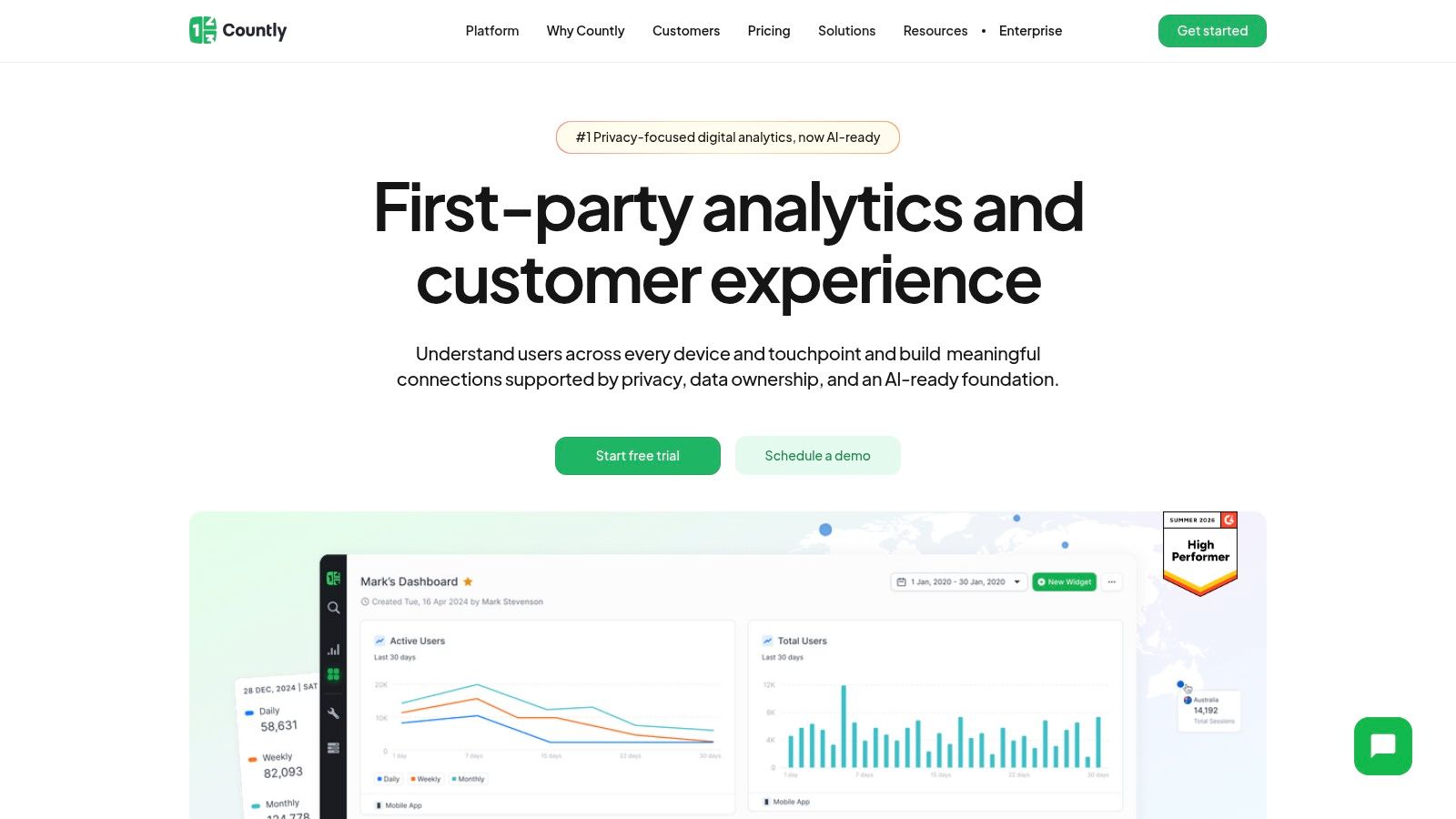
Countly is the data-control choice. If your team prioritizes self-hosting, deployment flexibility, and keeping analytics infrastructure under tighter internal control, Countly is worth a serious look.
Its community-backed Lite edition gives teams an open-source path, while the enterprise edition adds more plugins and capabilities like A/B testing and remote config. That split makes Countly attractive to teams that want to start with ownership and expand selectively.
Why teams choose it
Countly covers the essentials: events, funnels, retention, cohorts, user profiles, and deployment options across mobile, web, desktop, and IoT. For privacy-sensitive organizations, the architecture decision often matters as much as the reporting UI.
That said, self-hosting isn't free just because the license is flexible. Someone still has to scale it, secure it, maintain it, and support internal users. Teams often underestimate that operational tax when comparing it with fully managed SaaS mobile app analytics tools.
Best fit
- Choose Countly when: Compliance, data residency, or internal infrastructure control are central requirements.
- Less ideal when: Your team wants the fastest path to self-serve analysis with minimal operational burden.
- Smart approach: Validate whether you need self-hosting for policy reasons, or whether a managed platform with stronger day-to-day usability would serve the business better.
10. Heap
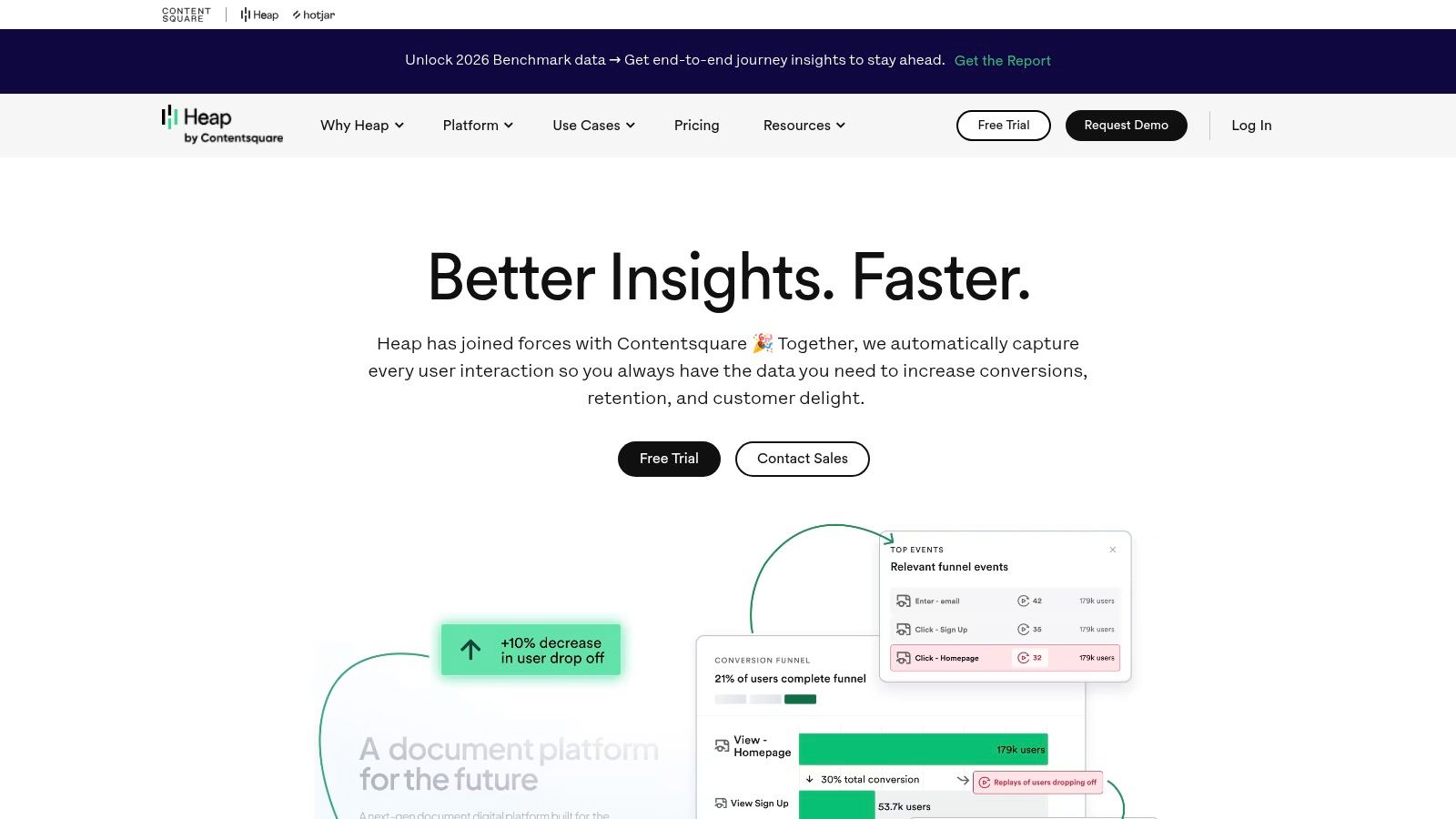
Heap is built around autocapture and retroactive analysis. That makes it attractive when a team wants value quickly without a long upfront instrumentation project. You capture broad interaction data first, then define useful events later.
That workflow can be a real advantage for teams that don't fully know their key questions yet. It can also create a mess if nobody governs what gets captured, modeled, and retained.
Where Heap works
Heap is strongest when time-to-insight matters more than perfect instrumentation discipline on day one. PMs can explore journeys, funnels, retention, and influence analysis without waiting for every event to be manually planned and shipped.
Session replay is available as an add-on, and warehouse export plus governance features help mature teams keep order as complexity increases. But autocapture always needs restraint. More captured data doesn't automatically create more usable insight.
The real trade-off
- Good choice for: Teams that want to move fast and avoid heavy engineering dependency early.
- Common problem: Autocapture can produce high data volumes and noisy schemas if nobody owns event hygiene.
- Commercial caveat: Pricing is opaque and typically requires a sales process, so model future scale before adopting it broadly.
Top 10 Mobile App Analytics Tools, Feature Comparison
| Product | Core features | UX / Quality (★) | Price / Value (💰) | Target audience (👥) | Unique selling points (✨) |
|---|---|---|---|---|---|
| Nuxie 🏆 | Provider-agnostic analytics; AI growth agent; flow editor; runtime & billing/entitlements | ★★★★☆ | 💰 Contact sales, no revenue-share billing option | 👥 Indie devs, PMs, growth teams, publishers, game studios | ✨ AI-native automation; remote publish without app releases; built-in billing & entitlement stack |
| Google Analytics for Firebase (GA4 for apps) | SDK event analytics; audience segmentation; BigQuery export; Firebase integrations | ★★★★☆ | 💰 Free core analytics; BigQuery billed | 👥 Early-stage apps, Firebase/Google Cloud users | ✨ Tight Remote Config / A/B / FCM integration; easy start-up |
| Amplitude | Funnels, cohorts, journeys; experiments & governance; warehouse integrations | ★★★★☆ | 💰 Free tier; usage-based scaling with events | 👥 Product teams focused on deep analytics | ✨ PM-friendly UX, collaboration, AI-assisted analysis |
| Mixpanel | Real-time funnels, retention, autocapture; dashboarding & collaboration | ★★★★☆ | 💰 1M events free; predictable overages | 👥 PMs, startups, smaller product teams | ✨ Fast self-serve exploration; startup pricing perks |
| PostHog | Product analytics + session replay, feature flags, experiments; self-host option | ★★★★☆ | 💰 Free self-host tier; managed pricing usage-based | 👥 Engineering-heavy teams, privacy-conscious orgs | ✨ Self-hostable stack; transparent unit pricing; integrated replay & flags |
| AppsFlyer | Deterministic/probabilistic attribution; SKAdNetwork; clean-room & privacy tools | ★★★★☆ | 💰 Custom, conversion-based pricing | 👥 UA/growth teams, enterprises needing cross-channel attribution | ✨ Enterprise-grade privacy, broad partner network, SKAdNetwork expertise |
| Adjust | Attribution, SKAdNetwork, reattribution, subscription analytics; fraud prevention | ★★★★☆ | 💰 Custom pricing (volume/features) | 👥 Teams needing flexible measurement & subscription insights | ✨ Data openness (callbacks/exports); mature attribution controls |
| UXCam | High-fidelity session replay; heatmaps; funnels; crash & UI-freeze insights | ★★★★☆ | 💰 Contact, volume/retention based | 👥 UX researchers, PMs, mobile product teams | ✨ Visual replay + heatmaps for fast friction diagnosis |
| Countly | Self-hostable analytics; plugins (A/B, remote config); user profiles | ★★★★☆ | 💰 Self-host (free/community) or enterprise paid | 👥 Privacy-sensitive teams, enterprises wanting data control | ✨ Own-your-data deployment; modular enterprise plugins |
| Heap | Autocapture & retroactive event definition; funnels, journeys; replay add-on | ★★★★☆ | 💰 Contact sales, tiers opaque | 👥 PMs who want fast time-to-insight with minimal instrumentation | ✨ Autocapture + retroactive analysis for rapid discovery |
How to Choose and Implement Your Analytics Stack
The best analytics tool is the one your team uses to make decisions. That sounds obvious, but most analytics failures aren't technical. They happen because teams buy for feature lists and then operate with unclear questions, weak event design, and disconnected systems.
Start with the job to be done. Product teams usually need behavioral analysis around onboarding, feature adoption, retention, and conversion. Growth teams need attribution, campaign measurement, and downstream value signals. UX and QA teams need replay, heatmaps, crashes, freezes, and performance context. Monetization owners need billing events, purchase state, entitlement status, and paywall performance in the same decision loop.
Industry benchmarks for modern platforms increasingly prioritize real-time data, behavioral context like session replay and funnel tracking, and technical performance signals, while also emphasizing metrics such as install-to-registration, Day 1, Day 7, and Day 30 retention, error encounter rates, funnel completion, and revenue per session (Quantum Metric guidance on mobile app analytics platforms). That's a useful lens because it forces teams to measure both business outcomes and product quality, not just engagement volume.
A practical stacking model
For early-stage teams, Firebase is still a pragmatic base layer. It's fast to implement, integrates well with Google's app stack, and covers the basics for iOS, Android, Flutter, and Unity. If the team starts asking more complex product questions, Amplitude or Mixpanel usually becomes the next step.
If you spend significantly on acquisition, add an MMP. AppsFlyer and Adjust solve a different problem from product analytics, and trying to make one tool do both jobs usually creates reporting arguments no one wins. Attribution and behavior should meet in your warehouse or in a well-defined downstream workflow.
For UX diagnosis, add session replay intentionally. Don't turn it on everywhere. Start with the onboarding funnel, checkout or paywall flow, account creation, and the most business-critical gameplay or content loops. That gives you enough visual context to debug friction without drowning in footage.
Where Nuxie changes the stack discussion
Nuxie is useful when your team's bottleneck is no longer insight collection, but execution speed. Because it combines provider-agnostic analytics, experimentation, in-app experiences, billing, entitlements, and growth automation, it can become the operational layer that sits on top of or alongside your existing tools. That's especially relevant for teams building across iOS, Android, React Native, Flutter, Unity, or Unreal and trying to remotely ship onboarding, surveys, paywalls, retention offers, and personalized flows without app releases.
Cross-platform choices also matter at the app layer. Flutter is still valuable for teams that want one codebase across iOS, Android, web, and desktop with consistent UI behavior (Gitnux overview of cross-platform development software). React Native 0.84, described as the latest stable release in 2026, defaults to Hermes V1, which is reported to reduce memory usage by 30% and improve cold starts, helping teams that need smoother runtime performance for dynamic in-app experiences (Adevs on React Native in 2026). For game teams, Godot 4.6 adds native integrations for Google Play Billing, Google Play Games Services, and Apple StoreKit 2, while keeping its MIT license and zero royalties forever (App Radar on mobile game engines and development platforms).
The rule I use is simple. Pick one tool for behavioral truth, one for acquisition truth if paid marketing matters, one for qualitative UX diagnosis, and one action layer for experiments and monetization changes. If one platform can responsibly cover multiple jobs without locking you into revenue share or a narrow platform scope, that's usually where stack simplicity starts paying off.
If you want analytics that lead directly to action, not another disconnected dashboard, take a close look at Nuxie. It gives mobile app and game teams a provider-agnostic way to connect analytics, experimentation, in-app experiences, billing, and entitlements across iOS, Android, React Native, Flutter, Unity, and Unreal, so you can ship onboarding flows, paywalls, retention offers, and personalized journeys without waiting on app releases.