Mobile Teams: The 2026 Guide to in App Purchase Sdk
Choose the right in app purchase sdk. This guide covers billing, entitlements, platform differences, and how provider-agnostic tools can replace RevenueCat.
Nuxie pricing reviewed October 6, 2026. Creation credits have separate plan charges. The revenue fee is waived when monthly attributed revenue is at most $10,000; above that threshold, 1% applies to the full adjusted net amount. See current Nuxie pricing.
Your team has probably reached the same point most mobile teams hit. The app works, retention is decent, and someone says, “Let's add subscriptions,” or “Let's sell packs, cosmetics, premium access, or extra content.” That sounds simple until engineering starts listing the actual work: App Store Connect setup, Google Play product configuration, receipt handling, entitlement state, restore flows, refunds, cross-device sync, sandbox testing, analytics, and paywall iteration.
That's where teams usually discover that an in app purchase SDK isn't just a payments helper. It's a decision about architecture, ownership, and future operating cost. If you get it wrong, you don't just ship slower. You also end up with brittle billing code, unclear entitlement logic, and growth experiments blocked by release cycles.
Why Your App Needs More Than Just a Buy Button
Mobile monetization is now too large to treat billing as a thin utility layer. The global in-app purchase market is projected to reach USD 449.90 billion by 2030, growing at a CAGR of 12.9%, according to Grand View Research's in-app purchase market analysis. That matters because it changes the role of monetization infrastructure. It's no longer a feature at the edge of the product. It's part of the product core.
A buy button is the visible tip. The hard part starts after the tap.
When a user buys on iOS or Android, your app has to answer a few essential questions. Did the store confirm the purchase? Does this user have access now? What happens if they reinstall, switch devices, cancel, upgrade, downgrade, or request a refund? If a game sells consumables and permanent access side by side, the logic gets even more fragile.
Practical rule: If entitlement state lives only on-device, you haven't finished the IAP architecture.
Teams that underestimate this usually create technical debt in three places:
- Client logic gets overloaded with purchase checks, retries, restore behavior, and local flags that drift out of sync.
- Backend gaps appear because nobody planned for validation, server notifications, or a clean entitlement source of truth.
- Product velocity slows down because every pricing or paywall change turns into an app update instead of a remote decision.
If your team needs a quick refresher on what counts as an IAP model in the first place, Nuxie's guide to the meaning of in-app purchases is a useful baseline before you choose tooling.
The right IAP stack doesn't just process money. It reduces state bugs, gives product and growth teams room to iterate, and keeps your billing layer from becoming a permanent maintenance project.
The Core Components of a Modern IAP SDK
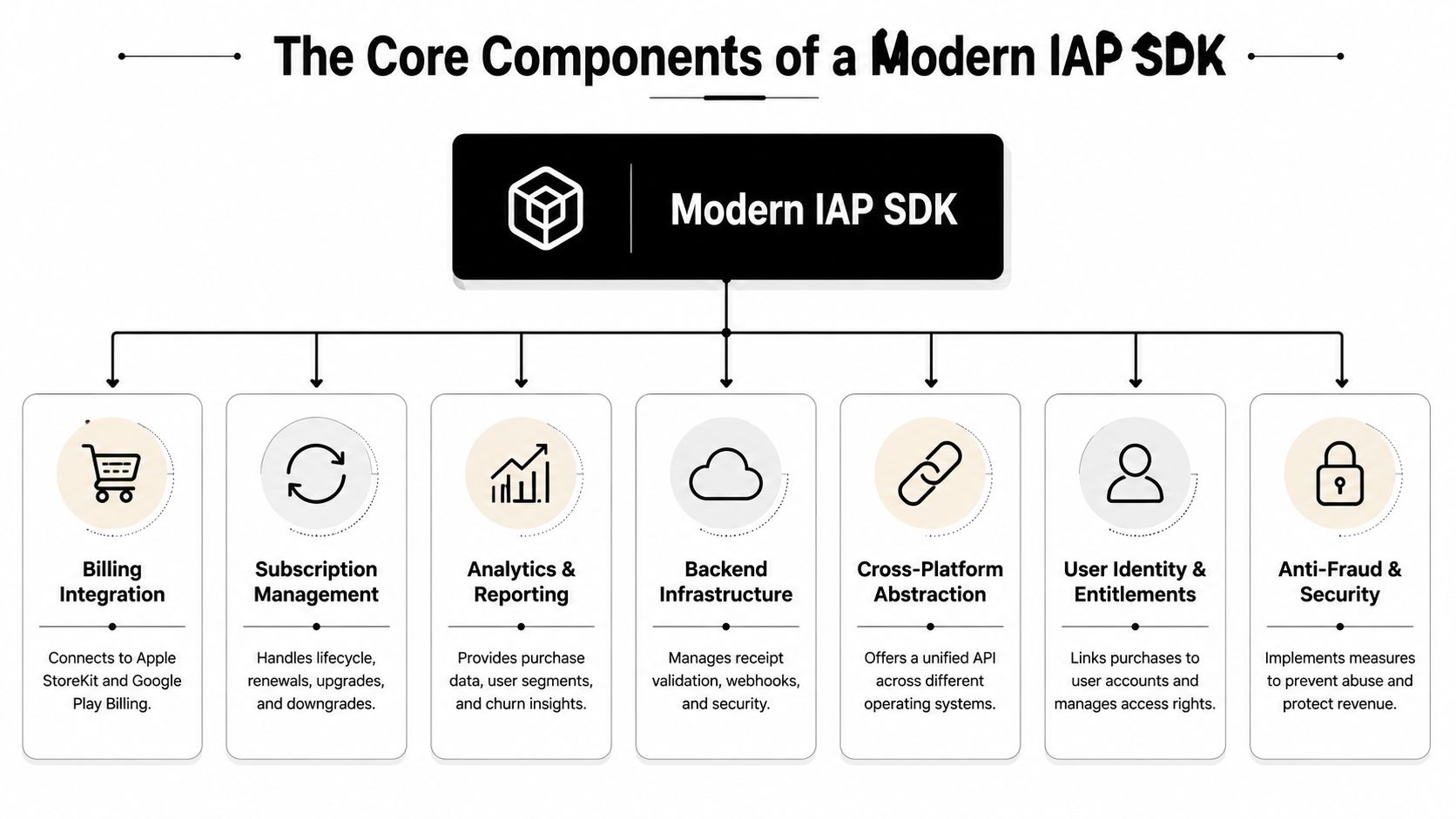
A modern in app purchase SDK should be treated as a system, not a library. If it only wraps StoreKit or Google Play Billing, it solves the smallest part of the problem.
Billing is only one layer
SDK evaluation often begins with checking for support for iOS and Android purchases. That's necessary, but it's not enough. In practice, the useful parts are the layers around billing: identity mapping, receipt validation, subscription state synchronization, entitlement rules, analytics hooks, and failure handling.
Think of it this way. The native store APIs are the cash register. Your entitlement system is the lock on the premium room. Your validation pipeline is the security camera. If any one of those is weak, users either lose access they paid for or gain access they shouldn't have.
A strong billing architecture usually includes:
- Store connectors that talk to StoreKit and Google Play Billing reliably.
- Validation services that confirm the transaction is legitimate before access is granted.
- Entitlement mapping so product IDs translate into app-level access such as Pro, Premium, Season Pass, Remove Ads, or Level Pack 3.
- User identity linking for restores, account merges, anonymous users, and cross-device sync.
Entitlements are where the business logic lives
This is the part many teams get wrong. Products are store objects. Entitlements are product decisions.
If a user buys monthly_premium_ios, your app shouldn't scatter that SKU check across multiple screens. It should ask one question: “Does this user have Premium?” That abstraction becomes even more important when you support React Native, Flutter, Unity, or Unreal, because platform-specific product identifiers multiply quickly.
A clean entitlement layer saves more time than a clever purchase wrapper.
This is also where broader mobile billing architecture matters. If you're evaluating the system beyond just SDK syntax, Nuxie's article on mobile billing system design covers the operational side teams often miss.
Backend and analytics separate hobby projects from real products
Once subscriptions enter the picture, state changes don't happen only when the app is open. Renewals, billing retries, grace periods, cancellations, and refunds can all happen outside the device session.
That means your IAP layer needs backend awareness, whether through your own service or a provider that handles sync and notifications. Product and growth teams also need more than raw transaction logs. They need usable reporting tied to users, cohorts, offers, paywalls, and retention behavior.
A modern setup should make these questions easy to answer:
| Need | Why it matters |
|---|---|
| Who has access right now | Support, gating, and restore flows depend on it |
| Why access changed | Renewal, cancellation, refund, or upgrade affect messaging |
| Which paywall or offer led to purchase | Growth decisions need attribution, not just revenue totals |
| What happens when stores disagree with local state | Your system needs a trusted source of truth |
If your SDK doesn't help with those problems, your team will end up building them anyway.
Navigating the Platform and Framework Maze
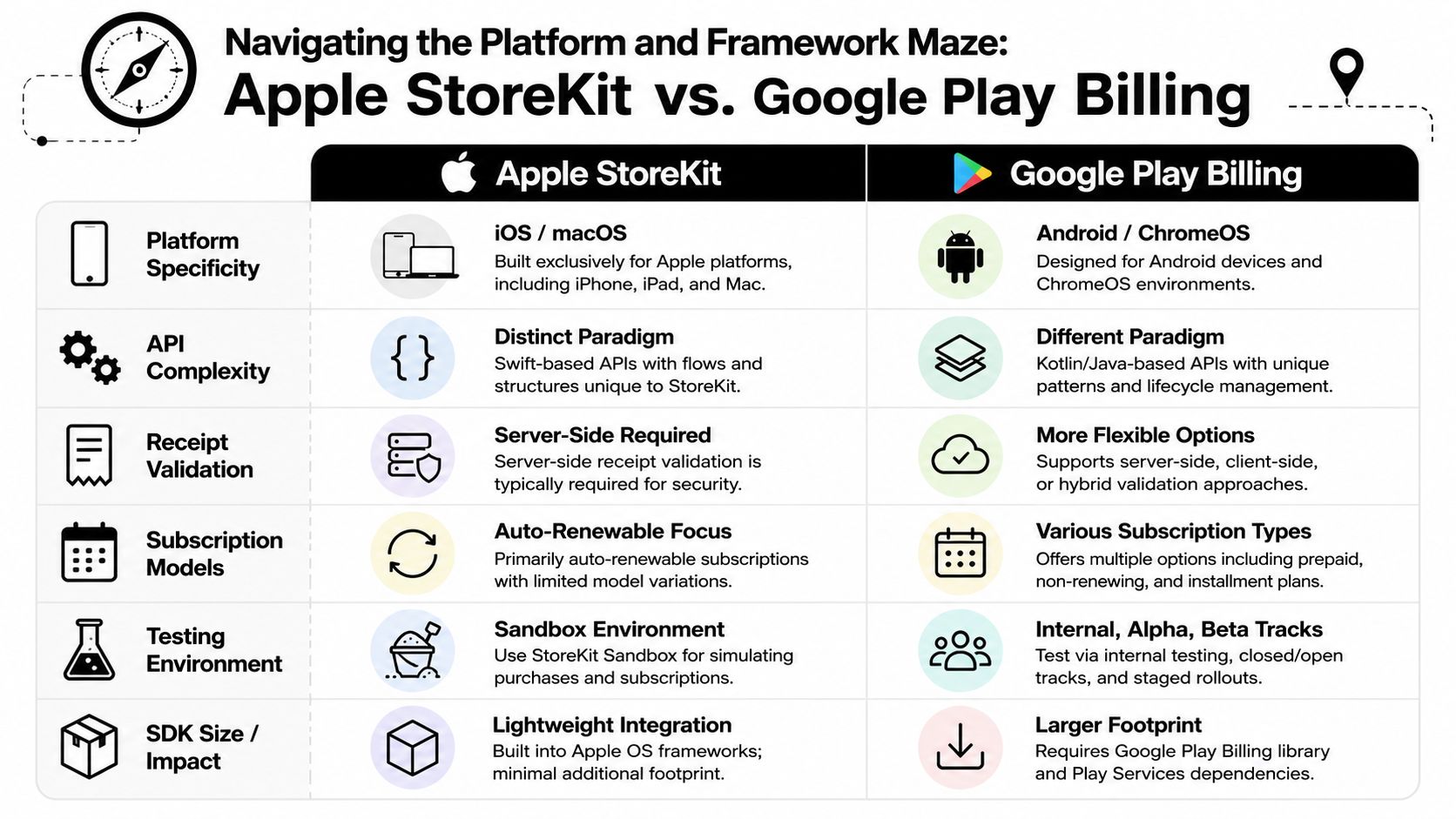
The pain starts when teams assume iOS and Android billing are structurally similar. They aren't. They solve the same commercial problem through different models, different console setup, and different runtime behavior.
Native billing models diverge early
On iOS, StoreKit requires you to configure purchases in App Store Connect before the app can retrieve product information. On Android, Google Play Billing also requires pre-configuration in the Play Console, but subscriptions follow a more complex nested model of Subscription, Base Plan, and Offer, as explained in Adapty's Android subscription tutorial. That means teams aren't managing one shared billing concept across stores. They're managing two different billing models.
That difference leaks into engineering in several ways.
On iOS, product configuration tends to feel more centralized and constrained. On Android, promotional logic and subscription structure often become more explicit and more operational. Neither model is “better.” They just create different failure modes.
Android has more moving parts than many teams expect
Since Google Play Billing Library 5, an Android subscription isn't just a product. It's a hierarchy. The subscription defines the core commercial item. The base plan defines the billing period and price model. The offer defines trial or intro conditions and returns an offer token at runtime.
That creates a few practical consequences:
- Catalog planning matters earlier because pricing and promotional structure need to be designed before billing code is complete.
- Runtime logic expands because apps may need to choose the right offer token for a user's eligibility path.
- Testing gets harder because errors often come from console setup rather than app code.
Google also requires products to be defined in the Play Developer Console before the app can query details through billing APIs. If the product isn't configured there, client-side discovery fails. That's good for consistency and fraud resistance, but it means configuration mistakes look like integration bugs until someone checks the console setup carefully.
iOS has its own strict rules
StoreKit has a similar dependency on remote setup. If the product isn't configured in App Store Connect, your code won't retrieve metadata. Apple also requires StoreKit for making digital content and subscriptions available inside the app. Third-party SDKs don't bypass that rule. They implement StoreKit underneath.
That distinction matters because cross-platform teams sometimes believe a wrapper changes the compliance rules. It doesn't. According to the Adobe community reference in the verified dataset, ignoring Apple's StoreKit requirement leads to rejection, and 12% of rejections in 2025 were tied to IAP violations, as cited in the Adobe community discussion.
If a vendor says it “avoids” StoreKit for native iOS digital purchases, treat that as a compliance question, not a feature claim.
Cross-platform frameworks multiply the abstraction risk
React Native, Flutter, Unity, and Unreal teams all face the same underlying issue. The framework makes UI and app logic feel shared, while billing remains store-native. That mismatch is where bugs creep in.
For example:
| Framework | Typical billing challenge |
|---|---|
| React Native | Shared JavaScript layer masks store-specific entitlement edge cases |
| Flutter | Plugin abstraction can hide subscription state differences until production |
| Unity | Game economies combine consumables, unlocks, and subscriptions in one flow |
| Unreal | Billing often sits outside the team's strongest tooling path, which slows debugging |
The more platforms you support, the more valuable a unified entitlement and analytics layer becomes. Otherwise your team is maintaining different state assumptions behind one product surface. That's how monetization code turns into a permanent exception list.
Common Integration Patterns and Hidden Pitfalls
Teams usually choose one of three approaches. They build directly on StoreKit and Google Play Billing. They buy a dedicated platform. Or they wrap native billing themselves and keep the abstraction in-house. All three can work. All three can go wrong.
Build, buy, or wrap
Building directly on native APIs gives you maximum control. It also gives you full responsibility for validation, restore flows, server notifications, entitlement storage, and platform changes. This route makes sense when billing is a strategic core competency and the team is ready to own the maintenance.
Buying a platform reduces setup time and usually improves reliability faster. The trade-off is dependency. You need to understand pricing, data access, export options, migration risk, and whether the vendor becomes your system of record.
A custom wrapper sits in the middle. It can simplify app code, especially for React Native, Flutter, Unity, or Unreal teams. But wrappers have a bad habit of looking simple while hiding unresolved platform mismatch underneath.
The Android non-consumable trap
One of the most common examples is Android “non-consumables.” Google Play doesn't provide a native non-consumable flag in the same way many teams expect from an iOS mental model. As discussed in RevenueCat's community thread on non-consumable behavior on Google Play, many cross-platform IAP SDKs auto-consume Android IAPs, which means developers have to manually prevent re-offers if they want durable access logic.
That can create ugly outcomes:
- Users can see a permanent purchase for sale again unless your app blocks re-offer correctly.
- Support tickets rise because users think they've been charged twice for the same content.
- Ported iOS logic fails on Android because the product model was never adapted to Play's behavior.
If you sell things like ad removal, level packs, character access, or premium feature bundles, this is not an edge case. It's core product logic.
Don't trust the label “non-consumable” unless you've tested repurchase behavior on Android end to end.
What works in production
The teams that avoid pain usually do a few things early:
- Separate store products from app entitlements so commercial catalog changes don't break access control.
- Test repurchase, refund, restore, and reinstall flows before launch, not after support tickets appear.
- Keep a server-side source of truth for high-value access decisions.
- Document platform-specific exceptions instead of pretending one abstraction removed them.
What doesn't work is assuming the SDK solved the product model for you. The SDK can reduce complexity. It can't remove the need for clear entitlement design.
How to Choose the Right In-App Purchase SDK
Most comparison pages focus on feature checklists. That's the wrong starting point. The better question is whether the SDK improves your total cost of ownership over the next few years.
A billing stack can look cheap in month one and expensive by year two if it adds revenue-share drag, blocks data portability, or forces your growth team into another vendor just to run paywalls and experiments.
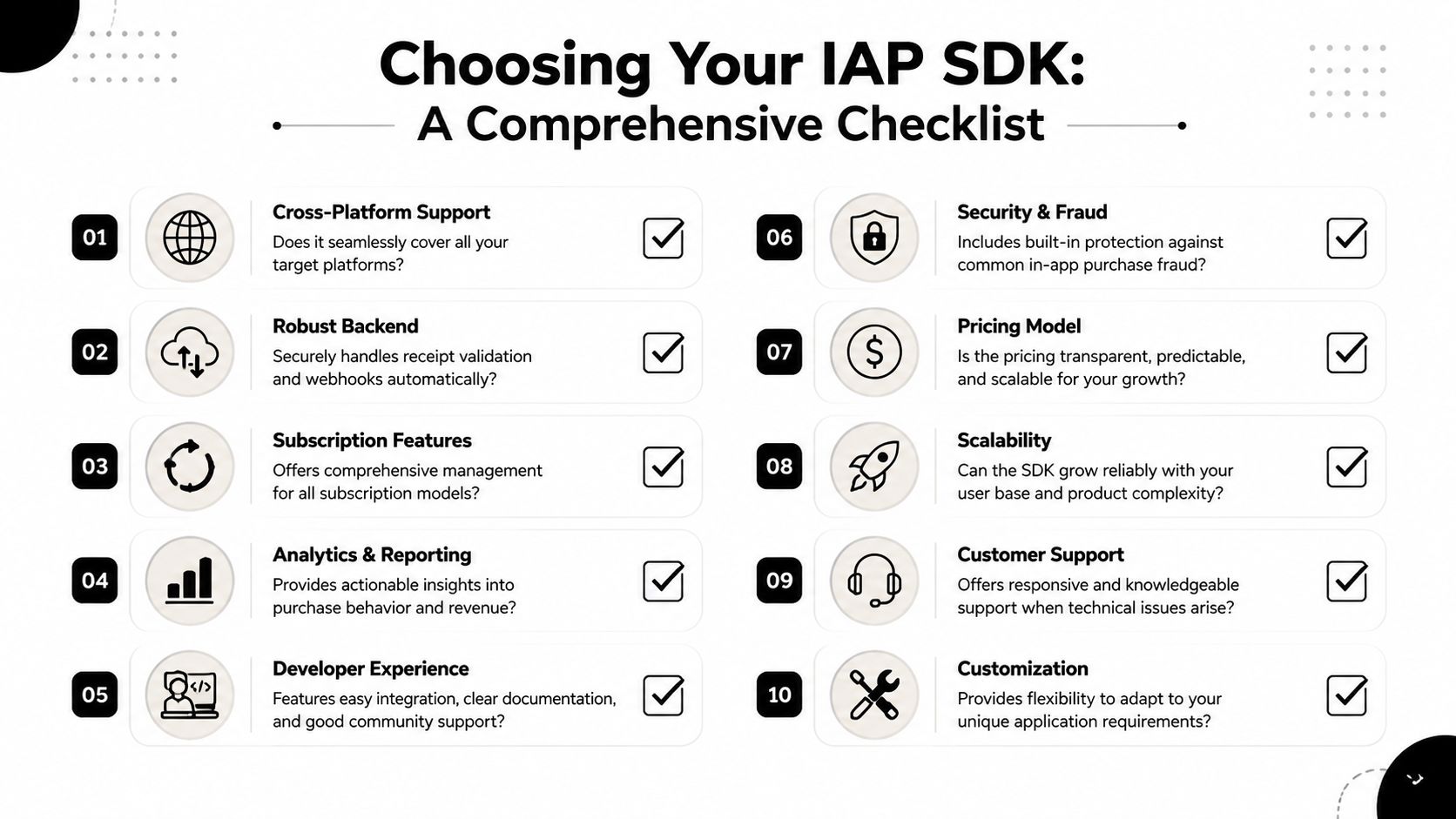
Start with the checklist below.
Evaluate the cost model, not just the invoice
Some products charge a SaaS fee. Others attach themselves to monetization volume. That may be acceptable if the platform replaces significant internal work and gives your team an advantage. But it changes the economics of scale.
A few questions cut through the noise:
- Does the vendor charge on revenue or on software usage?
- Will analytics and entitlement data be portable if you leave?
- Can you use the product with your existing billing provider, or must you migrate everything first?
- Will product, growth, and engineering need separate tools anyway?
That last question is where many teams overspend. They adopt one billing platform, one paywall tool, one experimentation system, and one analytics workspace, then spend months stitching them together. The invoice isn't the only cost. The integration surface is a cost too.
Provider-agnostic architecture matters more now
A recent U.S. court decision confirmed that Apple must allow developers to direct users to external links for alternative payment methods, according to Payrails' analysis of agnostic in-app payments. That makes provider-agnostic architecture much more important.
Here's the practical implication. If your SDK assumes StoreKit is the only monetization path worth designing for, you may end up constrained exactly when payment flexibility becomes strategically useful. Teams don't need to abandon native store billing. They do need infrastructure that can adapt if product, legal, or regional strategy changes.
A good modern stack should support coexistence between:
- Native store billing
- External payment routing where permitted
- Shared entitlements across billing sources
- Consistent analytics across purchase channels
This is also where provider-agnostic platforms stand out. Nuxie, for example, positions itself as an AI-native in-app experience, experimentation, analytics, billing, entitlement, and growth platform for mobile apps and games. It isn't limited to paywalls, though paywalls are one important use case. It can work with existing tools, and it doesn't charge a revenue-share fee for billing and entitlement data. That matters if you want to preserve flexibility across iOS, Android, React Native, Flutter, Unity, and Unreal without hardwiring your business to one monetization vendor.
To see the decision criteria in action, this overview is useful:
Use a practical scorecard
A fair evaluation should include more than SDK syntax.
| Decision area | What to check |
|---|---|
| Architecture | Can it coexist with your current stack or only replace it? |
| Entitlements | Is access modeled cleanly across stores and user identities? |
| Growth tooling | Can teams ship paywalls, offers, and experiments without app releases? |
| Data ownership | Can you export, inspect, and reconcile billing events cleanly? |
| Framework coverage | Does it support your actual stack, not just native iOS and Android? |
The best choice usually isn't the platform with the biggest feature page. It's the one that lets your team move fast without locking your revenue engine into someone else's roadmap.
Advanced Scenarios Migration and Coexistence
Developers rarely start from zero. They already have StoreKit code, a Google Play wrapper, RevenueCat, a custom entitlement service, or some mix of all four. That changes the decision. You're not just choosing a tool. You're choosing how much change the business can absorb.
Coexistence is often the smarter first step
A lot of teams assume they need a full cutover. Usually they don't.
If your current billing stack is stable enough, you can add a provider-agnostic layer above it for experiences, experiments, analytics, and broader growth operations. That's useful for teams that already rely on RevenueCat or homegrown purchase services but want faster paywall iteration, segmentation, retention offers, or game liveops flows without rebuilding billing first.
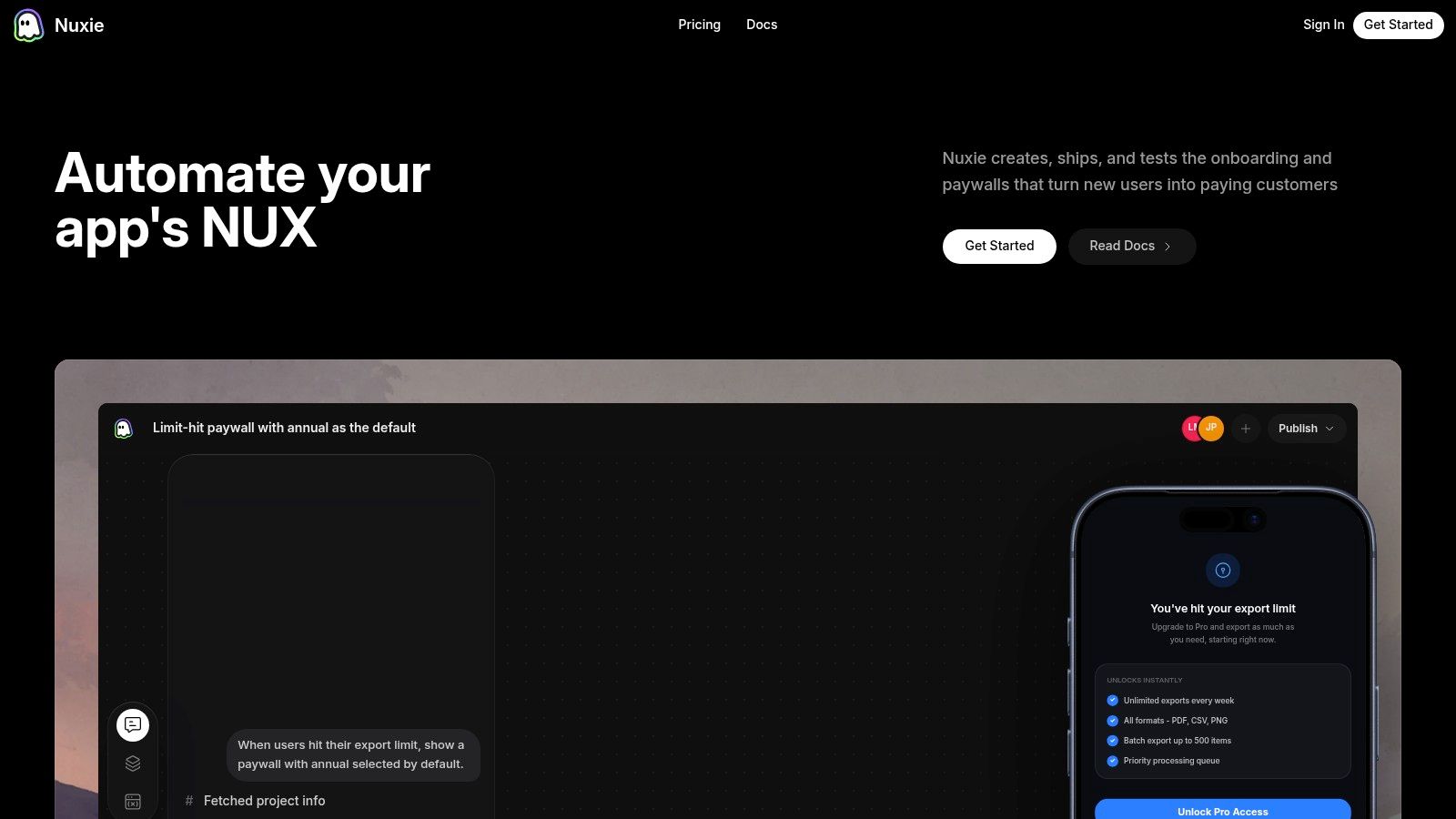
Nuxie fits well in this model because it can sit alongside existing providers rather than forcing a rip-and-replace migration. That's especially useful when a team wants AI-native in-app experiences, experimentation, analytics, billing visibility, and entitlement-aware journeys across iOS, Android, React Native, Flutter, Unity, and Unreal.
If subscription operations are your immediate concern, Nuxie's guide to app subscription management is a practical companion to migration planning.
Migration still makes sense in some cases
Sometimes the current stack itself is the bottleneck. Typical signs include fragmented analytics, expensive revenue-share economics, entitlement logic spread across services, and product teams blocked from running experiments without engineering.
In that case, migration is less about replacing an SDK and more about collapsing duplicated systems.
A sensible migration path usually looks like this:
- Mirror entitlements first so your new layer can observe state before it becomes authoritative.
- Move analytics and event reconciliation next because that exposes data mismatches quickly.
- Cut over purchase surfaces in stages rather than moving every product at once.
- Keep rollback paths clear for support and finance teams.
Don't misunderstand Apple compliance during migration
Cross-platform teams often get tripped up here. Third-party SDKs do not exempt you from Apple's IAP rules. They still rely on StoreKit underneath for native digital purchases on iOS. As noted earlier from the verified Adobe-linked reference, 12% of app rejections in 2025 were due to IAP violations. That's not a billing implementation detail. It's a release risk.
The safe migration question isn't “Can this SDK bypass StoreKit?” It's “How does this SDK implement StoreKit while keeping our architecture sane?”
That's why coexistence can be so valuable. It lets teams modernize growth, entitlement visibility, and experimentation without pretending platform policy disappeared.
Your IAP SDK Is Your Growth Engine
By 2026, an in app purchase SDK isn't just a commerce adapter. It's the layer where monetization, access control, analytics, experimentation, and product velocity meet.
If your team treats billing as a small technical integration, you'll keep paying for that decision in slower releases, harder debugging, and unreliable user access. If you treat it as architecture, you can build a system that supports subscriptions, consumables, entitlements, live offers, paywalls, restore flows, and cross-platform growth work without turning every change into a release project.
The strongest setups share a few traits. They separate products from entitlements. They respect the platform differences between StoreKit and Google Play Billing instead of hiding them badly. They give growth teams remote control over in-app experiences. And they preserve flexibility so the business can adapt as billing rules and payment options change.
That's why the long-term decision isn't just “Which SDK can process a purchase?” It's “Which platform helps us run a mobile business without trapping our team in monetization debt?”
Nuxie is built for teams that want that flexibility. It combines AI-native in-app experiences, experimentation, analytics, billing, entitlement sync, and growth automation for mobile apps and games across iOS, Android, React Native, Flutter, Unity, and Unreal. You can use it to ship paywalls, onboarding flows, retention offers, surveys, feature announcements, and liveops moments without waiting on app releases. It can work alongside your current billing stack or replace parts of it, and it does so under its published pricing. Explore Nuxie if you want a provider-agnostic path that gives product, growth, and engineering one system to build on.