
Master Growth Hacking for Mobile Apps in 2026
Practical guide to growth hacking for mobile apps. Master frameworks, ASO, monetization, and dev-friendly implementation for iOS & Android.
Most advice on growth hacking for mobile apps starts in the wrong place. It starts with channels, ad spend, virality, or app store tricks. That's backwards.
A mobile app rarely has an acquisition problem first. It usually has an activation and retention problem that paid traffic temporarily hides. Teams pour more users into the top of the funnel, then wonder why CAC rises, reviews stall, and revenue lags. The bucket leaks before growth compounds.
That's why the strongest growth teams don't chase isolated hacks. They build a system. Product, engineering, design, monetization, analytics, and lifecycle messaging all operate against the same user journey, with the same instrumentation and the same decision rules. That's what makes growth repeatable.
Beyond the Buzzword What Is Mobile Growth Hacking
Growth hacking for mobile apps isn't a bag of tricks. It's a disciplined way to improve the full user lifecycle through fast experiments, better instrumentation, and tighter product feedback loops.
That definition matters because the market is too large and too crowded for static plans. The mobile application market is projected to reach $885.3 billion by 2033 with a 15.5% CAGR, and users spent 5.3 trillion hours in mobile apps in 2025 alone, which is why static marketing breaks down in saturated categories according to Grand View Research's mobile application market outlook.
The common mistake is treating growth like a top-of-funnel marketing function. In practice, the most impactful work usually sits inside the product. Onboarding. Empty states. First-session guidance. Feature education. Pricing presentation. Trial conversion. Win-back logic. Review prompts. Those aren't side details. They are the growth surface area.
Growth is a system, not a campaign
A useful definition for technical teams is simple: growth hacking is the continuous process of identifying friction in the user journey, shipping targeted experiments, and measuring whether user value and business outcomes improve.
That means a growth roadmap shouldn't read like a list of channels. It should read like a diagnosis:
- Acquisition quality: Are the users you attract aligned with the app's core value?
- Activation speed: Do users reach value quickly, or do they hit setup friction?
- Retention loops: Does the product give people a reason to return?
- Monetization timing: Are offers shown when intent is high, or when context is poor?
- Feedback capture: Are ratings, surveys, and behavioral signals closing the loop?
One of the most practical shifts is moving from generic cohorts to behavior-based cohorts. Teams that segment by intent, progress, and friction points make better decisions than teams that segment only by source or geography. The mechanics are covered well in this guide to behavioral segmentation for mobile products.
Growth work starts when you stop asking “How do we get more installs?” and start asking “Where does user value break down?”
What doesn't work
Three patterns waste time:
- Channel-first planning: Buying traffic before fixing first-session drop-off.
- One-time optimization pushes: Redesigning onboarding once, then leaving it untouched for quarters.
- Vanity KPI reporting: Celebrating installs while active use, subscriptions, or purchase frequency stall.
The teams that win treat growth as product infrastructure. That's less glamorous than a hack. It's also much more durable.
The Strategic Blueprints Growth Frameworks and North Stars
Without a framework, teams run disconnected experiments and call it growth. One sprint tweaks onboarding. Another changes paywall copy. Marketing tests a store listing. Engineering adds a referral mechanic. Each task looks sensible in isolation, but the system never gets clearer.
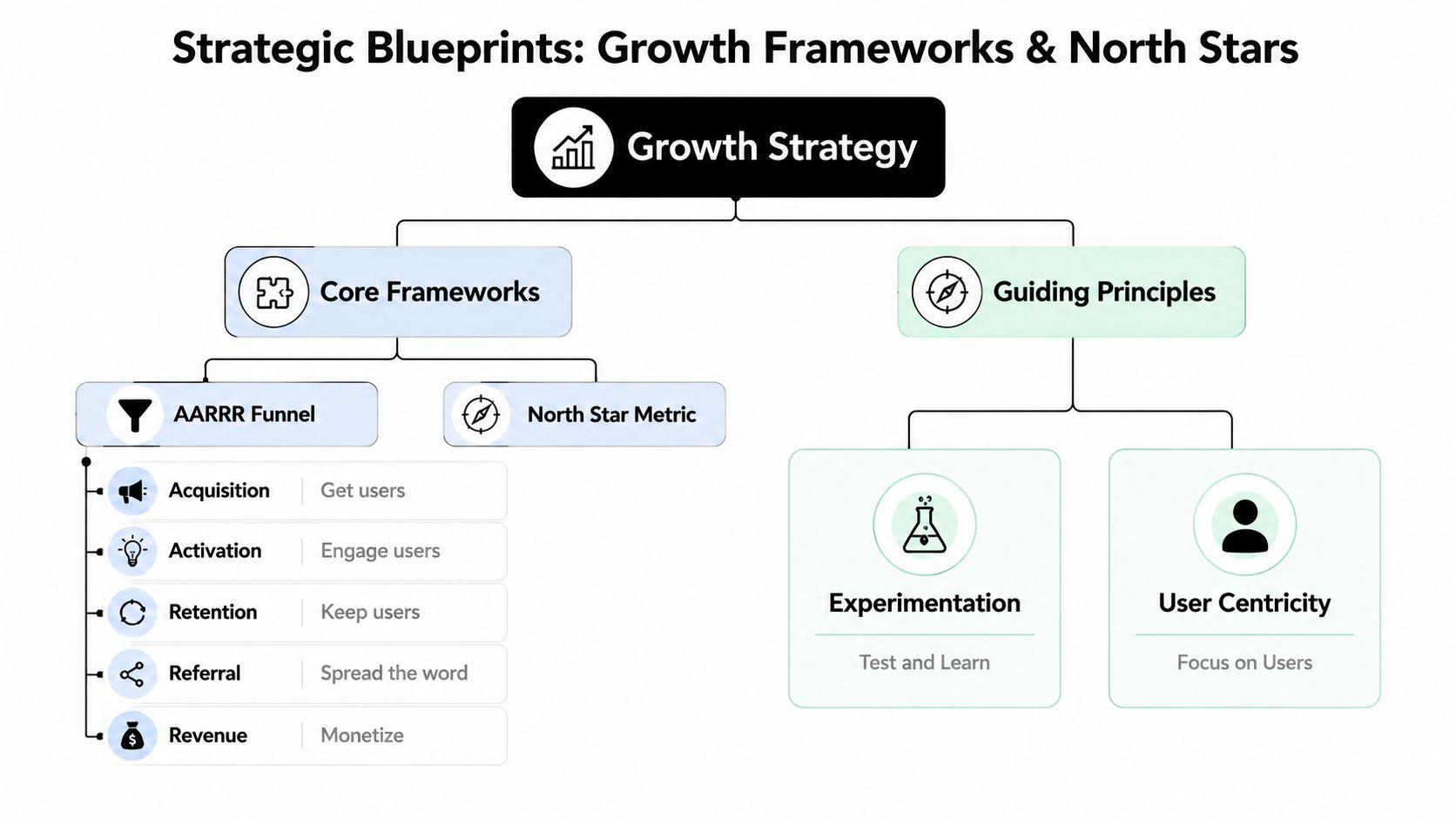
Two models fix that. AARRR gives you a diagnostic map of the user journey. The North Star Metric keeps every team aligned on what “better” means.
Use AARRR as a debugging framework
Pirate Metrics is often taught as a funnel acronym. That undersells it. For product and engineering teams, it's closer to a debugging framework for user progress.
- Acquisition asks whether the right users arrive.
- Activation asks whether they experience value.
- Retention asks whether the product becomes a habit or repeated utility.
- Referral asks whether satisfied users pull in similar users.
- Revenue asks whether value capture matches value delivery.
The sequencing matters. If activation is weak, retention usually looks worse than it really is. If retention is weak, referral becomes noisy because users haven't received enough value to advocate. If monetization appears weak, the issue may be timing, not pricing.
That's why retention loops deserve more attention than they currently receive. Most apps lose the majority of their users within 30 days, and that first month is the primary failure point for 75% of new applications, as noted in this mobile app statistics roundup. That's not a reason to panic. It's a reason to stop treating growth as mostly acquisition.
Pick a North Star that reflects product value
A North Star Metric isn't a vanity number. It's the clearest expression of recurring user value in your product.
For a meditation app, it may be completed sessions. For a team productivity app, it may be weekly collaborative actions. For a game, it may be meaningful play sessions tied to progression. For a subscription utility app, it may be retained subscribers who complete the core task repeatedly.
Practical rule: If your North Star can rise while user value falls, it's the wrong metric.
A strong North Star does three things:
- Connects usage to value. Downloads don't do that. Neither do impressions.
- Creates shared priorities. Product, marketing, and monetization can all influence it.
- Forces trade-off conversations. A short-term conversion boost that harms retained usage should lose.
A simple planning model
A practical planning stack looks like this:
| Layer | Question | Example |
|---|---|---|
| North Star | What long-term value matters most? | Weekly completed core actions |
| AARRR stage | Where is the bottleneck? | Activation |
| Hypothesis area | What friction might explain it? | Signup too early, unclear first task |
| Experiment | What change will test it? | Guest mode plus guided first outcome |
That structure keeps growth work from collapsing into random acts of optimization.
The Growth Engine Product-Led Tactics and Channels
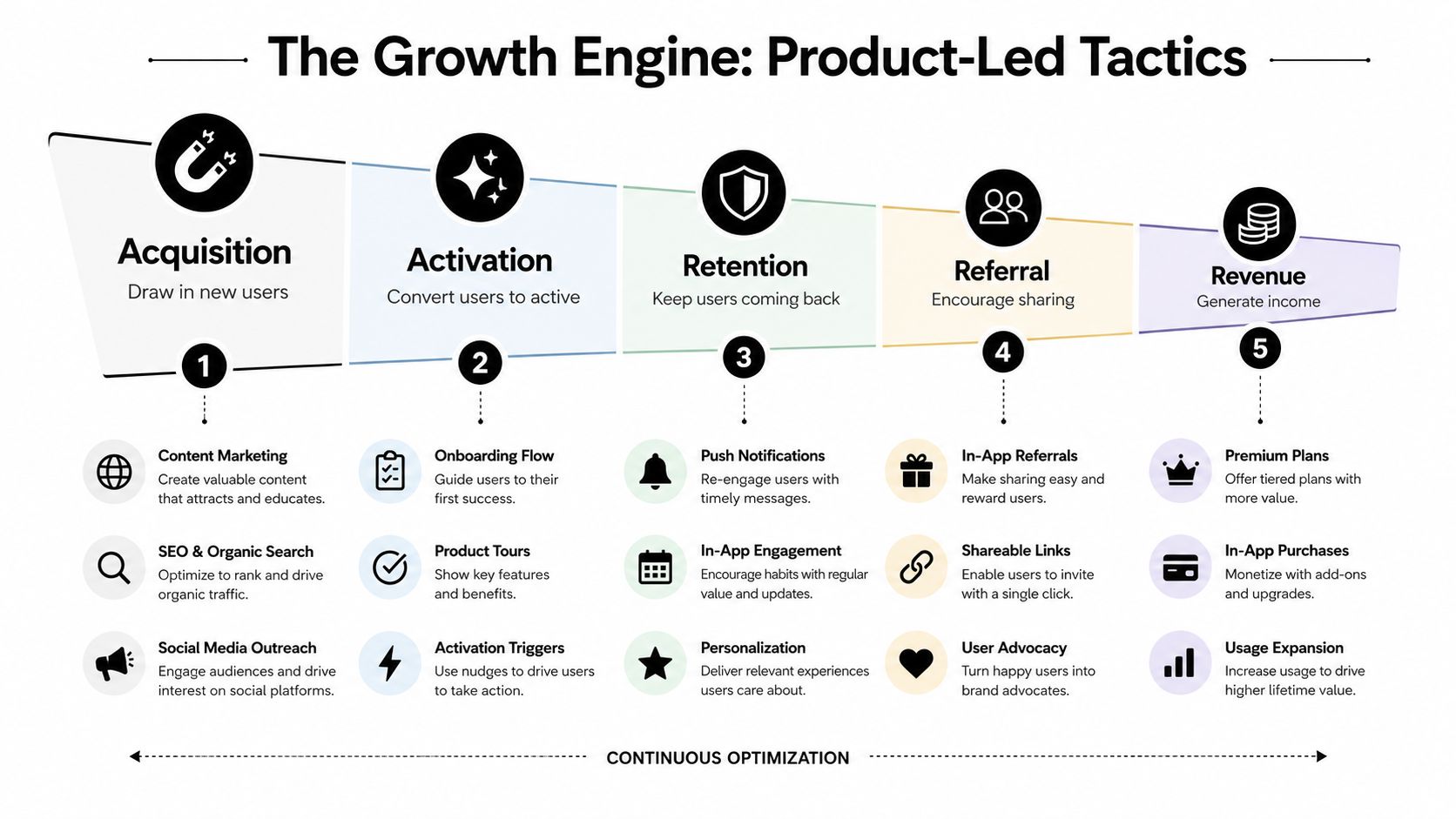
When teams talk about growth hacking for mobile apps, they often list tactics without connecting them to the user journey. That creates two bad outcomes. First, the team implements too many things at once. Second, nobody knows which part of the funnel improved.
A better approach is to treat acquisition, activation, retention, referral, and revenue as connected product surfaces. Each stage has its own job. Each job needs different tactics.
Acquisition that improves downstream quality
Qualified acquisition starts before the first install. App Store Optimization should describe the actual product promise, not just chase broad keywords. Creative, screenshots, preview video, and short description need to pre-frame the experience users are about to get.
If your app solves one urgent job, say that clearly. If it serves multiple use cases, segment your listing assets by the audience you care most about. A broad message may increase curiosity installs while lowering activation because the product experience doesn't match the user's expectation.
For games, the same rule applies to ad creatives and store pages. Don't promote spectacle if the retained experience is depth, economy design, or social progression. Misaligned acquisition traffic creates false negatives later in the funnel.
Activation is where the growth engine either works or stalls
This is usually the most impactful part of the system. Apps that optimize the activation funnel see 20% to 40% higher long-term retention than apps that prioritize raw download volume, and reducing time-to-value from 30 seconds to under 10 seconds correlates with a 15% to 25% increase in Day-1 retention, according to Business of Apps on mobile app growth strategy.
That should change how you design onboarding.
A strong first session does four things:
- Removes avoidable setup friction: Delay account creation when possible. Let users start as a guest if identity isn't immediately required.
- Pre-seeds context: Use templates, sample data, or default states so the product doesn't open empty.
- Guides one meaningful action: Don't explain ten features. Get one success.
- Uses progressive disclosure: Show complexity after the first value moment, not before it.
The technical implementation matters as much as the UX. If your onboarding changes require full app releases, the learning cycle gets too slow. Remote-configured flows, versioned screens, and event-based branching make it much easier to test onboarding variants, shorten time-to-value, and adapt by segment. There's a useful breakdown of mobile onboarding patterns in this guide to mobile app onboarding.
Teams often overdesign onboarding copy and underinvest in onboarding logic. Logic matters more.
Retention depends on return triggers and product memory
Retention work should answer a blunt question: why should this user come back tomorrow?
For productivity and utility apps, the answer is usually saved state, recurring tasks, streaks, reminders, or collaborative dependency. For media apps, it's fresh content and personalized resurfacing. For games, it's progression, rewards, live events, and social pressure.
Retention surfaces usually include:
- In-app messaging for feature education or contextual nudges
- Push notifications tied to behavior, dormancy, or unfinished actions
- LiveOps moments for games, including limited-time events and economy prompts
- Review workflows triggered after a positive milestone, not randomly
A common mistake is overusing broad broadcasts. If everyone gets the same message, many recipients get irrelevant noise.
Referral works when sharing is part of the product
Referral loops don't begin with a program page. They begin with a moment of user satisfaction worth sharing.
In consumer apps, that may be a completed outcome, a personalized result, or a collaborative invitation. In games, it may be clan activity, gifting, or achievement sharing. In creator products, it may be visible output with attribution.
Build sharing into the UI. Don't assume users will leave the app, find your landing page, and send a manual invite.
Revenue should feel like the next logical step
Monetization is strongest when it follows intent. For subscription apps, paywalls work best when the product has already framed the value gap between free and paid. For games, IAP prompts work best when tied to progression, scarcity, or event participation. For media and utility apps, entitlement messaging has to be clear or users won't understand what they're buying.
This is why paywalls matter, but they're only one part of the engine. Revenue also depends on billing reliability, entitlement state, pricing presentation, win-back offers, cancellation interception, and post-purchase reinforcement.
Designing and Measuring Growth Experiments
Many teams say they run experiments when they're really shipping changes and checking whether a dashboard moved. That's not experimentation. It's post-rationalization.
A useful growth experiment has a clear cause-and-effect claim, a defined audience, a stable measurement window, and a decision rule before launch. If any of that is fuzzy, the result will be hard to trust.
Write hypotheses that engineers can implement
The cleanest format is If, then, because.
Examples:
- If we let first-time users skip account creation, then onboarding completion should improve, because the current signup wall appears before the user sees value.
- If we show the annual subscription option only after the user completes a setup milestone, then purchase intent should improve, because the pricing context will be clearer.
- If we trigger a review prompt after a successful action rather than after session count, then rating quality should improve, because the ask will follow a positive product moment.
This format forces specificity. It also gives product, design, and engineering a shared interpretation of what's being tested.
Match KPIs to the funnel stage
Not every experiment should be judged by revenue immediately. Early-funnel changes often need proximal metrics.
| Funnel Stage | Growth Goal | Primary KPI | Secondary KPI |
|---|---|---|---|
| Acquisition | Improve traffic quality | Install-to-activation rate | Store listing conversion quality by source |
| Activation | Help users reach first value | Onboarding completion | Time-to-value |
| Retention | Increase repeat use | Return usage after first key action | Message interaction or feature re-entry |
| Referral | Increase user-driven sharing | Invite starts or share completions | Referred user activation quality |
| Revenue | Improve monetization flow | Purchase or trial start rate | Entitlement activation and cancellation intent |
Use one primary KPI per experiment. Keep secondary KPIs as guardrails or supporting signals.
For measurement discipline, build a shared event taxonomy before you launch tests. Teams that name events inconsistently across iOS, Android, React Native, Flutter, Unity, and Unreal end up debating definitions instead of learning from results. A provider-agnostic event model and a unified workspace for journey analytics make this much easier. A good starting point is a clear app analytics implementation model.
Don't test copy, timing, layout, audience, and pricing all at once unless you're prepared to learn almost nothing about why the result changed.
Keep experiments operationally simple
A few rules save a lot of pain:
- Test one core variable at a time when you're diagnosing a bottleneck.
- Freeze instrumentation before launch so the team doesn't alter success logic mid-test.
- Segment by lifecycle state because new users and retained users behave differently.
- Document rollout conditions including app version support and fallback behavior.
- Record implementation caveats such as notification permissions, offline state, or billing sync timing.
The best experimentation teams don't just produce wins. They produce decisions the team trusts.
The Developer Toolkit for Growth Implementation
Growth ideas often die in the handoff between product intent and runtime reality. The mockup looks straightforward. The app architecture isn't. Now the team needs native screens on iOS and Android, parity in React Native and Flutter, custom hooks in Unity, and some exception path in Unreal. Two releases later, the experiment window has passed.
That's why growth implementation needs its own technical standard.
What the stack must support
A modern growth stack should support the following without turning every experiment into a release train problem:
- Cross-platform delivery: iOS and Android are the baseline, but many teams also need React Native, Flutter, Unity, and Unreal support.
- Remote publishing: Teams need to ship onboarding screens, feature announcements, offers, surveys, and event-driven experiences without waiting on full binary releases.
- Behavioral targeting: Personalization only works if the runtime can evaluate audience logic using user traits and in-app events.
- Experiment controls: Variant assignment, holdouts, and analytics wiring should be part of the system, not bolted on later.
- Offline-aware rendering: In-app experiences shouldn't fail just because the user hits a weak connection.
- Billing and entitlement awareness: Monetization screens need current subscription and purchase state.
Many teams often stitch together too many vendors. One tool manages analytics. Another handles paywalls. Another handles lifecycle messages. Another stores entitlement state. Another runs remote config. It can work, but the edge cases pile up quickly.
Cross-platform trade-offs are real
Framework choice changes how fast you can iterate on growth surfaces.
Flutter paints every pixel with its own rendering engine and aims for consistent UI behavior across platforms, including a stated 60fps frame rate according to this Flutter rendering overview. That consistency helps when you need the same onboarding or offer experience across iOS and Android.
Cross-platform stacks can also reduce development effort by about 50% compared with building separate native apps, as described in this cross-platform development discussion. That's relevant for growth work because more shared code usually means faster experiment turnaround.
Still, cross-platform isn't automatically the right answer for every app:
- Native is still the better fit when you need top-end performance, deep device integration, or graphics-heavy rendering, which Appnality's native vs cross-platform mobile game development comparison notes clearly.
- Unity is often the practical default for mobile game development, though its UI and rendering model doesn't behave like native app UI, as discussed in Unity's community thread on mimicking native apps.
For growth teams, the takeaway is simple. Your tooling can't assume a single app architecture.
Segmentation, messaging, and billing need one operational model
Behavioral targeting isn't optional anymore. Personalized push notifications based on user behavior can generate a 3x to 5x higher click-through rate than generic broadcasts, according to Ksoft Technologies on growth hacking strategies for mobile apps. That benefit disappears if your audience data is stale or your triggers are loosely defined.
A practical implementation model looks like this:
| Capability | What teams need in practice |
|---|---|
| Audience logic | Real-time segments based on events, properties, lifecycle state, and purchase state |
| Experience builder | A collaborative editor for onboarding, offers, announcements, surveys, and game LiveOps moments |
| Analytics workspace | Funnel views, campaign analytics, and experiment reads without exporting data across tools |
| Billing layer | Subscription sync, purchase data, and entitlement resolution that can coexist with existing providers |
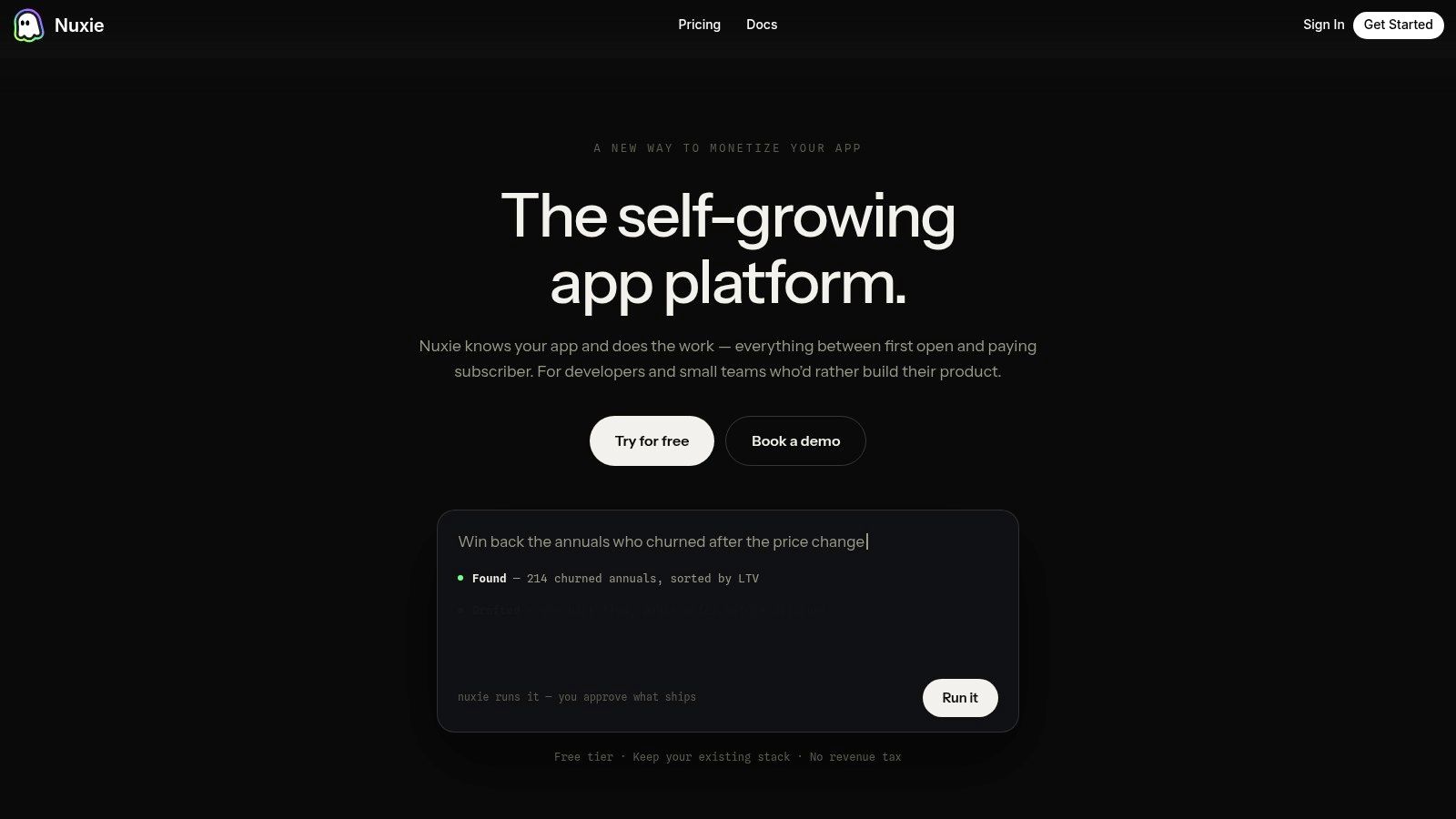
A short product walkthrough helps make the implementation model concrete:
The best platforms don't force a rip-and-replace decision. They work with the stack you already have. That includes Firebase for analytics patterns, existing billing providers, StoreKit, Google Play Billing, or entitlement systems you want to preserve. Provider-agnostic architecture matters because mobile teams rarely rebuild their growth stack from zero.
One detail deserves more scrutiny than it gets: billing data access. Some products sit on top of monetization but take a revenue share. That can make sense for some teams. It's also a structural cost you should evaluate carefully, especially if you want billing, subscription sync, and entitlement data without adding a percentage fee on top.
Sample Growth Playbooks for Common Scenarios
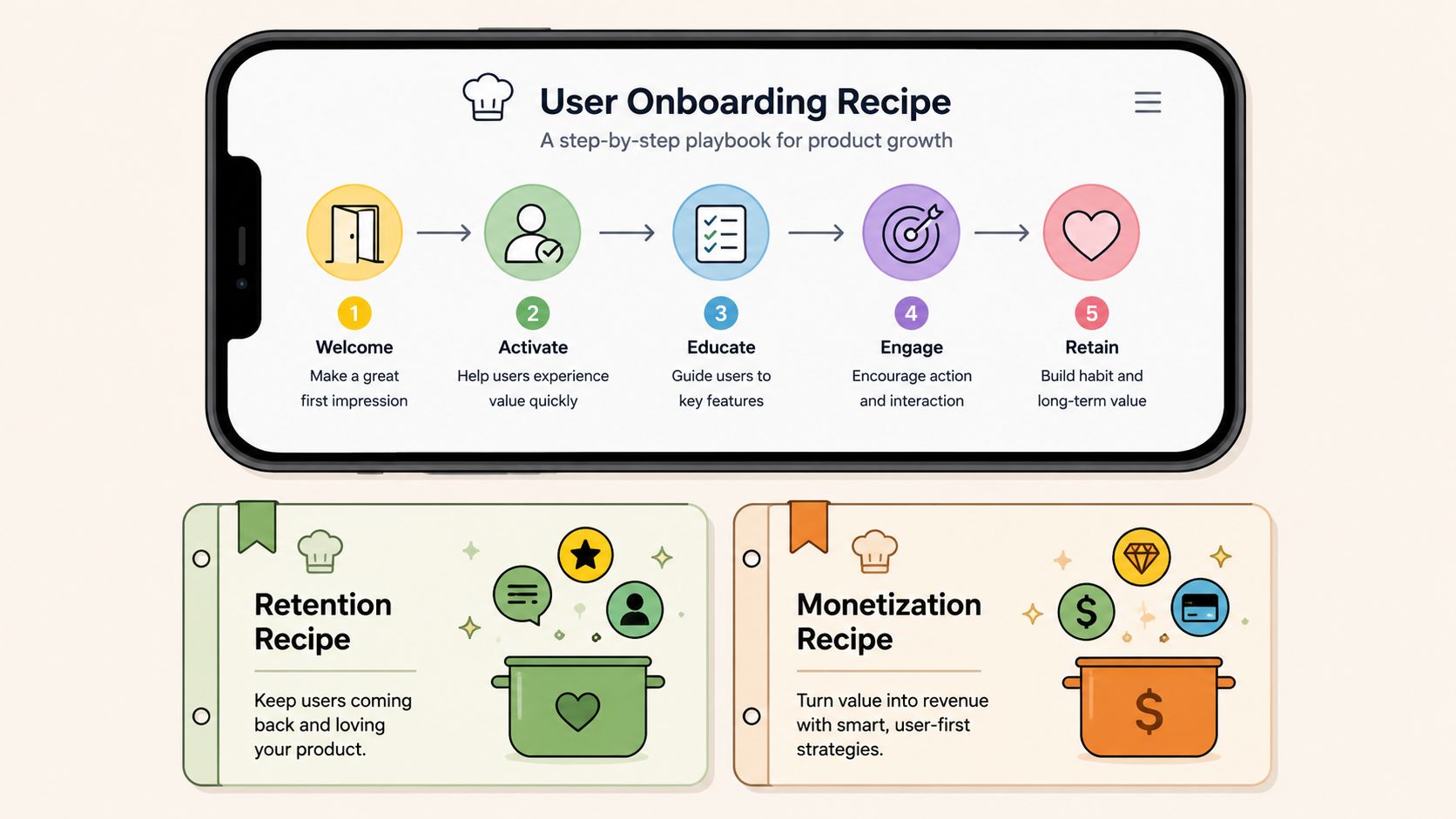
Theory is useful, but teams usually need a starting recipe. The best playbooks are small enough to ship quickly and specific enough to teach the team something even if the result is mixed.
Playbook one onboarding flow for better early retention
Start with a user journey map of the first session. Mark every step that delays first value. Then create one lighter path that removes at least one nonessential action.
A common version looks like this:
- Let users start without forced account creation.
- Pre-fill the first screen with sample data or a starter template.
- Highlight one primary action only.
- Delay feature tours until after the first successful outcome.
- Trigger a soft reminder if the user leaves before completing the key action.
Measure onboarding completion, first key action completion, and repeat usage from users who reached that milestone. If the new path improves completion but lowers retained usage, you may have removed too much qualification and attracted the wrong behavior.
Playbook two paywall test for trial intent
This test works best after the product has already demonstrated value. Don't place it at cold open unless your app's proposition is immediately obvious.
A practical experiment compares two things, not six. For example, test timing before testing price framing. Or test annual-first presentation before testing copy length. Keep entitlement handling, restore flows, and billing instrumentation stable so the signal stays clean.
Use this checklist:
- Eligibility logic: Show the paywall only to users who reached the target action.
- Audience split: Separate new users from returning users.
- Experience consistency: Keep plan details, legal copy, and restore purchase behavior aligned across variants.
- Guardrails: Watch cancellation intent, restore errors, and post-purchase confusion.
A paywall is rarely underperforming in isolation. It often reflects weak value framing upstream.
Playbook three LiveOps screen for a game economy push
For games, growth often happens inside content cadence and economy design rather than classic marketing surfaces. A time-bound LiveOps screen can support progression, event participation, or IAP interest when it appears in the right gameplay context.
A practical flow is:
- Detect a player milestone or event entry state.
- Show a limited-time event screen with clear rewards.
- Include one frictionless path into gameplay and one store-linked economy option.
- Follow up with reminder messaging only for players who engaged but didn't complete.
This works better than broad store promotion because the offer is connected to an active player goal. For Unity and Unreal teams, the key technical detail is making sure UI events, purchase state, and reward claims are synchronized cleanly across runtime and backend services.
Conclusion Building a Sustainable Growth Culture
Sustainable growth doesn't come from finding one clever tactic. It comes from building a team habit.
The habit is straightforward. Diagnose the bottleneck. Form a hypothesis. Ship the smallest credible experiment. Measure the result with discipline. Keep what improves user value. Remove what adds noise. Repeat until that cycle becomes normal product work, not a side project.
That operating model changes how teams prioritize. Instead of arguing about whether acquisition, onboarding, messaging, paywalls, or LiveOps matters most, they learn where the current constraint is and work there. Instead of treating analytics as reporting, they use it for decisions. Instead of shipping static experiences, they build adaptable systems.
Growth hacking for mobile apps works when it stops being a slogan and starts becoming infrastructure, process, and culture. The teams that compound aren't the ones with the loudest hacks. They're the ones that fix the leaky bucket, respect implementation details, and keep learning faster than competitors.
If your team wants a faster way to build that system, Nuxie is built for it. Nuxie is an AI-native in-app experience, experimentation, analytics, billing, entitlement, and growth platform for mobile apps and games across iOS, Android, React Native, Flutter, Unity, and Unreal. Teams use it to design and remotely ship onboarding flows, surveys, feature announcements, paywalls, retention offers, LiveOps moments, and personalized screens with provider-agnostic analytics and billing support. It can work alongside your existing stack, including current analytics and monetization tools, or replace parts of it, and it doesn't charge a revenue-share fee for billing and entitlement data.