Gamification in Apps: Guide for Growth & Retention
Technical guide to gamification in apps for product & growth teams. Design, implement & measure systems to boost retention & monetization.
The number that should change how teams think about gamification in apps isn't a badge count or a leaderboard rank. It's market size. The global gamification market was $10 billion in 2022 and is projected to reach $116.68 billion according to AppsFlyer's gamification market overview. That projection matters because it signals a shift from cosmetic engagement tactics to a serious product and growth discipline.
Often, teams still treat gamification as a layer you sprinkle on top of an app after the core product ships. That's usually where it goes wrong. Effective gamification in apps is behavior design tied to business outcomes. You're not adding points because points are fun. You're designing loops that help users complete onboarding, return with intent, progress toward value, buy at the right moment, and stay long enough to build habit.
That distinction changes implementation. Product defines the target behavior. Growth defines the KPI. Engineering decides where state lives, how rules execute, and which events are durable enough for experimentation. Design makes rewards legible without turning the app into a toy. If any one of those pieces is missing, the system looks active but doesn't move the numbers that matter.
What Gamification in Apps Means in 2026
In 2026, gamification in apps means building structured, measurable motivation systems inside products that aren't games, and sometimes inside games where progression and monetization need cleaner orchestration. The app might be a fintech product, a fitness app, a subscription media product, a shopping app, or a mobile game with a live economy. The mechanics can look different, but the intent is the same. Move users from passive usage to repeated, goal-directed action.
It's not a feature bundle
Teams often reduce gamification to points, badges, and leaderboards. Those are mechanics, not strategy. The actual job is to answer four questions:
- What behavior matters most: finish onboarding, start a streak, complete a workout, make a first purchase, upgrade, return after churn risk.
- What feedback closes the loop: progress bar, level-up, access, social proof, milestone animation, reward inventory.
- What reward fits the moment: status, access, content, utility, discount, entitlement, cosmetic item.
- What event proves success: retained session, completed task, conversion, subscription start, premium feature adoption.
When teams get this right, gamification stops being decorative UI and becomes part of the operating model for growth.
The 2026 standard is operational, not static
The stronger teams don't hard-code one achievement system and leave it there for a year. They run gamification like LiveOps. Rules change. Copy changes. reward timing changes. Segments change. Trigger thresholds change. The system has to react to user state, billing state, entitlement state, and context across iOS, Android, React Native, Flutter, Unity, and Unreal.
Gamification works best when it's treated as a living system with telemetry, targeting, and iteration, not a launch asset.
That's why the architecture matters as much as the idea. A points economy that can't be rebalanced remotely becomes expensive. A streak system that breaks offline creates distrust. A reward ladder that doesn't connect to paywalls, offers, or access control turns into vanity.
The Psychology and Business Case for Gamification
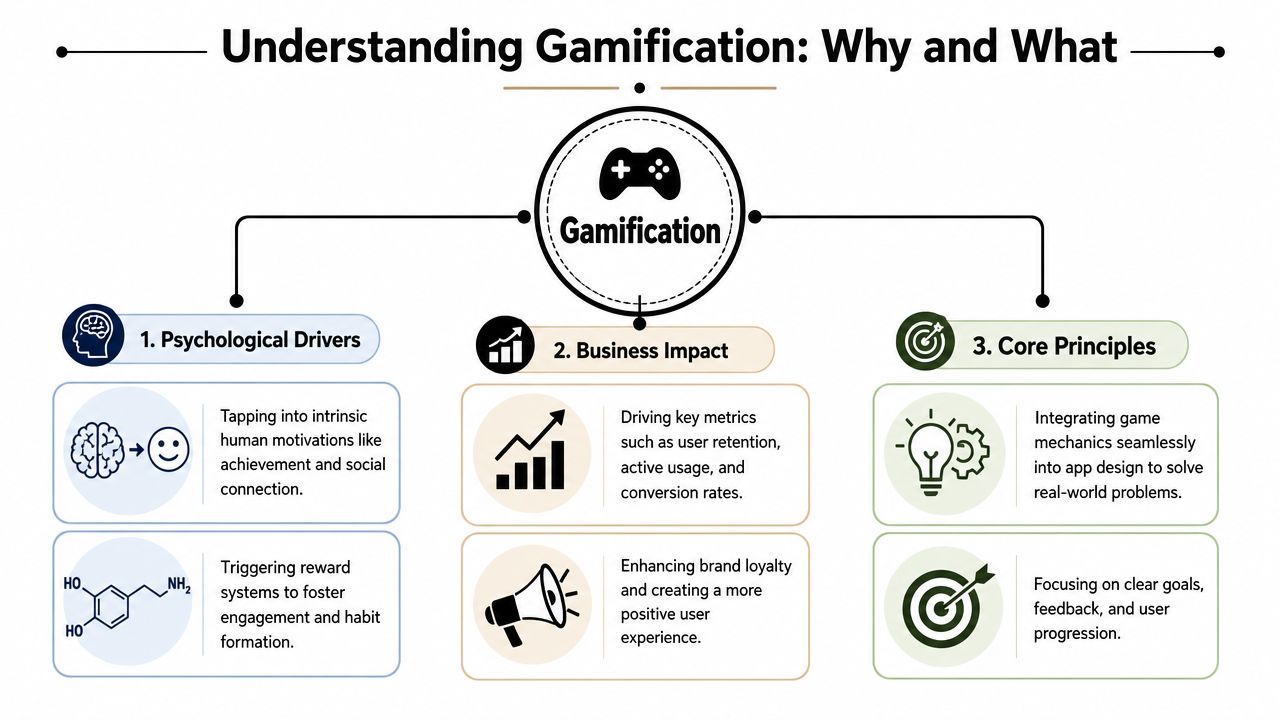
The business case starts with a simple outcome. Brands that correctly implement gamification can see an average increase of 22% in user retention, according to Optimove's analysis of gamification in mobile apps. Retention is the KPI that makes every downstream metric easier. Better retention usually gives teams more chances to educate, monetize, and recover acquisition cost.
Competence drives completion
Users stay engaged when they can tell they're getting better. In product terms, that means visible progress, short feedback loops, and milestones that feel earned. A blank dashboard creates uncertainty. A progress ladder with clear next steps reduces drop-off.
This maps well to onboarding and feature adoption. If your app asks a user to complete a setup flow, import data, build a habit, or finish a profile, competence mechanics help them move through friction. Progress bars, staged reveals, and “next best action” prompts all serve the same purpose. They reduce ambiguity.
Autonomy improves long-term fit
People don't want to feel manipulated. They want to choose from meaningful paths. In gamified systems, autonomy comes from branching missions, selectable goals, flexible challenge types, and rewards that match intent. A casual user may want streaks and guidance. A power user may want mastery, status, and optimization.
Autonomy matters for monetization too. If every reward path pushes the same upgrade, users start to ignore it. If the app lets users choose between earning access, receiving utility, or progressing faster, the system feels more respectful and often performs better.
Relatedness makes loops stick
Social proof, cooperative challenges, team goals, and lightweight competition create accountability. The key is restraint. Not every product needs a public leaderboard. For many categories, a private comparison, friend milestone, or community challenge is enough.
Practical rule: If the social mechanic makes newcomers feel behind instead of motivated, redesign the ranking surface before scaling it.
Psychological drivers should map to explicit KPIs
A useful planning model is to tie each driver to one business measure:
| Psychological driver | Product expression | KPI most likely to move |
|---|---|---|
| Competence | Progress, mastery, milestone feedback | Onboarding completion, feature adoption |
| Autonomy | Choice of goals, challenge paths, reward paths | Repeat usage, lower early churn |
| Relatedness | Team events, social proof, cooperative tasks | Retention, referrals, community participation |
The mechanics aren't the goal. The KPI is.
Core Gamification Use Cases for Mobile Growth
The fastest way to evaluate gamification in apps is to walk the user lifecycle and ask where motivation drops. That usually surfaces four practical use cases: onboarding, retention, monetization, and LiveOps. Done well, gamification mechanics can increase user engagement by up to 48%, as described in Acodez's technical overview of mobile app gamification. The caveat is important. The lift comes from design that channels curiosity and competition toward valuable actions, not from random reward noise.
Onboarding that behaves like a quest
A lot of onboarding fails because it front-loads setup without payoff. A quest structure fixes that. Instead of one long checklist, break onboarding into missions that each reveal visible progress. A budgeting app can reward “connect your first account,” then “categorize three transactions,” then “set one spending rule.” A creator app can guide “publish first post,” then “customize profile,” then “invite collaborators.”
This pattern works because users can see movement. Every completed task signals competence and lowers uncertainty about what to do next.
Retention loops that create daily intent
Daily rewards only work when the daily action has product value. Otherwise teams build shallow habit loops that produce opens but not outcomes. In language learning, the streak works because the app ties each return session to lesson completion. In productivity, a streak can work if it tracks meaningful work, not just app launches.
Useful retention loops often combine:
- A repeatable action tied to the product's core value
- Visible continuity such as streak counters or calendars
- Recovery mechanics so one missed day doesn't destroy motivation
- Escalating context where the challenge evolves as the user matures
Monetization that feels earned
Monetization mechanics should reward progress, not interrupt it at random. Battle-pass logic is one example, even outside games. A subscription app can offer a tiered progression track where users access premium templates, advanced insights, or exclusive content as they complete meaningful actions. Paywalls still matter, but the best ones arrive in context, right after demonstrated intent.
A strong system also separates reward types. Some rewards are emotional or status-based. Others grant access, utility, or billing-related entitlements. Treating every reward as a discount usually weakens the loop.
For teams running event-based experiences, game LiveOps tactics for app teams offer a useful mental model. Limited-time missions, progression ladders, and return campaigns work outside traditional games too.
Live events keep mature products fresh
Apps with flat content or repetitive workflows need event logic. That might be a weekend challenge in fitness, a themed reading goal in a media app, or a seasonal collection mechanic in commerce. The event doesn't need to be huge. It needs a clear start, finish, and reward structure.
A mature app often doesn't need more features first. It needs better reasons for users to come back this week.
Actionable Gamification Design Patterns
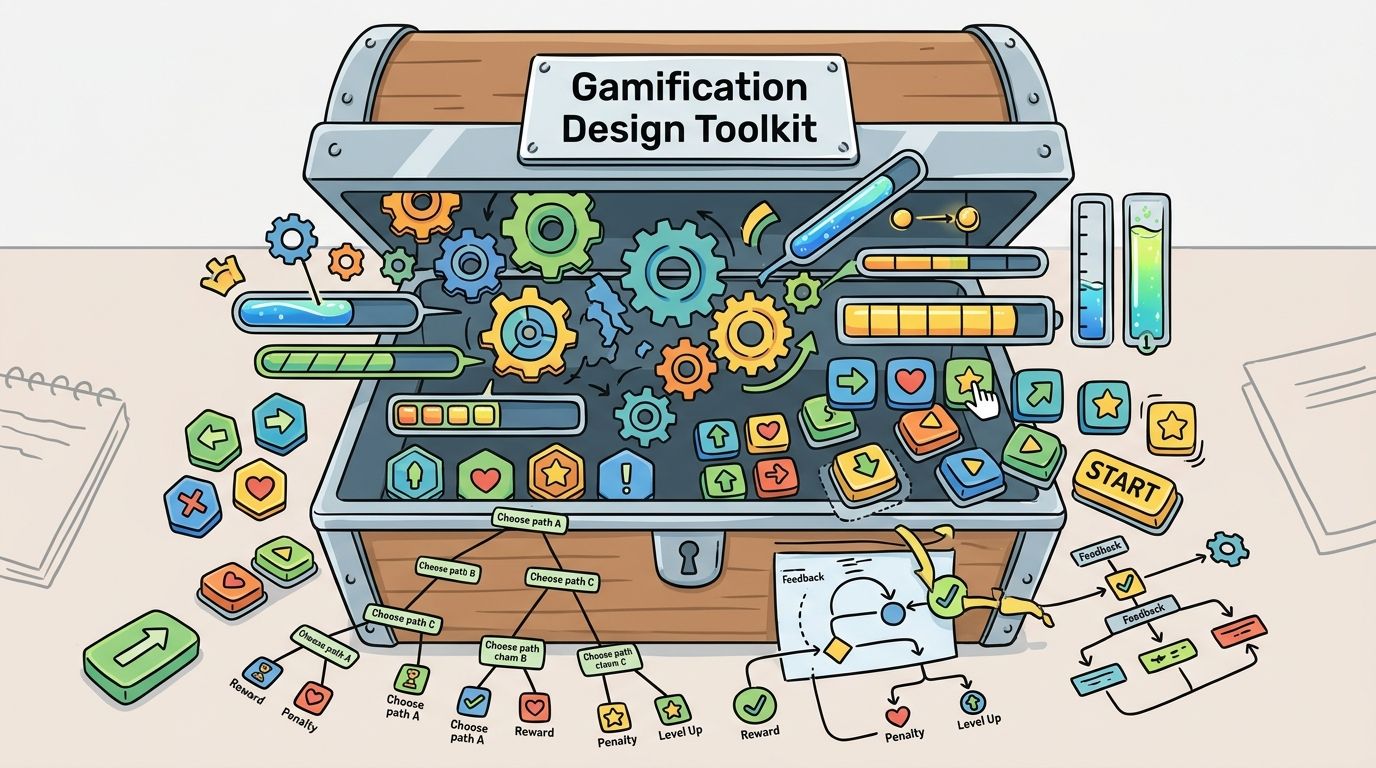
The old PBL formula, points, badges, leaderboards, is too narrow for most modern products. Those mechanics can help, but they rarely sustain engagement by themselves. Stronger systems combine progression, timing, narrative framing, social structure, and reward design.
Progress loops beat isolated rewards
A point total with no meaning becomes wallpaper. A progress loop gives points context. XP contributes to levels. Levels open up missions. Missions reveal new surfaces. New surfaces create better rewards. That's a loop.
This is why progress bars outperform abstract counters in many products. Users need to know what they've done, where they stand, and what the next action reveals.
Appointment mechanics create rhythm
Daily check-ins, timed challenges, and rotating missions work because they create cadence. They don't need to be daily, and they shouldn't force artificial frequency. The right interval depends on how often your product naturally delivers value.
Good appointment mechanics have three traits:
- They respect the product's natural usage cycle
- They provide immediate feedback on completion
- They don't punish missed participation too harshly
A finance app might use weekly goals. A meditation app might use daily practice windows. A game with event energy systems may refresh on a shorter loop.
Narrative framing turns chores into progression
People tolerate repeated actions more easily when the product gives them a frame. Fitness apps have used journey framing for years because “complete quest three” feels more coherent than “log another run.” The same idea works in learning, wellness, and creator tools.
Narrative doesn't need fantasy art. It can be as simple as naming stages in a way that reflects user transformation.
A useful walkthrough on reward design and behavioral loops sits below.
Hybrid rewards hold attention longer
The most practical pattern for long-term performance is a hybrid reward system. The Journal of Marketing Research article on game and value rewards found that combining game rewards like levels and points with value rewards like discounts can be highly effective. That matters because pure game rewards can energize activity, while value rewards can connect that activity to business outcomes such as premium purchases.
The trade-off is where teams get sloppy. Too much game intensity can distract users from the action that matters. If the user is obsessing over the loop instead of completing the purchase, the mechanic is doing its own job and failing yours.
The Technical Guide to Implementing Gamification
Teams often face the same implementation choice. Build a gamification engine in-house, or use a platform that handles delivery, targeting, experimentation, and measurement. The right answer depends on product complexity, release cadence, team shape, and how often you expect the system to change.
The in-house route
In-house gives you maximum control. For some products, especially games with custom economies or apps with unusual domain logic, that's the right call. But teams often underestimate the full surface area. It's not just points and rules. It's event pipelines, remote config, state management, QA, analytics, experiment assignment, rollback paths, eligibility logic, offline behavior, billing integration, and content operations.
Platform and client decisions also matter:
- Native iOS and Android: Best when you need deep device integration, tight performance, camera or sensor access, or graphics-heavy surfaces. Appnality's discussion of native mobile development trade-offs highlights why native remains important for resource-intensive apps and advanced device features.
- React Native and Flutter: Strong when your team needs one codebase and faster shipping across platforms. A verified industry data point states these frameworks can reduce mobile app development time by approximately 50% and save teams an estimated 200 hours on iOS and Android projects, based on the referenced development discussion.
- Flutter specifically: It offers its own rendering engine and UI system, which can help when your gamified UI needs consistency across platforms. Angular Minds' Flutter vs React Native comparison notes Flutter's dedicated rendering approach and automated system checkups.
- Unity and Unreal: Useful when the app experience is closer to a game, or when 3D, physics, or high-fidelity interaction is central. Unity can ship mobile apps, but the linked developer discussion on Unity for mobile app development reflects a common view that it's generally not the best fit for mimicking native app UI.
The platform route
A platform-based approach makes more sense when growth teams need to ship and iterate without waiting on app releases. The value isn't only speed. It's separation of concerns. Engineering owns the runtime and event quality. Product, growth, and design can operate the experience layer.
A modern setup should support:
- Cross-platform delivery: iOS, Android, React Native, Flutter, Unity, and Unreal from one operational layer
- Remote configuration: Rules, copy, reward ladders, eligibility, and timing without binary updates
- Analytics and experiments: Trigger analysis, cohort splits, conversion tracking, and rollback
- Billing and entitlements: Reward access tied to purchase state, paywalls, trials, offers, and synced subscriptions
- Offline-safe behavior: Durable local state and replay logic where network access is unreliable
If your team wants to operate in-app experiences like configurable flows rather than hard-coded screens, an in-app flow builder for mobile growth is usually the missing layer.
Gamification Implementation Approach Comparison
| Consideration | In-House Build | Platform (e.g., Nuxie) |
|---|---|---|
| Initial speed | Slower, requires custom event and rule systems | Faster to launch and iterate |
| Flexibility | Maximum, but engineering-dependent | High, with constraints shaped by platform capabilities |
| Cross-platform support | Separate implementation burden across stacks | Shared operational layer across supported stacks |
| Experimentation | Must build assignment, reporting, and rollback | Usually available as part of the system |
| Maintenance | Ongoing cost in QA, tooling, and content ops | Lower engineering maintenance, more operational leverage |
| Billing and entitlements | Requires integration work and state sync | Can be connected to existing providers or managed centrally |
Build in-house when your game economy or domain logic is the product. Use a platform when iteration speed and operational control matter more than reinventing infrastructure.
Measuring Success and Avoiding Common Pitfalls
Most failed gamification programs don't fail because the animations are bad. They fail because teams measure the wrong thing. “Badges earned” isn't a business KPI. Neither is “missions started” unless it leads somewhere useful.
Measure downstream behavior, not just surface activity
Start with the business event, then work backward to the mechanic. If the app needs better monetization, track purchase starts, subscription conversions, entitlement activations, and post-conversion retention. If the app needs stronger onboarding, track task completion and early return behavior. If the goal is habit, measure repeated completion of the core value action, not generic opens.
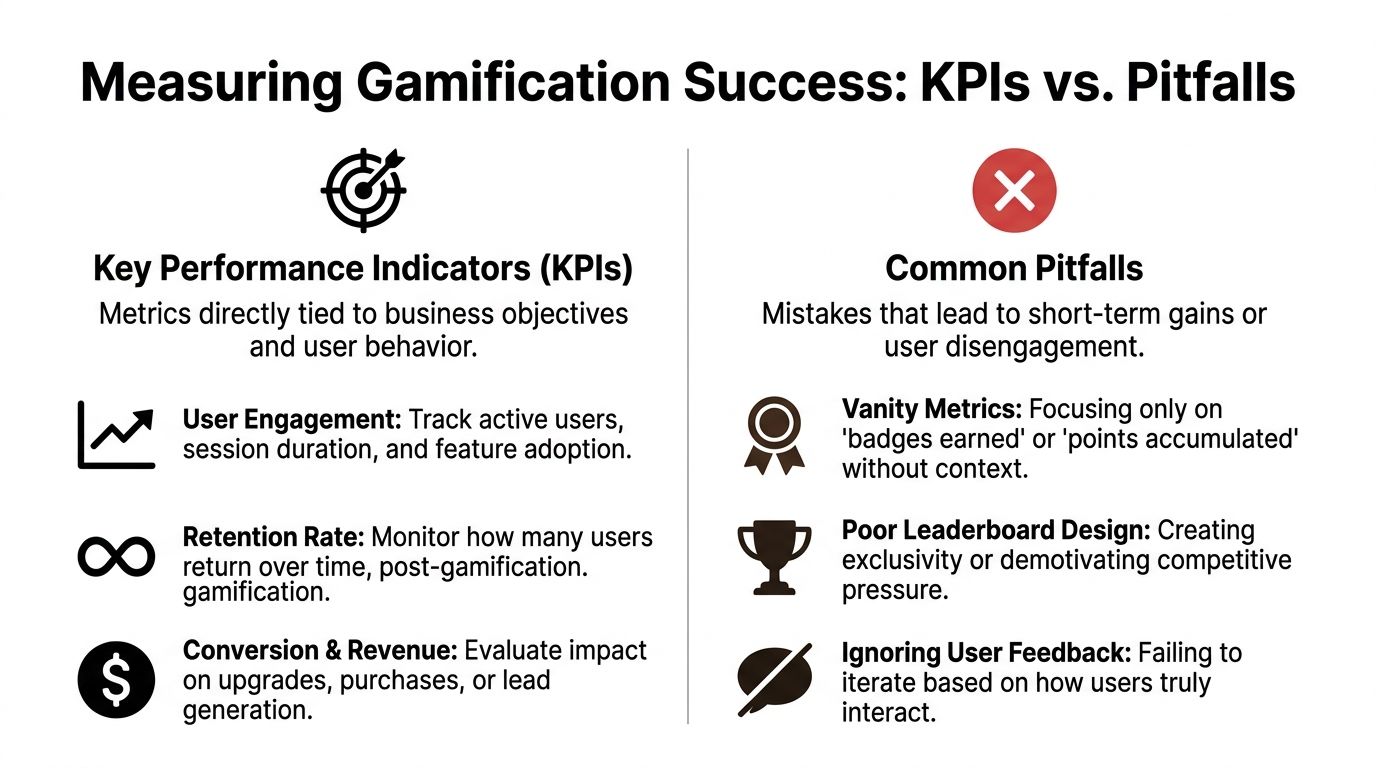
A practical KPI stack usually includes:
- Core product completion: Did users do the thing that proves value?
- Retention quality: Are users returning and completing meaningful actions?
- Monetization movement: Did the mechanic increase upgrades, purchases, or accepted offers?
- Segment response: Which user states benefit, and which ones get distracted?
Analytics needs to support event quality, user properties, reward state, and experiment variants. Teams that want one workspace for behavioral and journey analysis often benefit from mobile app analytics built for in-app decisioning.
Common failure modes
The first failure mode is “chocolate-covered broccoli.” That's when teams wrap a weak core experience in rewards instead of fixing the product. If the underlying task is confusing or low-value, no badge system will save it.
The second is overexposure. If every screen flashes urgency, progress, and rewards, users stop feeling progress and start feeling pressure. Gamification needs pacing.
The best reward system often feels obvious in hindsight. The user knows what happened, why it happened, and what to do next.
The third is brittle implementation. Hard-coded thresholds, app-release dependencies, and inconsistent event naming kill iteration. Teams need to tune challenge difficulty, eligibility, message timing, and reward type as they learn.
The regulatory issue most teams ignore
Behavior-changing apps in health, wellness, and mental health carry another layer of risk. A 2024 study found that 69% of gamified mHealth apps faced low compliance with EU Medical Device Regulations, according to JMIR Serious Games research on gamified health app regulation. That's not a minor legal footnote. It affects how you design prompts, claims, rewards, and health-related behavior loops.
If your app uses gamification to influence adherence, treatment behavior, or mental health routines, involve compliance early. Reward design can't drift into misleading medical framing. Social comparison mechanics can also create unintended pressure in sensitive categories. In regulated products, “motivating” and “safe” aren't separate conversations.
Conclusion From Theory to Live Ops
Gamification in apps works when teams treat it as a system, not a skin. The system starts with a target behavior, maps that behavior to a KPI, and expresses it through mechanics that fit the product instead of overwhelming it. The strongest programs balance psychology with instrumentation, reward design with restraint, and creativity with operational discipline.
That's why the practical center of gravity has shifted from one-off feature launches to ongoing LiveOps. Teams need to adjust missions, tune reward ladders, test monetization moments, personalize journeys, and connect all of it to analytics, billing, and entitlement state across iOS, Android, React Native, Flutter, Unity, and Unreal. Paywalls are part of that picture, but only one part.
AI-native systems will push this further. The next generation of gamified experiences won't just segment users by broad cohorts. They'll adapt to timing, intent, progression state, and predicted friction in much more precise ways. The opportunity isn't to make apps feel more like games. It's to make motivation, feedback, and growth systems far more responsive.
If your team wants to ship gamified onboarding, retention flows, paywalls, LiveOps moments, and personalized in-app journeys without turning everything into a custom infrastructure project, Nuxie is worth a look. It's an AI-native platform for mobile apps and games that combines in-app experience delivery, experimentation, analytics, billing, and entitlements across iOS, Android, React Native, Flutter, Unity, and Unreal. It's provider-agnostic, can work with your existing stack, and doesn't charge a revenue-share fee for billing and entitlement data.