
10 Best Subscription Analytics Tools for Apps (2026)
Compare the best subscription analytics tools for mobile apps and games. Our guide covers features, pricing, and integrations for Nuxie, RevenueCat, and more.
Your app is adding subscribers, but the harder part starts after that. A renewal rate drops on Android while iOS stays flat. Finance reports one MRR number, product reports another. A paywall test lifts trial starts, then six weeks later retention weakens and nobody agrees on whether the test worked.
That is the point where basic store reporting stops being enough. Once subscriptions become a core part of the business, teams need tools that connect billing events, entitlement state, cohort behavior, and experiment results. Otherwise, you get clean charts and messy decisions.
From a mobile product perspective, the useful way to evaluate subscription analytics tools is by job-to-be-done, not by feature count. Some tools are strongest as billing and entitlement infrastructure with analytics layered in. Some are built for finance teams that need well-defined SaaS metric calculations and flexible imports. Others focus on paywalls, pricing tests, and monetization workflows inside the app.
The core issue is often entitlement trust, not analytics sophistication. If iOS, Android, Stripe, and web purchases do not reconcile cleanly, every downstream metric is suspect. That is why the right choice depends on your stack, your source of truth, and who needs to act on the data. For native apps, cross-platform apps, and mixed mobile-plus-web businesses, those integration details usually matter more than one more dashboard tab.
1. Nuxie

Nuxie is the one I'd shortlist first if your team wants to connect subscription analytics to in-app action instead of stopping at charts. It combines analytics, experimentation, in-app experience delivery, billing and entitlement infrastructure, and remote publishing across Nuxie supported platforms including iOS, Android, React Native, Flutter, Unity, and Unreal. Paywalls are part of the product, but they're not the whole story.
The practical difference is that you can build connected journeys instead of isolated surfaces. A mobile team can ship onboarding, quizzes, surveys, feature announcements, retention offers, and monetization screens from the same runtime. That matters when churn isn't just a pricing problem. Sometimes it's a segmentation problem, a bad first-session problem, or a poor renewal messaging problem.
Where it fits best
Nuxie is strongest for teams that want one system to design, test, target, and publish in-app experiences without waiting on full app releases. The runtime supports on-device targeting, offline-ready delivery, and automated campaign analytics. That makes it useful for apps and games where responsiveness matters and where product, growth, and monetization teams all need to touch the same funnel.
It also helps that the platform is provider-agnostic. You can augment or replace RevenueCat, StoreKit, and Google Play Billing flows without taking on a revenue-share fee. That's a meaningful finance and architecture decision for teams that have already outgrown “just add one more SDK” thinking.
Practical rule: If your team wants to test messaging, offers, entitlement-driven screens, and post-purchase flows in one place, a pure analytics layer won't be enough.
What works and what doesn't
What works:
- Fast iteration: AI generation and a visual builder reduce the time between idea and live test.
- Cross-platform coverage: It's one of the few options that speaks to app teams and game teams in the same product language.
- Infrastructure included: Billing sync, purchase data, and entitlements in the same stack simplify a lot of mobile plumbing.
- Transparent entry pricing: It's free to start, and Pro is listed at $9.99 per month or $49.99 per year with a 7-day free trial on the Nuxie site.
What doesn't:
- You still need adoption discipline: This adds an SDK and a new operational workflow. If your team isn't ready to manage experiments, targeting rules, and content ops, the product can feel bigger than what you need.
- Enterprise buyers should pilot: Public customer proof points and certifications aren't prominent, so larger teams should validate security, scalability, and reporting fit before a broad rollout.
For teams that want analytics tied to execution, not just reporting, Nuxie is unusually complete.
2. RevenueCat
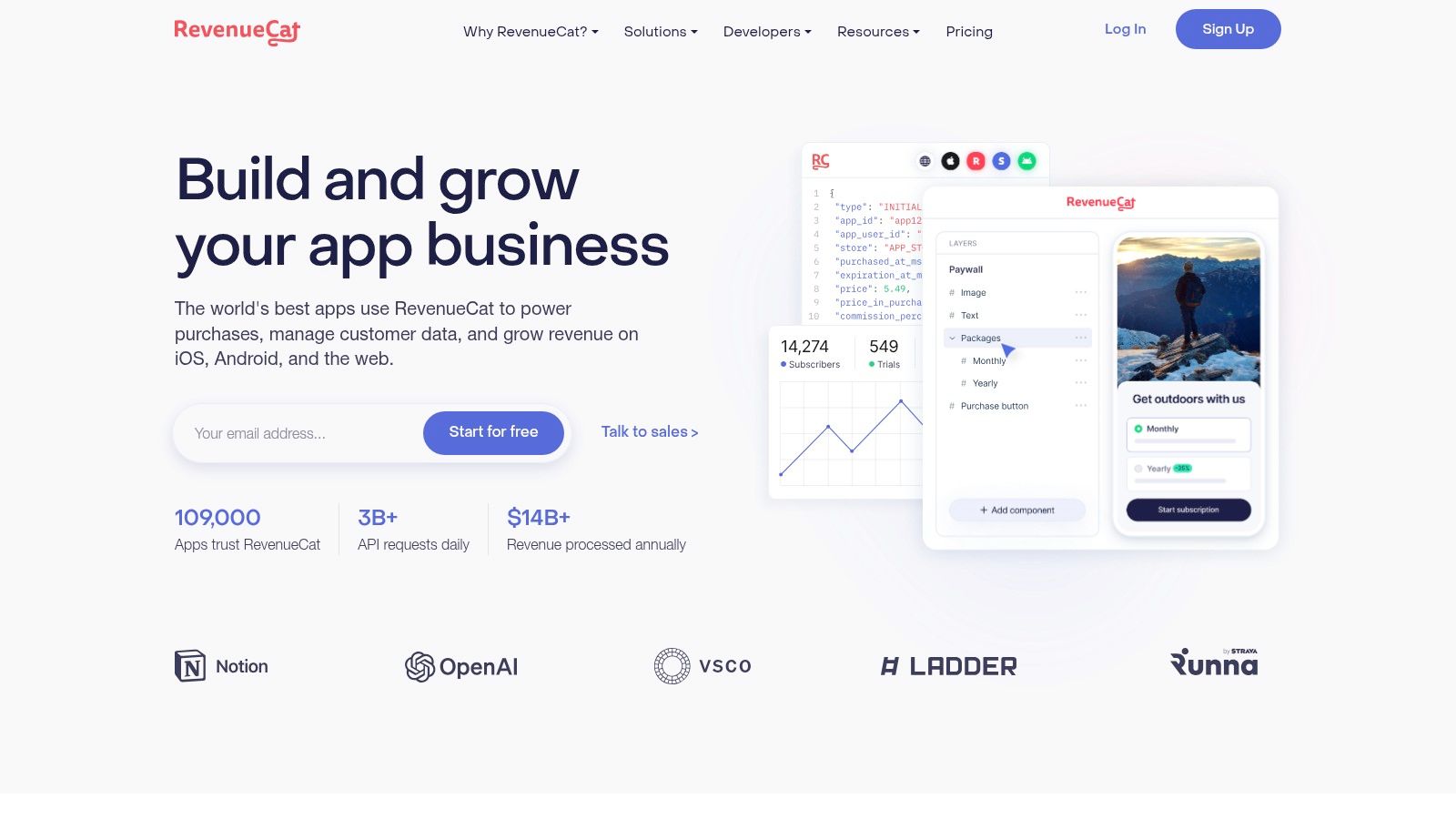
RevenueCat is still the default answer for many mobile teams because it solves the hard, unglamorous layer first. Receipt normalization, entitlements, cross-platform subscriber state, and clean downstream events are the foundation. If that layer is messy, every dashboard built on top of it is suspect.
For iOS, Android, and web subscription businesses, RevenueCat gives you a stable source of truth for subscription status and lifecycle analytics. It's especially attractive for indie apps and teams that need mature SDKs and broad integrations without building receipt validation in-house.
Where it's strongest
RevenueCat is strongest when your main pain is infrastructure. It handles the messy cross-store reality well and plays nicely with Braze, Amplitude, Segment, Mixpanel, and webhook-driven data stacks. That means product and lifecycle teams can work from the same subscriber state without each team inventing its own definition of active, trialing, refunded, or churned.
If churn is your immediate concern, the useful move isn't just watching the rate. It's instrumenting the states that lead into churn and pairing them with a clear framework for subscriber churn rate analysis.
RevenueCat is often the right first purchase when the real issue is entitlement trust, not analytics sophistication.
Trade-offs to weigh
- Best for mobile-first subscriptions: It's less compelling if most of your revenue comes from complex B2B invoicing or heavily customized web billing.
- Costs can rise with scale: Usage-based pricing is fine early. Finance teams may push back once revenue grows and the infrastructure line item becomes more visible.
- Growth tooling is additive: Paywalls and experimentation exist, but many teams still pair RevenueCat with a separate experience layer.
If your stack is shaky at the billing and entitlement layer, RevenueCat is a safe choice. If your stack is already stable and you need faster in-app experimentation, it may be only part of the answer.
3. ChartMogul
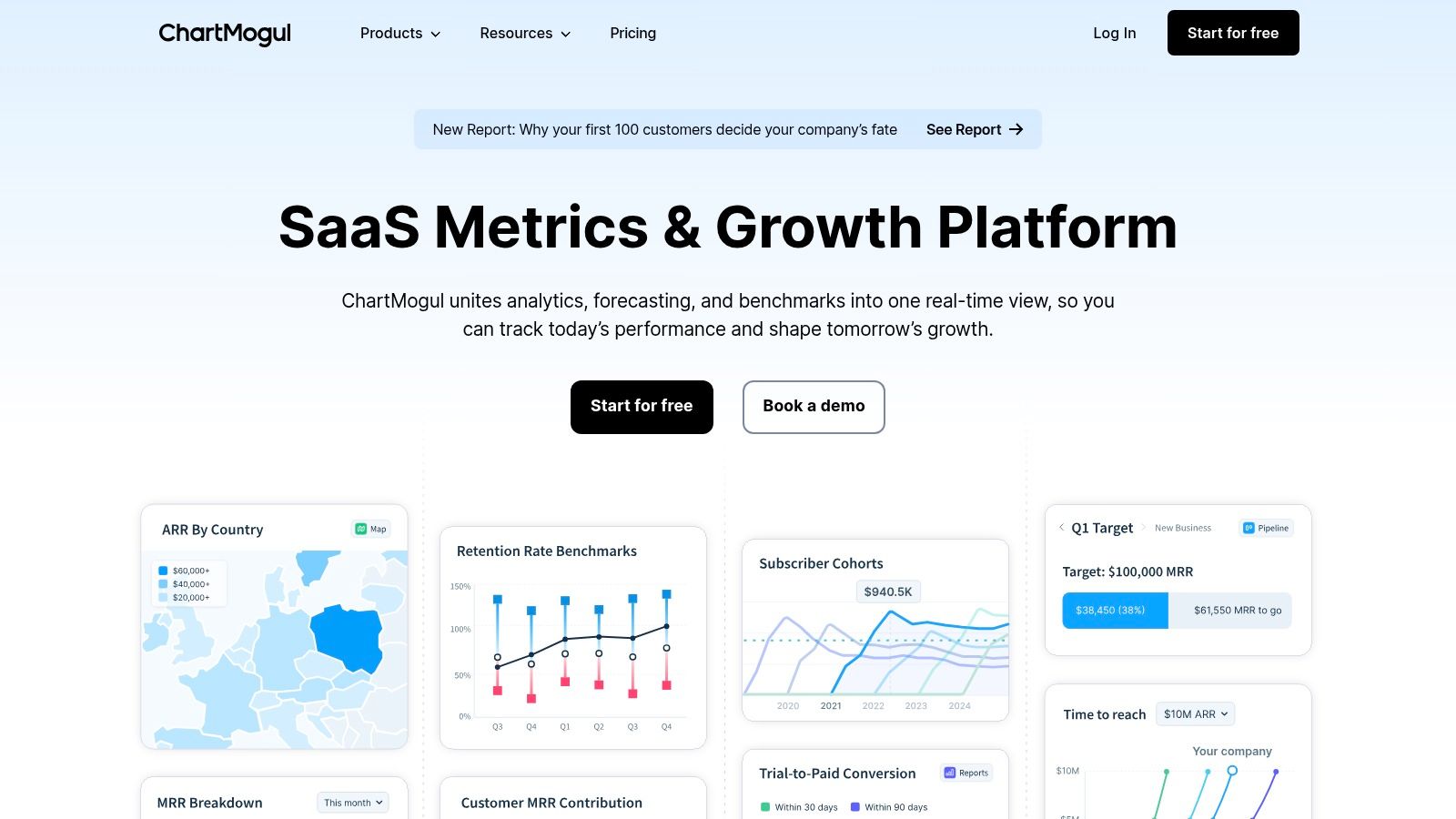
Monday's exec review starts in 20 minutes. Finance has one MRR number, product has another, and nobody agrees on whether upgrades, reactivations, and failed payments belong in the same chart. ChartMogul fits that situation well.
Its core job is recurring revenue reporting. I'd put it in the pure analytics bucket, not the all-in-one growth platform bucket. If your team needs a single place to standardize MRR, ARR, churn, LTV, cohorts, and retention across Stripe, Chargebee, Paddle, Recurly, or imported billing data, ChartMogul is built for that job.
That focus is the reason teams buy it. Leadership gets consistent definitions. Finance gets cleaner board reporting. Growth teams get a stable revenue layer they can compare against product analytics instead of rebuilding the same metrics in BI every quarter.
For teams trying to align product reporting with finance reporting, it helps to agree on the underlying subscription business metrics before anyone starts mapping events or importing historical data.
Where it fits best
ChartMogul works best when subscription data already exists in billing systems and the main problem is consolidation, not app-side purchase handling. That usually means SaaS companies, hybrid subscription businesses, or mobile companies with a meaningful web billing motion alongside app stores.
For native mobile apps, the trade-off is straightforward. ChartMogul is not your StoreKit 2, Google Play Billing, or entitlement layer. iOS and Android teams still need another system to validate receipts, reconcile renewals, handle grace periods, and map subscriber state before the revenue data is clean enough to trust here. On React Native, Flutter, and other cross-platform stacks, that usually means one more integration path to maintain.
Trade-offs to weigh
- Strong at reporting, weak at operational execution: It explains revenue movement well, but it will not run paywalls, pricing tests, onboarding experiments, or win-back flows.
- Mobile setup depends on upstream plumbing: If Apple and Google subscription events are messy, ChartMogul will reflect that mess rather than fix it.
- Best for shared finance and leadership visibility: Product teams that need user-level behavioral analysis still pair it with tools like Amplitude, Mixpanel, or a warehouse.
- Cost and complexity rise with stack size: The value is high when it becomes the company's revenue source of truth. It is harder to justify if it sits on top of several paid billing and analytics tools without replacing any of them.
ChartMogul is the right choice when your biggest subscription analytics problem is metric consistency across billing sources. If your biggest problem is improving trial conversion inside the app, choose a tool closer to paywalls, experiments, and app-store infrastructure.
4. Paddle ProfitWell Metrics
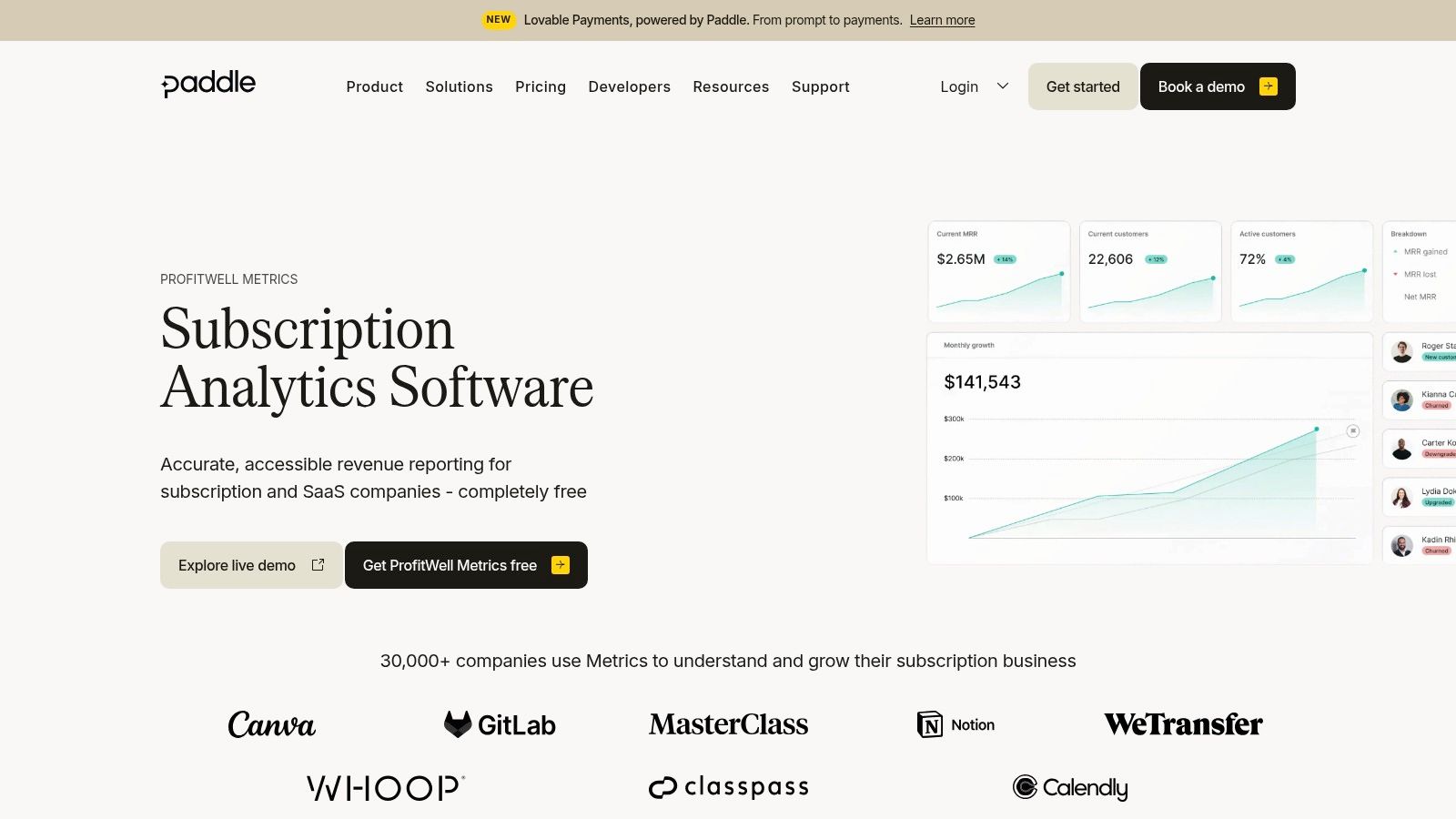
Paddle ProfitWell Metrics makes the most sense when you're already in Paddle's world and want analytics where billing already happens. That's the appeal. You don't create another reporting island. You keep recurring revenue metrics close to payments, tax, and retention workflows.
For SaaS and web subscription teams, that convenience is real. Product, finance, and growth can read the same billing-native metrics without waiting for engineering to reconcile exports.
Best use case
If your company uses Paddle Billing, ProfitWell Metrics is one of the lowest-friction ways to get MRR, churn, cohorts, and LTV into day-to-day operations. It reduces tool sprawl and gives you segmentation by plan, market, or custom fields inside a familiar environment.
That integrated model is also why it's less compelling for native mobile IAP teams. It isn't a full mobile entitlement and receipt infrastructure layer by itself. If your business depends on App Store and Google Play subscription state, you'll still need app-native plumbing elsewhere.
Practical trade-off
The upside is simplicity. The downside is dependency. If Paddle isn't your billing system, the value drops sharply.
I'd choose it in two cases:
- Paddle is already your billing source of truth
- You want analytics tightly coupled to tax, retention, and billing operations
I'd avoid it if your main challenge is in-app subscription UX, game economy logic, or cross-platform entitlement management.
5. Baremetrics
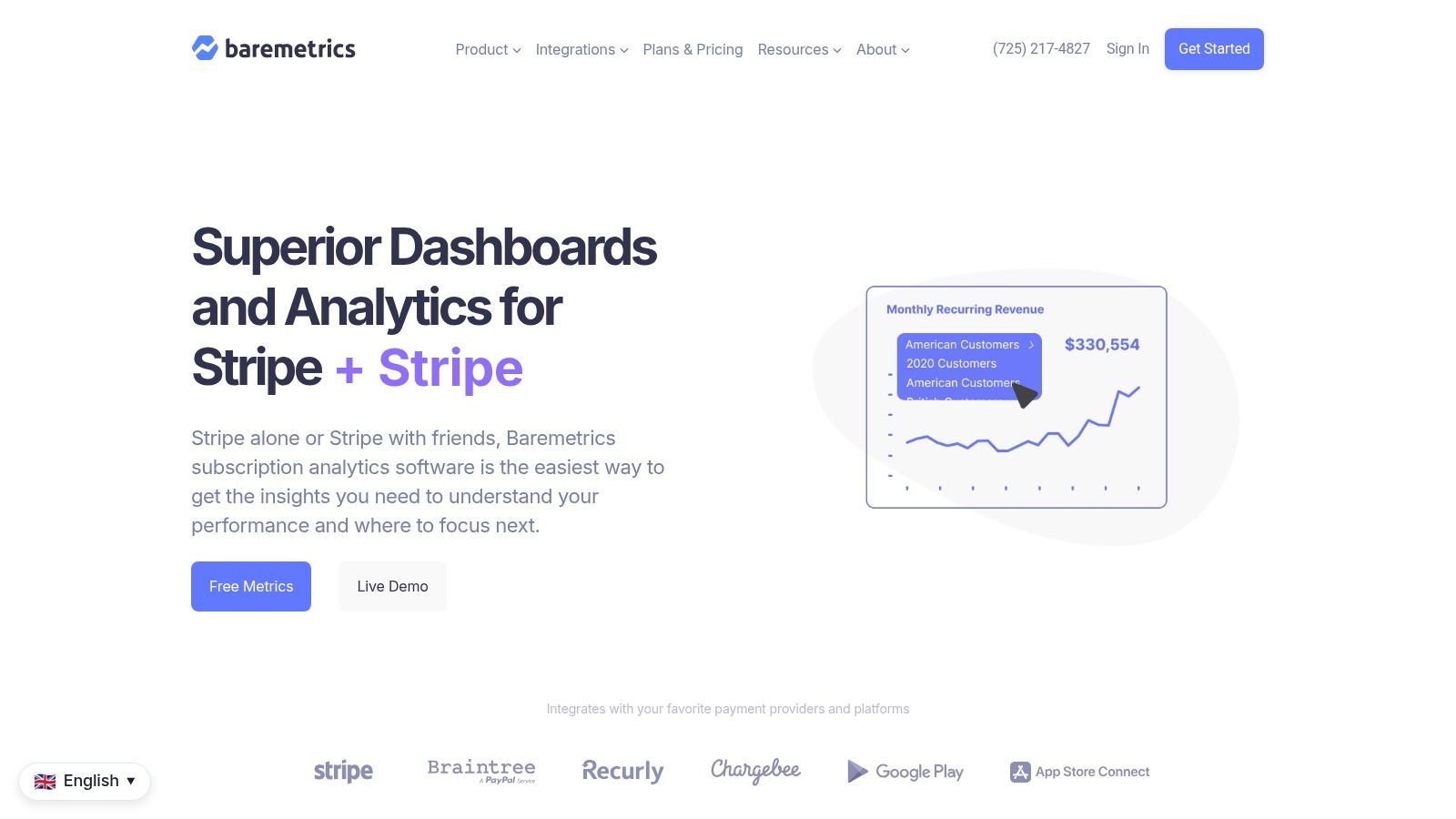
Baremetrics is for teams that want quick revenue clarity without building custom analytics. Connect Stripe or another supported billing source, and you get clean dashboards for MRR, ARR, churn, LTV, cohorts, forecasting, and cash flow views. It's easy to understand why finance and founders like it.
The product is especially useful when your business is subscription-heavy but not mobile-IAP-heavy. If your money lives in Stripe, Baremetrics is one of the faster ways to turn raw billing events into readable trends.
What it's good at
Baremetrics does visual clarity well. The charts are readable, the setup is fast, and the add-ons for payment recovery and dunning can make the product more operational than a standard analytics dashboard.
It's also well suited to teams that don't want to stand up a warehouse-first analytics stack just to answer recurring revenue questions. That's a reasonable choice for lean teams.
Clean dashboards are helpful. Clean definitions are more important. If refunds, pauses, discounts, and failed payments aren't modeled correctly, nice charts won't save you.
Where it's weaker
- Less app-store native: For mobile subscriptions, the IAP layer usually needs to be normalized somewhere else first.
- Can feel pricey for smaller teams: Especially if you only need a narrow slice of the functionality.
- Best when billing already lives in a supported web stack: It's not the tool I'd pick to drive monetization experimentation inside an app.
Baremetrics is a good analytics product. It just isn't a mobile growth operating system.
6. Adapty
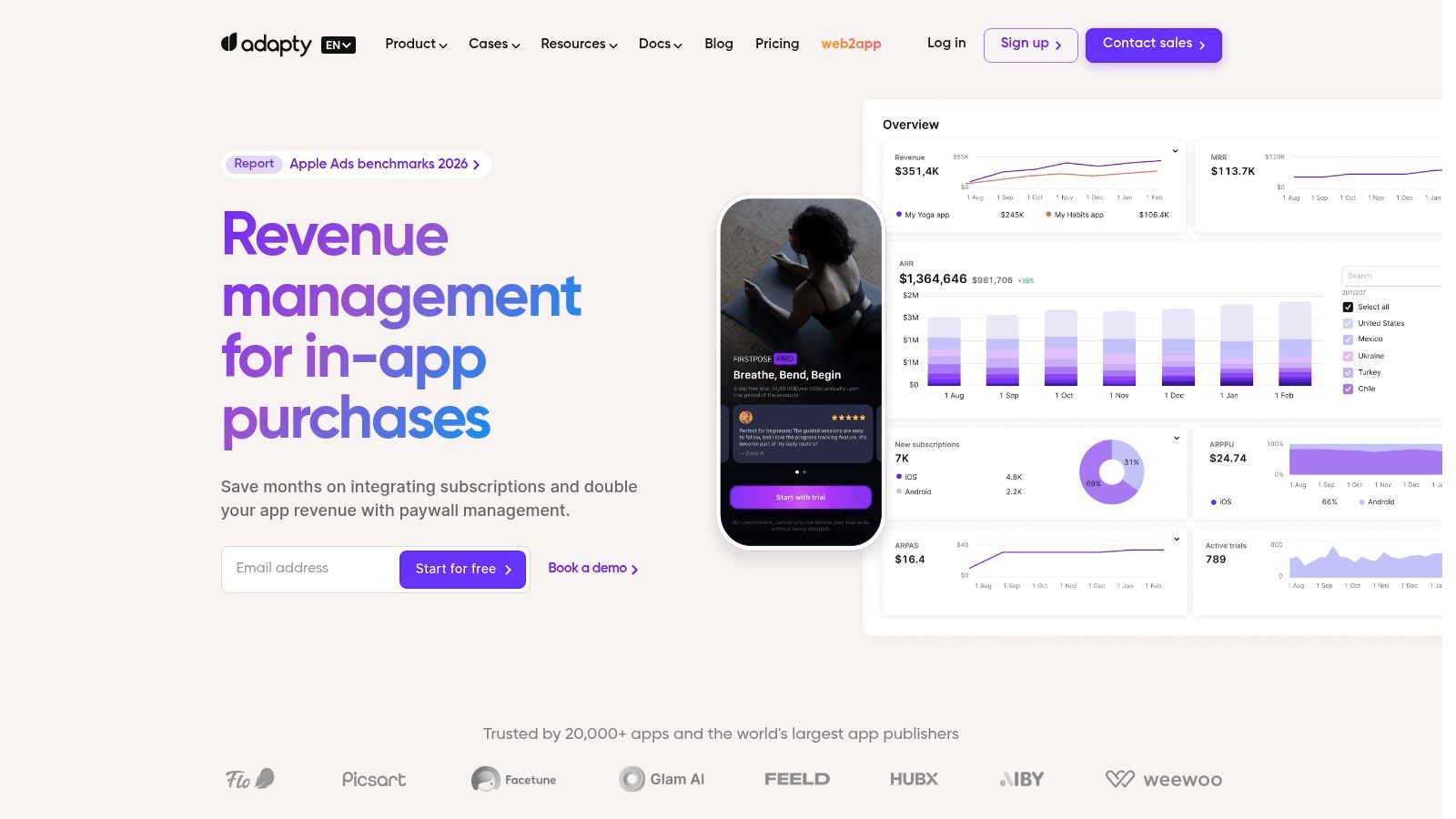
A common mobile growth scenario looks like this: marketing wants to test a new annual plan, design wants to localize the paywall, and engineering does not want another release blocked on pricing copy. Adapty is built for that situation.
Its core job-to-be-done is not pure subscription analytics. It is a mobile monetization stack that combines paywalls, experiments, purchase infrastructure, and revenue reporting in one place. That distinction matters. Teams choosing between tools in this category should decide whether they need finance-grade subscription reporting, or a system that helps them ship and measure monetization changes inside the app.
Adapty fits the second use case well. For iOS and Android apps, it gives product and growth teams tighter control over paywall iteration without turning every test into an engineering project. It also supports React Native, Flutter, and Unity, which is useful for cross-platform teams trying to avoid maintaining separate monetization logic across clients.
Where it fits best
Adapty works best when subscription growth depends on frequent testing. Remote paywalls, pricing experiments, introductory offer changes, and audience-level targeting are the main draw. The analytics matter because they sit close to the purchase events that created them, which makes it easier to judge whether a paywall change improved conversion or just shifted mix.
That setup has practical advantages, but there are implementation details to watch. On iOS and Android, SDK adoption is usually straightforward. Cross-platform frameworks need more care. React Native and Flutter teams should check how much of the paywall and event logic lives in the wrapper versus native modules, especially if they already have custom purchase handling or attribution plumbing. Unity teams should validate edge cases early, including restore flows and entitlement sync, before committing to a full rollout.
If your churn problem is partly a packaging problem, not just an acquisition problem, these subscription pricing strategies for mobile apps are a useful place to start before you run tests.
Trade-offs to consider
- Best for mobile monetization teams: Adapty is strongest when in-app subscriptions are the center of the business, not one billing stream among many.
- Revenue-based pricing can become expensive at scale: Finance teams will want to model cost against expected lift, especially if subscription volume is already high.
- Analytics depth is tied to the platform's scope: If you need broad warehouse-level reporting across web, app, ads, support, and finance systems, you may still want a separate BI layer.
- Migration work is real: Replacing or wrapping an existing purchase stack can touch entitlements, attribution, historical events, and experiment governance.
I'd put Adapty in the all-in-one growth platform bucket, not the pure analytics bucket. That makes it a strong choice for teams trying to move faster on paywalls and offers, and a weaker fit for teams that mainly need neutral subscription reporting across a mixed billing stack.
7. Qonversion
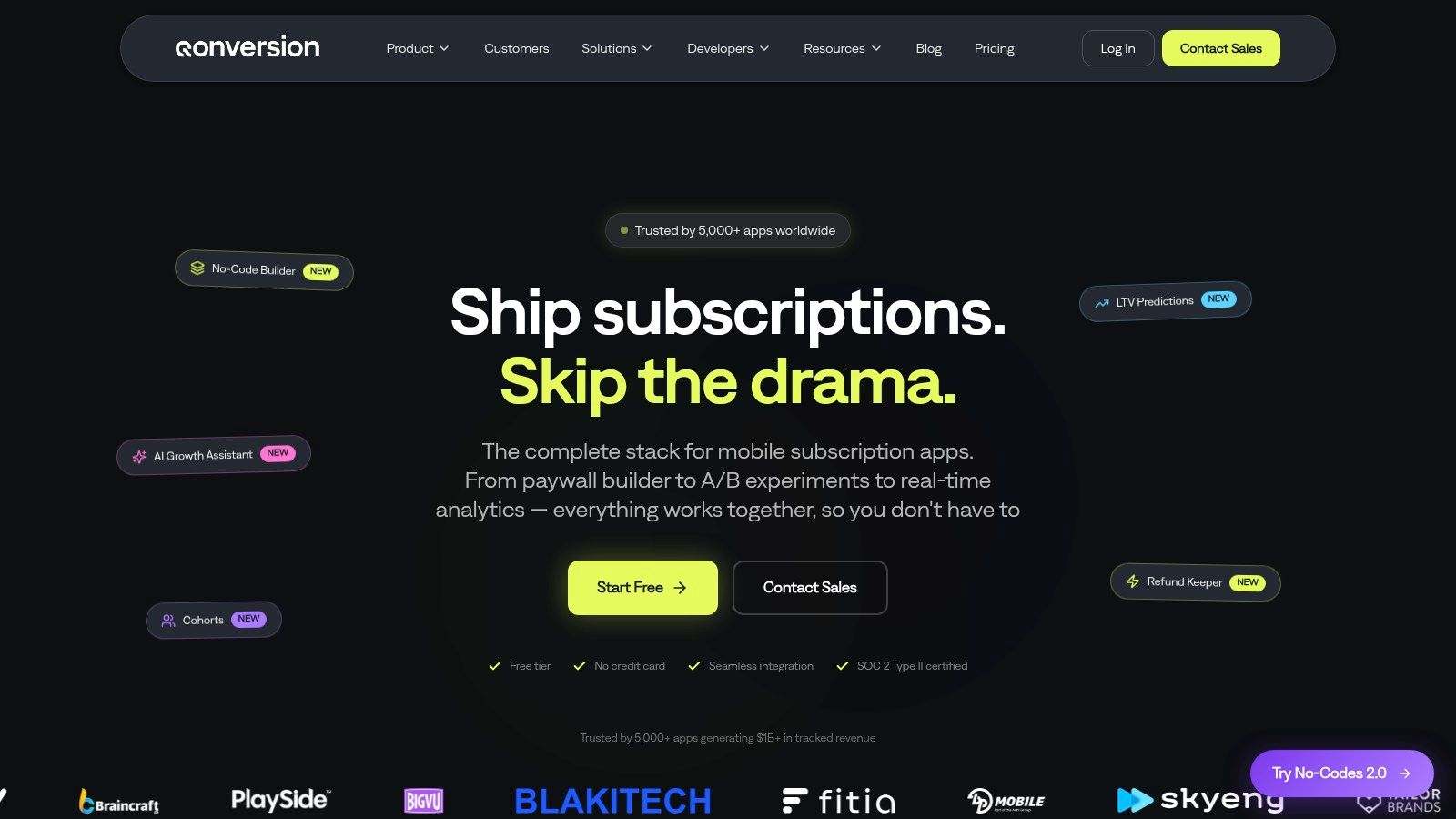
Qonversion is one of the better fits for teams that want an end-to-end mobile subscription stack but don't necessarily want to replace everything at once. Its Analytics Mode is the practical differentiator. You can use Qonversion's metrics and reporting without fully changing your current IAP flow on day one.
That lowers adoption risk. For a product lead, that matters because replacing purchase infrastructure is rarely a small project, even when vendors market it that way.
Where it fits
Qonversion combines entitlements, real-time analytics, paywall A/B testing, LTV reporting, and attribution views. It's aimed squarely at mobile apps, not general subscription businesses. That focus is a plus if your roadmap revolves around app monetization.
The product is especially useful for teams that want one platform to optimize subscriptions and experiment with offers while keeping analytics close to revenue events. If your current stack is fragmented between entitlement tooling, analytics, and testing, Qonversion can simplify things.
Trade-offs
- Revenue-share style pricing can become a finance conversation
- It's mobile-specific, so web and B2B billing use cases are secondary
- You still need clear internal definitions for revenue quality and lifecycle states
Qonversion is a strong middle ground. It's broader than pure analytics and more analytics-aware than some paywall-first tools.
8. Apphud
Apphud is often the pragmatic pick for teams that want infrastructure and analytics without immediately stepping into enterprise pricing or a heavy platform commitment. It covers real-time revenue analytics, cohorts, paywall and pricing experiments, exports, and webhook-driven integration with downstream systems.
I've found tools like Apphud work well for teams that are operationally serious but still small enough to care about fixed monthly costs and straightforward setup.
Why it earns a place
Apphud gives you more than basic revenue charts. Proceeds tracking, refunds, VAT-aware reporting, and raw exports are all useful when a mobile finance view needs to line up better with platform realities. That makes it attractive for apps where “revenue” in the dashboard and “cash that settled” don't always feel close enough.
It also gives growth teams room to test without turning the monetization stack into a science project.
The right tool for an indie app is often the one your team will actually maintain. A theoretically better stack isn't better if no one trusts or updates it.
Limitations
- Monthly tracked revenue caps can matter as you scale
- The ecosystem is smaller than the biggest names in the category
- It's still primarily a mobile IAP product, not a broad recurring revenue platform
Apphud is a practical compromise. It won't win every enterprise bake-off, but it solves real subscription analytics and experimentation problems for a lot of app teams.
9. Glassfy

Glassfy is appealing when you want lightweight subscription plumbing with reporting across app stores and some web billing scenarios. It supports iOS, Android, Stripe, and Paddle use cases, which makes it more cross-channel than some mobile-only competitors.
That flexibility can be useful for hybrid businesses where subscriptions don't live in just one place.
What stands out
Open-source SDKs and real-time subscription events make Glassfy attractive to developer-led teams. If you want a vendor that feels closer to infrastructure than marketing software, Glassfy has that posture.
Its out-of-the-box reports around churn and ARPU cover the basics well enough for teams that want visibility without a large analytics implementation. That's usually the draw.
Watch-outs
- Public pricing isn't clearly listed
- The community and ecosystem are smaller than the largest vendors
- You may outgrow the reporting layer if your team needs deeper behavioral or experimentation workflows
Glassfy is worth considering when you want lean subscription infrastructure and don't need a heavyweight growth platform around it.
10. Superwall

Superwall is not a full subscription analytics platform in the broad sense. It's a paywall experimentation platform with analytics attached. That distinction matters because teams often buy it for exactly the right reason: they need to ship, localize, and test paywalls fast.
If your biggest bottleneck is monetization iteration speed, Superwall can be the right answer even if it doesn't replace your billing or entitlement stack.
Best use case
Superwall works best when your team already has subscription infrastructure handled elsewhere and wants a strong paywall editor, localization, templates, and A/B/n testing around offers, copy, and layouts. The analytics are tied to paywall performance, conversion, trials, and proceeds, which keeps the product tightly focused.
That focus is useful. It means the team responsible for monetization can move without dragging in your broader data stack for every screen change.
Limits you should accept
- It isn't a full entitlement or billing layer
- Costs tied to conversions can be hard to forecast
- It solves one slice of subscription optimization, not the entire lifecycle
Superwall is a very good point solution. Just don't mistake it for a complete recurring revenue operating stack.
Top 10 Subscription Analytics Tools Comparison
| Product | Core features | UX & Reliability ★ | Value & Pricing 💰 | Target audience 👥 | Unique selling points ✨ |
|---|---|---|---|---|---|
| Nuxie 🏆 | In-app experiences + visual flow editor, experiments, billing & entitlements, multi-platform runtime | ★★★★★ | 💰 Free → Pro $9.99/mo or $49.99/yr (7‑day trial) | 👥 Mobile product/growth teams, indie makers, publishers, game studios | ✨ AI-generated screens, one-tap publishing, sub-50ms offline-ready runtime, no revenue-share billing |
| RevenueCat | Receipt normalization, entitlements, real-time revenue & lifecycle analytics | ★★★★★ | 💰 Usage-based (can grow costly) | 👥 Mobile subscription apps, high-scale titles | ✨ Battle-tested SDKs, single source of truth for app-store receipts |
| ChartMogul | Multi-source billing ingestion, MRR/ARR, cohorts, forecasting | ★★★★☆ | 💰 Tiered by ARR (can be pricey at scale) | 👥 SaaS businesses with multiple gateways | ✨ Robust SaaS metric calculations, flexible imports |
| Paddle (ProfitWell Metrics) | Built-in MRR/churn/LTV in Paddle dashboard, segmentation | ★★★★ | 💰 Bundled with Paddle (best value if on Paddle) | 👥 Merchants using Paddle for billing | ✨ Tight coupling with payments, tax & retention tools |
| Baremetrics | MRR/ARR/churn dashboards, forecasting, dunning tools | ★★★★ | 💰 Fixed tiers for Stripe; can be pricey for small apps | 👥 Stripe-first SaaS teams | ✨ Fast setup, revenue recovery/dunning features |
| Adapty | No-code paywalls, experiments, Apple Ads/UA add‑ons, analytics | ★★★★ | 💰 Revenue-based pricing tiers (may include % fees) | 👥 Mobile apps focused on growth & UA | ✨ Paywall A/B testing + ad/UA integrations |
| Qonversion | IAP infra, paywall builder, real-time analytics, Analytics Mode | ★★★★ | 💰 Revenue-share pricing options | 👥 Mobile teams wanting unified IAP stack | ✨ Analytics Mode (use metrics without switching billing), fast SDKs |
| Apphud | IAP infra + experiments, proceeds tracking, exports | ★★★ | 💰 Fixed monthly tiers with MTR caps | 👥 Indie apps and mid-size studios | ✨ Clear low-entry pricing, proceeds accuracy & exports |
| Glassfy | Open-source SDKs, multi-store plumbing, real-time events | ★★★★ | 💰 Contact for pricing (not public) | 👥 Developers needing lightweight multi-store SDKs | ✨ Developer-friendly open SDKs, cross-store support |
| Superwall | Visual paywall editor, A/B/n tests, conversion & revenue analytics | ★★★★ | 💰 Cost scales with conversions | 👥 Growth teams focused on paywall optimization | ✨ Fast paywall iteration loop, conversion-centric analytics |
How to Choose A Decision Framework for Your Team
Organizations shouldn't start by asking which tool has the longest feature list. Start with where your subscription truth lives and what decision you need the tool to improve. In practice, there are three common buying motions: you need infrastructure, you need reporting, or you need faster growth execution.
If your billing and entitlement layer is still fragile, start there. RevenueCat, Qonversion, Apphud, Glassfy, Adapty, and Nuxie all operate close to the purchase event. That matters because if subscriber state is wrong, your MRR, churn, and cohort views won't be trustworthy anyway. This is more important now because broader market research projects the subscription analytics tool market to reach US$18.56 billion by 2034 at an 8.89% CAGR, which suggests teams are moving beyond simple reporting into more operational use cases, as discussed in Luzmo's overview of analytics angles including governance and decision intelligence.
If your infrastructure is already stable and leadership needs consistent recurring revenue reporting, look at ChartMogul, Baremetrics, or Paddle ProfitWell Metrics. These products are best when standardized definitions, finance visibility, and fewer debates over what counts as active recurring revenue are priorities. They're less useful when the growth team is blocked on changing user journeys.
The third category is the most common for mobile teams with some maturity. You already have purchases flowing, but your dashboards don't tell you what to do next. This is the gap many teams feel. Industry commentary has pointed out that most coverage stays at the dashboard layer and doesn't explain how to connect subscription metrics to product, growth, and sales actions in a practical metrics tree, which is exactly the gap highlighted in Ringly's discussion of operationalizing subscription analytics. That's where all-in-one growth products become more valuable than a pure analytics layer.
A few rules help avoid expensive mistakes:
- Choose by core job: If you need entitlements, don't buy a finance dashboard first.
- Audit SDK overlap: Mobile teams often end up with duplicate event, paywall, and purchase SDKs that create data drift and release risk.
- Check framework support early: iOS and Android support is table stakes. React Native, Flutter, Unity, and Unreal support can change the integration cost dramatically.
- Validate governance, not just charts: Strong-looking growth can hide weak revenue quality or unreliable definitions. The market is paying more attention to this now.
- Run a pilot: A short pilot with one or two real funnels will tell you more than any sales demo.
One more strategic point matters. Surveys cited in industry coverage say 72% of subscription-based eCommerce companies rely on subscription analytics tools to track revenue trends and identify churn drivers. That adoption makes sense, but the durable advantage doesn't come from owning a dashboard. It comes from turning subscriber data into better pricing, cleaner entitlements, smarter segmentation, and faster in-app changes.
For early-stage app teams, an all-in-one product is usually the better bet because it cuts coordination overhead. For data-mature teams, a layered stack can work well if someone owns metric governance and integration quality. For games, publishers, and cross-platform app teams, I'd be especially careful about tools that look polished but are too narrow in SDK support or too dependent on one channel.
The right subscription analytics tool is the one that helps your team act on revenue signals before the next release cycle, not the one that gives you the prettiest churn chart.
If you want a single platform that covers analytics, experimentation, in-app experiences, billing sync, purchase data, and entitlements across mobile apps and games, Nuxie is worth piloting. It's especially strong for teams that want to ship onboarding flows, quizzes, surveys, paywalls, retention offers, and LiveOps moments without waiting for app releases or paying a revenue-share fee for billing infrastructure.