
10 Best Superwall Alternatives for Mobile Apps (2026)
Looking for a Superwall alternative? Compare the 10 best tools for mobile paywalls, experiments, and growth. See how Nuxie, RevenueCat, and others stack up.
Your paywall is probably not the main bottleneck anymore. The ceiling usually shows up when growth teams want to connect onboarding, segmentation, pricing, retention, and entitlement logic into one system, but the current stack only handles the purchase screen.
That's where the search for a Superwall alternative begins. Not because Superwall is broken, but because a paywall-first tool can become limiting once you need quiz-based onboarding, branching offers, churn surveys, cross-platform journeys, or billing infrastructure that doesn't depend on stitching together extra vendors.
This market has also moved toward broader platforms. Adapty's comparison material calls out that Superwall charges $0.20 per conversion after the first 250 free conversions, which works out to about $2,000 per month at 10,000 monthly conversions, and that cost profile is one reason teams look at more integrated options as they scale (Adapty's Superwall comparison). In practice, the decision is less about “best paywall builder” and more about where you want your growth logic to live.
1. Nuxie

Nuxie is the strongest fit when you've outgrown the idea that monetization starts and ends on a paywall. It's built more like a remote in-app journey system than a single-purpose paywall tool. That matters when your highest-impact experiments involve onboarding questions, personalized value props, upsell timing, surveys, retention offers, and entitlement-aware follow-up screens.
The product is especially compelling for teams shipping across iOS and Android, but it doesn't stop there. Nuxie is designed for React Native, Flutter, Unity, Unreal, and broader mobile game and app use cases where the same campaign logic needs to work across very different clients.
Where Nuxie is different
The practical distinction is that Nuxie can run connected flows instead of isolated screens. A team can build a quiz-style onboarding, branch users by responses, show different value screens, trigger a personalized animated paywall, assign an experiment, and feed results back into analytics without waiting for a store release.
That's a better match for how real mobile growth works. Conversion usually moves when the journey gets tighter, not just when the paywall headline changes.
Practical rule: If your experiment backlog includes steps before or after the paywall, a paywall-only SDK will start creating architectural friction.
Nuxie also takes a provider-agnostic approach to billing and entitlements. You can use its billing and subscription sync infrastructure as a primary system, or run it alongside existing tools. The important trade-off is flexibility versus setup. You'll need to integrate the SDK and map products carefully, but you don't get boxed into a revenue-share billing model just to access growth features.
What works well in practice
A few capabilities stand out for technical teams:
- Connected flow editing: Build onboarding, surveys, announcements, paywalls, and win-back moments in one visual system instead of scattering logic across remote config, CMS content, and app code.
- Cross-platform runtime: Useful for teams supporting native apps plus React Native, Flutter, Unity, or Unreal clients that need consistent experiment behavior.
- Rich presentation layer: The Rive-based runtime makes it easier to ship interactions that feel native and animated rather than webview-like.
- Billing and entitlements without revenue share: That changes the cost discussion for teams that expect monetization to scale.
One more practical angle. If your current stack treats A/B testing as only a paywall concern, it's worth looking at mobile paywall A/B testing in the broader funnel, because most monetization wins come from sequence design, not just paywall layout.
The downside is straightforward. Nuxie is more platform than widget. Small teams looking for a drop-in paywall builder with minimal setup may find a narrower tool easier to launch this week. Teams that want a long-term growth operating layer usually make the opposite trade.
2. RevenueCat
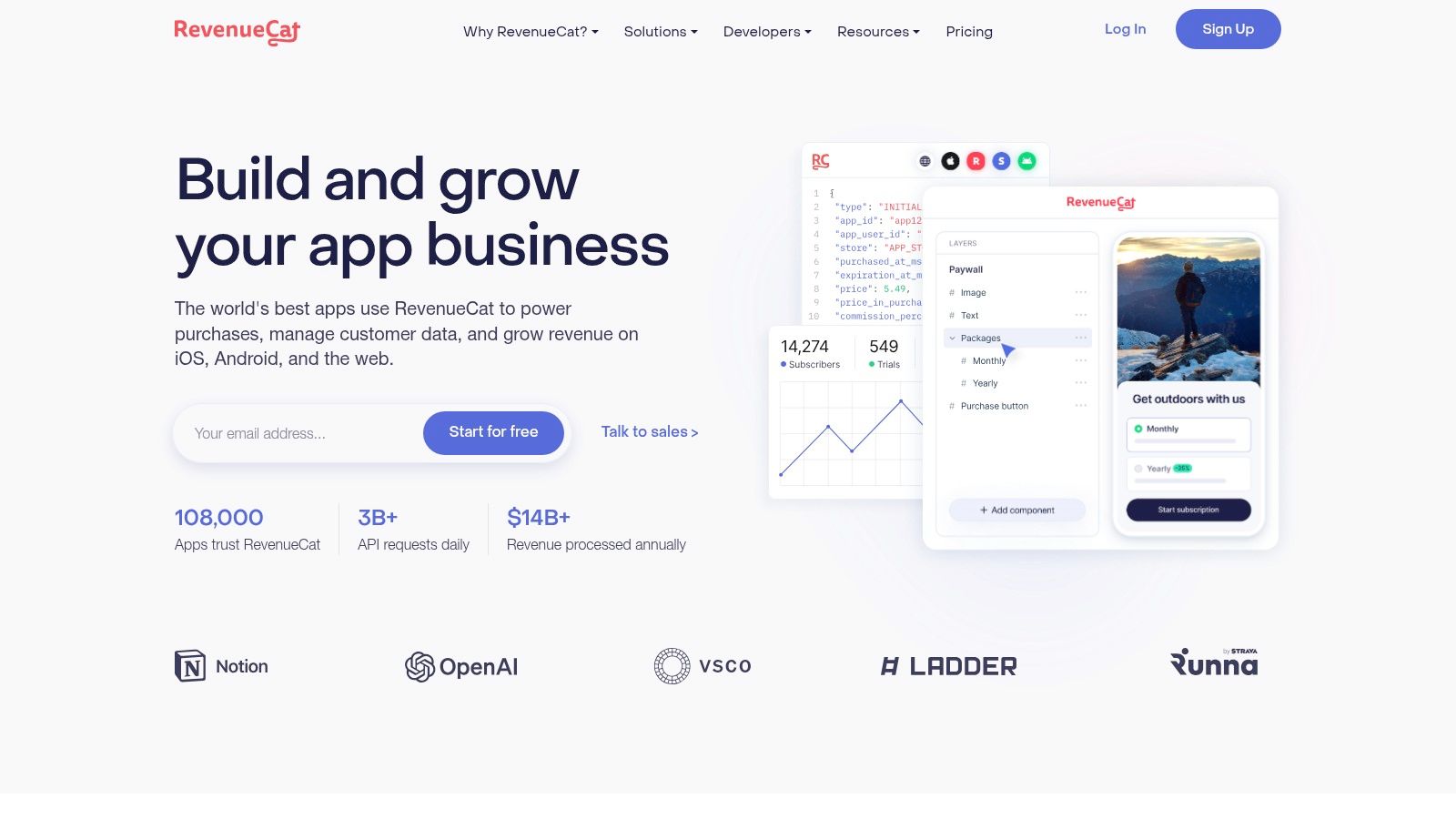
If your main pain is subscription infrastructure, not creative control, RevenueCat remains one of the safest Superwall alternative options. It reduces a lot of StoreKit and Google Play Billing complexity, handles server-side receipt validation, and gives teams a mature entitlement layer with broad SDK coverage.
That makes it a strong pick for engineering teams that don't want to build and maintain their own subscription backend. It's also one of the easiest tools to justify when finance, support, and product all need a shared system of record for purchases and access.
Where it wins
RevenueCat is less opinionated about flashy growth design and more opinionated about clean subscription plumbing. That's often the right trade. If broken entitlements, messy subscription state, or reconciliation issues are hurting the business, fixing that matters more than shipping a prettier paywall.
It also helps that RevenueCat already documents a Superwall integration for dynamically updated paywalls tied to subscription metrics. That tells you where it sits in the stack. It can be the billing and customer data layer even if another tool owns presentation.
RevenueCat is usually the right answer when your team says, “We need a reliable subscription backend first, then we'll decide how much journey orchestration we need on top.”
The main caution is pricing model sensitivity at scale. The market has moved toward evaluating total cost of ownership, not just launch speed. That's also why teams compare it with broader stacks and think harder about where free trials, win-backs, and retention offers should live. If that's your current debate, this guide on product free trial strategy is the more useful lens than a simple feature checklist.
RevenueCat is strongest when entitlements are the center of the problem. It's weaker if your team wants one visual system for onboarding, surveys, branching, in-app campaigns, and paywalls across multiple surfaces.
3. Adapty
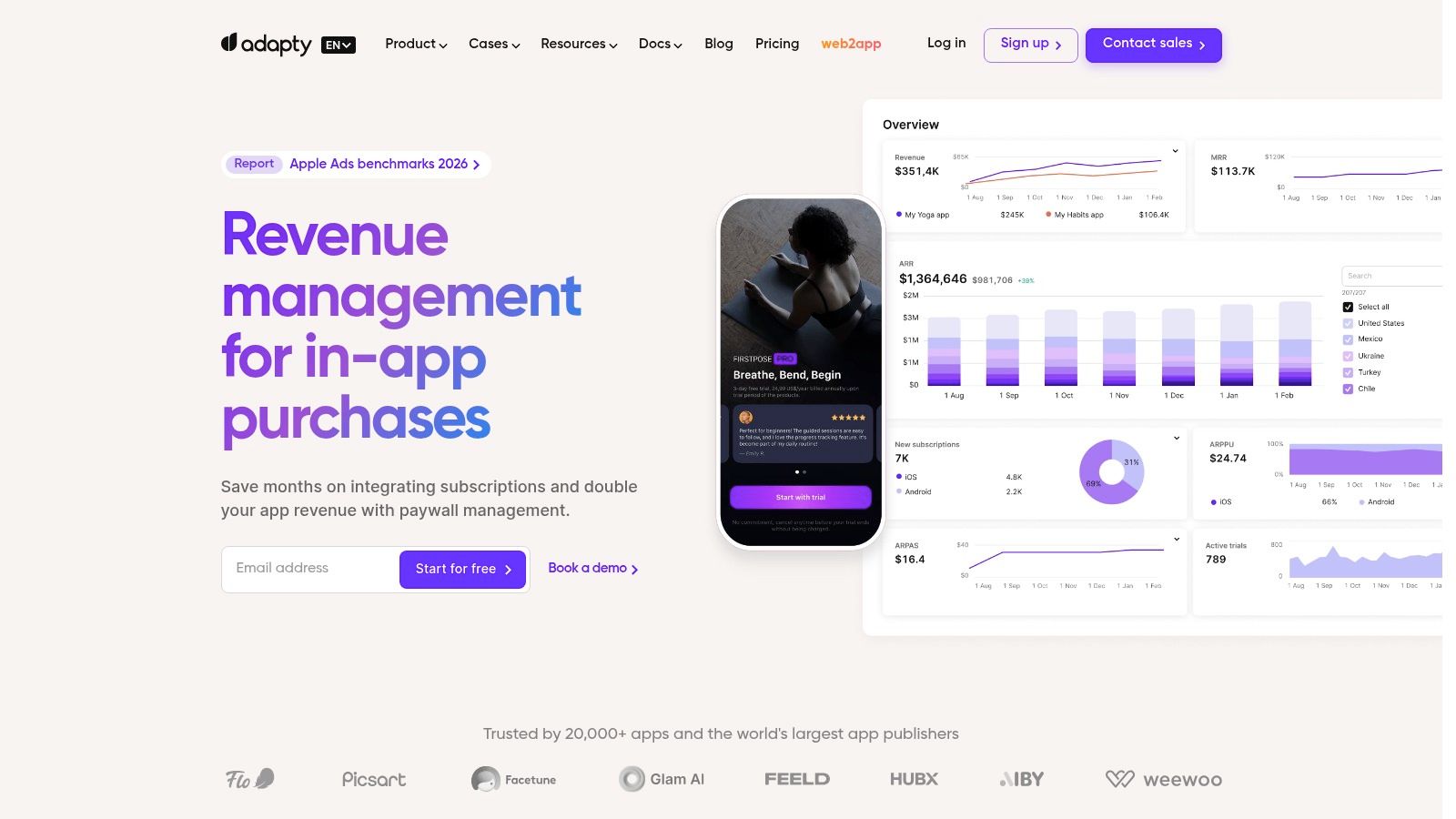
Adapty is one of the clearest examples of why teams move beyond a Superwall-style setup. It combines purchase infrastructure, analytics, and a visual flow builder, so you're not forced to bolt a separate subscription backend onto a separate paywall tool.
That all-in-one approach is the core appeal. If your product and growth teams want to launch onboarding and pricing tests without app releases, Adapty gives them a more unified operating model than a paywall-only product.
Why teams shortlist it
Adapty explicitly positions itself around subscription management at scale, predictive churn analytics, and self-running A/B tests. That's a different posture from Superwall's narrower focus. It's closer to a growth stack with monetization at the center.
It also supports the practical workflow many teams want now: marketer-led or PM-led experiments, native rendering via SDK, and revenue analytics that sit close to the purchase system instead of being split across tools.
A lot of teams arrive here after realizing their launch problem isn't “how do I build a paywall?” but “how do I ship and iterate the entire monetization path?” That includes onboarding, offer sequencing, pricing presentation, and post-purchase tracking.
- Best fit: Subscription apps that want one platform for paywalls, onboarding flows, and revenue analytics.
- Watch for: Migration planning if you already have entitlements, analytics events, and experiments spread across several vendors.
- Less ideal for: Teams that want a more provider-agnostic orchestration layer and don't want core growth workflows centered in a subscription platform.
For teams still sorting out first-launch sequencing before they optimize everything else, launching the app with the right growth instrumentation matters as much as the tool choice.
Adapty is one of the best alternatives if you want more than a paywall builder, but still want monetization to be the organizing principle of the stack.
4. Qonversion
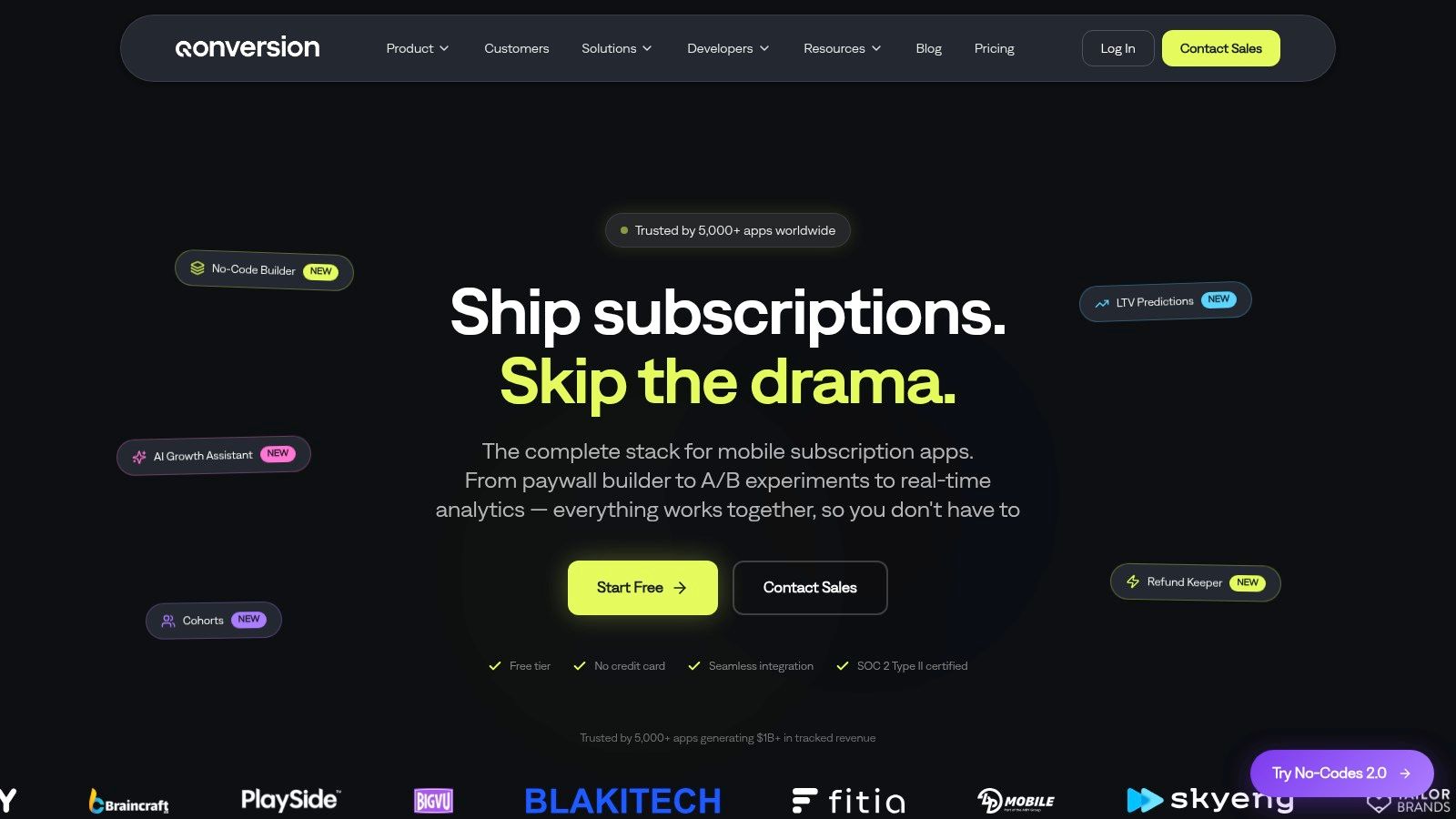
Qonversion makes the strongest case when your team thinks in experiments first. It's not just about changing a paywall template. It's about testing offers, trial structures, pricing variables, copy, and remote-config behavior with enough rigor that growth decisions don't turn into opinion contests.
That “variables” pattern is what I'd focus on. It gives product and growth teams more room to change monetization behavior without resubmitting the app, but it still expects disciplined instrumentation. If your event taxonomy is messy, the platform won't save you.
Good fit for experiment-heavy teams
Qonversion is useful when teams want to control more than presentation. If your roadmap includes remote text changes, pricing tests, offer sequencing, and segment-specific variants, it gives you a flexible layer to run those tests.
The upside is speed. The downside is governance. Once teams realize they can change a lot without releases, they can also create a lot of noise without a clear experiment framework.
The more flexible the remote variable system is, the more important it becomes to lock naming, ownership, and rollback rules before you scale usage.
I'd put Qonversion in the shortlist for consumer subscription apps with an active experimentation culture. I'd be more cautious for teams that want polished visual journey building out of the box, or for studios that need richer non-paywall experience orchestration across onboarding and retention moments.
5. Apphud
Apphud tends to appeal to teams that want practical subscription analytics and experiments without buying into a heavier enterprise motion. It's especially usable if you care about attribution at the placement level, meaning you want to know which screen or trigger drove the conversion.
That framing is more useful than it sounds. A lot of mobile teams over-focus on paywall design and under-focus on where the paywall appears, what preceded it, and which user state triggered it.
Where Apphud is strong
Its JSON-driven paywall approach gives engineers control, and its placement model helps product teams reason about context. That can be a good combination for mid-market apps that want clarity more than glossy tooling.
There is a trade-off. Compared with visual builders, JSON-driven systems can create more work for developers and designers. You often get flexibility, but not always speed for non-technical teams.
- Why teams like it: Clear experimentation concepts, straightforward docs, and a sensible model for connecting placements to outcomes.
- Why some teams move on: If growth managers want to own more of the build-and-ship workflow directly, the implementation can feel more developer-mediated than visual flow tools.
Apphud is a solid Superwall alternative when you want practical analytics and paywall experimentation, but not necessarily a full visual growth OS.
6. Purchasely
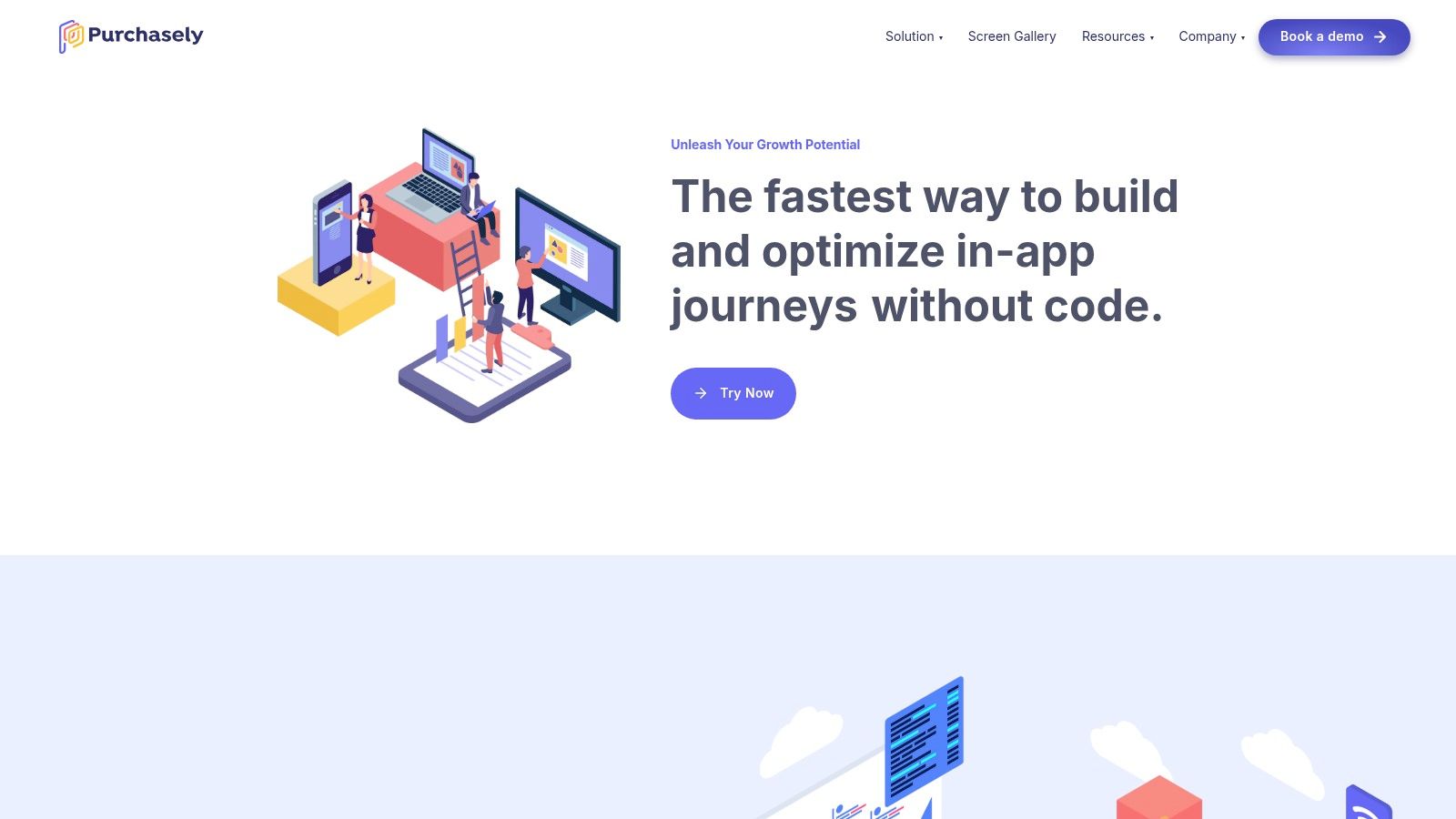
Purchasely is worth a serious look if your app has stronger brand requirements and more complex in-app journeys than a basic subscription funnel. It's often a better fit for publishers, media products, and apps that need native-feeling onboarding, promotions, and win-back sequences across multiple stores.
The native-builder approach is the selling point. Some teams don't want a webview feel or a limited paywall template system. They want their monetization screens to match the rest of the app closely, especially when brand trust affects conversion.
Best use cases
Purchasely is a good option when monetization is tied to a broader product journey. Think onboarding paths, promotional surfaces, churn prevention flows, and reactivation moments, not just the first subscription pitch.
It also helps that the market is putting more weight on cross-platform and non-mobile journey design. Nami's comparison messaging explicitly frames the need for one subscriber journey across iOS, Android, React Native, Next.js, web, and major connected TV platforms (Nami's Superwall comparison). Even if you don't choose Nami, that framing is useful. It's a reminder that “mobile paywall tool” can be too small a category for the problem.
Purchasely is less ideal if you need self-serve pricing transparency up front. It's a stronger fit for teams willing to go through a sales process to get a more customized setup.
7. Nami ML
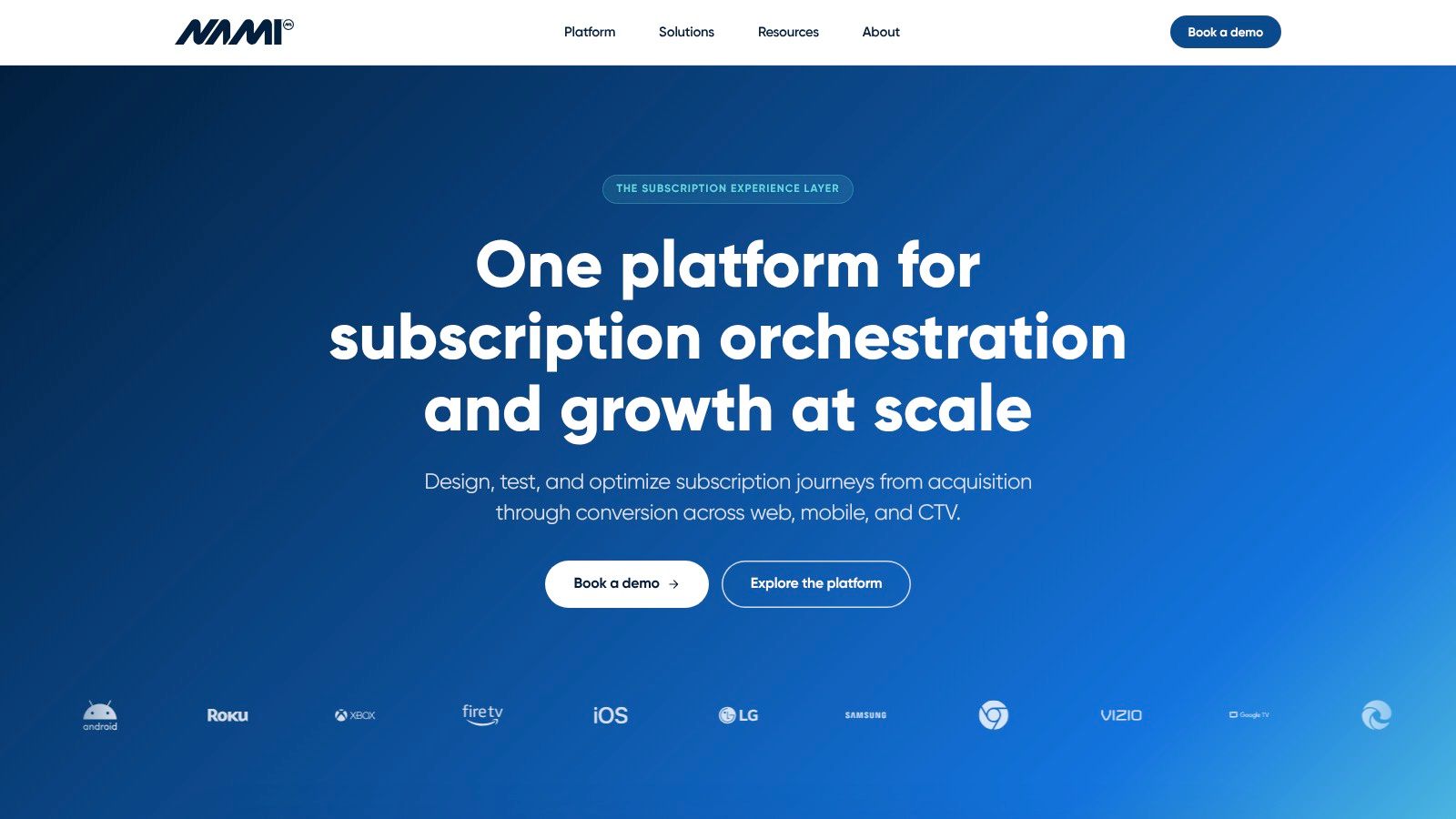
Nami ML fits teams that have outgrown a paywall tool and now need a system for managing the full subscriber journey. If Superwall solves presentation, Nami is closer to subscription operations: paywalls, entitlements, access control, audience logic, and governance across products.
That distinction matters once revenue depends on more than a single checkout screen. A streaming app, publisher, or multi-brand mobile business usually needs the same subscriber state to carry across onboarding, purchase, renewal, win-back, and access on other platforms. Nami is built for that kind of environment.
Where Nami makes sense
Nami is strongest when the hard part is coordination. Multiple apps, shared subscription rules, separate growth and engineering teams, and pressure to keep billing logic consistent across iOS, Android, web, and TV apps all push you toward a more centralized platform.
According to Global Market Insights' alternative data market analysis, the alternative data market was estimated at USD 4.9 billion in 2023, with strong projected growth through 2032. The takeaway for mobile teams is straightforward: buyers increasingly want systems that connect targeting, experimentation, analytics, and access control instead of stitching together isolated tools.
That does not mean Nami is the right default for every app.
It is a better fit for companies standardizing subscriber operations across channels than for indie teams trying to ship a paywall test this week. The trade-off is complexity versus control. You get broader orchestration and stronger governance, but you should expect a heavier evaluation cycle, more implementation planning, and less of the quick self-serve feel you get from simpler point solutions.
8. Glassfy

Glassfy is the alternative I'd look at when a team wants more ownership and less dependence on a platform's commercial model. Its open-source angle and cross-store support make it attractive for MVPs, lean product teams, and developers who care about portability.
That said, this is one of those tools where you should verify support expectations early. Open and flexible is good. Open and under-supported is not, especially once real revenue depends on billing state and entitlements staying accurate.
Why teams consider it
Glassfy makes sense when you want subscription infrastructure with a lighter commercial posture and a bias toward data ownership. It can be a strong choice for prototypes and straightforward subscription products.
The primary trade-off is depth. If you need advanced visual flow building, richer campaign logic, or a full experimentation environment, you may outgrow it faster than you would with more opinionated growth platforms.
Choose Glassfy when control and lean implementation matter more than having every growth surface in one UI.
I'd put it in the “good technical base, less complete growth system” bucket. For some teams, that's exactly right.
9. IAPHUB
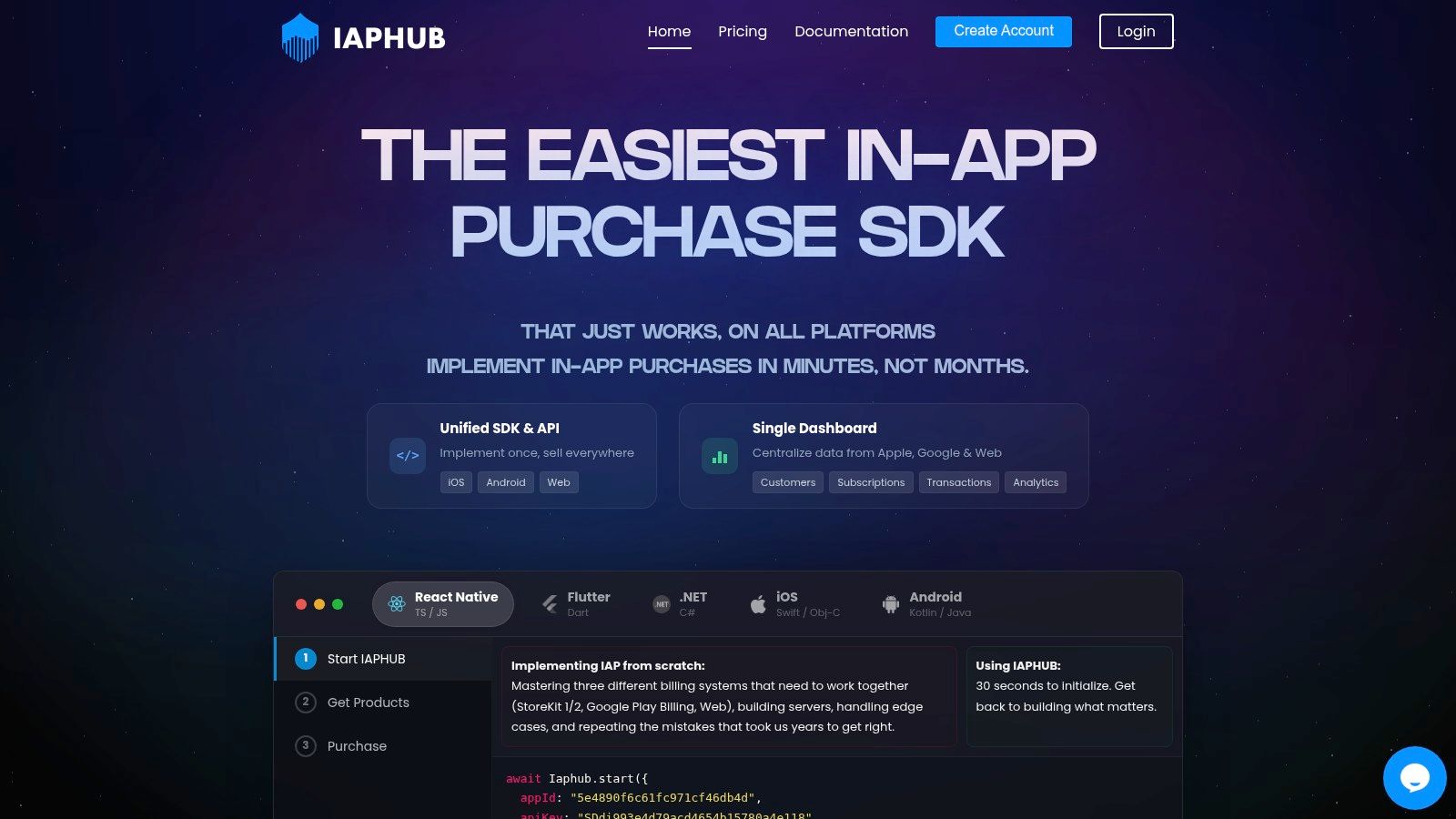
IAPHUB is the straightforward option for lean teams that need in-app purchase infrastructure without a lot of ceremony. Receipt validation, entitlement sync, remote product listings, and a web billing path cover the basics well.
This isn't the choice for teams chasing the most advanced visual paywall experimentation. It's the choice for teams that want a clean backend, predictable setup, and enough flexibility to support app-store plus web billing scenarios.
What to expect
IAPHUB works best when your app doesn't need a heavy growth orchestration layer yet. You know you need reliable billing infrastructure, but you're still comfortable building more of the user-facing experience yourself.
That can be an advantage. A lot of teams adopt complex tooling before they've validated enough of the monetization model to justify it.
- Strong fit: Lean SaaS apps, indie products, and teams adding subscription sync plus web checkout without rebuilding their backend.
- Weak fit: Teams expecting no-code journey design, advanced segmentation, and large-scale remote experimentation from day one.
IAPHUB is practical. It's not glamorous, but sometimes practical is exactly what you need.
10. Appflow.ai

Appflow.ai fits teams that have outgrown hardcoded paywalls but are not ready to buy into a full mobile growth stack. If your immediate job is to test pricing, compare paywall variants, and clean up subscription reporting, it covers that layer without forcing a bigger platform migration on day one.
That focus is both the appeal and the limitation.
For early-stage subscription apps, a narrower tool can be the right call. You get faster setup, less operational overhead, and enough experimentation capability to answer basic monetization questions. If your roadmap already includes onboarding logic, lifecycle messaging, segmentation tied to entitlements, and coordinated testing across the whole user journey, Appflow.ai will start to feel incomplete.
When a lighter stack makes sense
Appflow.ai works best when monetization is the main problem you are solving right now. It gives product and growth teams a way to ship paywall changes without waiting on app releases, track core subscription outcomes, and build a more disciplined testing loop.
The trade-off is scope. Superwall alternatives look similar if you only compare paywall editors. They look very different once you evaluate who can handle onboarding, activation, monetization, and retention in one system. Appflow.ai sits closer to the point-solution end of that spectrum.
Mordor Intelligence, in its alternative data market forecast, projects the market at USD 17.78 billion in 2026 and USD 143.87 billion by 2031. The exact numbers matter less than the direction. Teams are buying more decisioning and analytics tooling, which usually raises expectations for experimentation depth and lifecycle coordination.
That is the practical lens to use here. Appflow.ai is a reasonable choice if you need a focused monetization layer today and want to avoid overbuilding too early. It is a weaker fit if you are replacing Superwall because you want one platform to manage the full path from first-run experience to revenue expansion.
Top 10 Superwall Alternatives: Features & Pricing Comparison
| Product | Core features | Quality ★ | Pricing 💰 | Target 👥 | Unique ✨ |
|---|---|---|---|---|---|
| Nuxie 🏆 | AI generator, visual flow editor, analytics & entitlements, offline-first runtime | ★★★★☆ (fast, reliable) | 💰 Free-to-start; Pro $9.99/mo or $49.99/yr | 👥 Product/growth & mobile app/game teams | ✨ Natural-language screen gen, sub-50ms cached flows, built-in billing (no revenue-share) |
| RevenueCat | Subscription backend, server receipt validation, paywalls, revenue analytics | ★★★★☆ (mature, scalable) | 💰 Usage-based (on tracked revenue) | 👥 Teams needing proven infra & compliance | ✨ Large ecosystem, real-time revenue & cohort analytics |
| Adapty | Visual Flow/paywall builder, A/B tests, cohort & LTV analytics | ★★★★☆ (marketer-friendly) | 💰 Tiered; growth add-ons (Apple Ads, Refund Saver) | 👥 Marketer-led growth teams | ✨ Rapid server-driven experiments without releases |
| Qonversion | Experiments-first A/B stack, remote variables, real-time subscription metrics | ★★★★☆ (statistical guidance) | 💰 Plan limits vary; check thresholds | 👥 Data-driven teams focused on experimentation | ✨ Statistical-significance guidance + flexible remote vars |
| Apphud | Remote JSON paywalls, A/B tests, placements, cohort analytics | ★★★★☆ (practical mid-market) | 💰 Transparent public pricing with MTR tiers | 👥 Mid-market apps experimenting with paywalls | ✨ Placement-based attribution & ASA support |
| Purchasely | No-code native paywall & journey builder, multi-store IAP infra | ★★★★☆ (brand-focused) | 💰 Sales-led pricing (contact) | 👥 Publishers & media apps needing branded journeys | ✨ Broad store coverage (App Store, Play, Huawei, Amazon) |
| Nami ML | No-code subscription journeys, entitlement orchestration, governance | ★★★★☆ (enterprise posture) | 💰 Enterprise pricing (contact sales) | 👥 Brands centralizing subscription UX & entitlements | ✨ Enterprise-grade orchestration & governance controls |
| Glassfy | Open-source SDK + backend, multi-store support, real-time events | ★★★★☆ (DIY, owner-data) | 💰 Zero‑MTR messaging; verify commercial terms | 👥 Teams that want to own data & reduce commission leakage | ✨ Open-source SDK + cross-store infra |
| IAPHUB | Receipt validation, remote product listings, web billing (Stripe), webhooks | ★★★★☆ (lean & clear) | 💰 Clear self-serve tiers; affordable entry | 👥 Lean teams wanting simple entitlements + web checkout | ✨ Straightforward SDK + Stripe hosted checkout |
| Appflow.ai | Real-time revenue analytics, no-code paywall A/B, cross-platform SDKs | ★★★☆☆ (lightweight) | 💰 Lower effective costs for early stages | 👥 Indies & small teams testing pricing/layouts | ✨ Affordable experimentation stack with quick setup |
The Future of Mobile Growth Is Connected
A team adopts Superwall to launch paywalls quickly. A few months later, the main work sits in five places: onboarding in app code, billing in a separate platform, analytics in Amplitude or Mixpanel, lifecycle messaging in Braze or OneSignal, and entitlement edge cases buried in support tickets. At that point, the problem is no longer paywall velocity. It is system fragmentation.
That is the standard to use when choosing a Superwall alternative. Evaluate the platform against the full user journey, from first session to renewal and win-back, not just the paywall editor. If the tool cannot coordinate onboarding logic, targeting, experiments, billing state, and post-purchase experiences, your team still owns the glue code and the operating overhead.
The better buying question is simple: what will your growth stack look like after 12 months of iteration?
A point solution can be enough for an app that only needs faster paywall tests. It starts to break down when pricing logic, offer eligibility, trial messaging, web checkout, or entitlement recovery need to work across multiple surfaces and teams. That is where platform design matters. You are choosing data ownership, workflow speed, and the number of systems your team has to keep in sync.
A useful evaluation usually comes down to four checks:
- Journey coverage: Can the platform handle onboarding, segmentation, monetization, and retention flows, or does it stop at the paywall?
- Billing and entitlement ownership: Does it give your team a clear source of truth for access state, renewals, cancellations, and restores?
- Channel and client support: Will it still fit if you add web billing, React Native, Flutter, Unity, or other surfaces on the roadmap?
- Cost at scale: Does pricing stay reasonable once revenue, events, experiments, or managed seats increase?
This is also why migration planning matters. Replacing Superwall is rarely just a UI change. It often means reworking event schemas, purchase validation, remote config, audience logic, and experiment reporting. Teams that choose a broader platform usually spend more time upfront on implementation, then save time every week because product, growth, and engineering work from the same operating layer.
The next generation of mobile growth tools will be judged on execution, not editor polish. The winners will connect analytics, monetization, entitlement state, and lifecycle actions tightly enough that teams can ship and learn without rebuilding the same logic across vendors.
If your team wants one system for onboarding, paywalls, experiments, analytics, billing, and entitlement-aware journeys across iOS, Android, React Native, Flutter, Unity, and Unreal, Nuxie is the strongest fit in this list. It is built for teams that want to run mobile growth as one connected system instead of assembling it from separate point tools.