10 Best Subscription Management Software of 2026
Find the best subscription management software for mobile, games, and SaaS. We compare 10 top platforms on features, pricing, use cases, and tech stack fit.
A team ships subscriptions on iOS first, adds Android a quarter later, then launches a web checkout for acquisition. Billing goes live quickly. The harder work starts after that. Users expect purchases to carry across platforms, product wants to test paywalls and onboarding without waiting on app review, and support needs a clear answer when access fails.
That is why subscription management becomes a stack decision, not just a payments decision. The system you choose ends up owning entitlement state, store validation, pricing logic, experiment rollout, analytics events, and often part of your release process. For engineering leads, the core question is not which tool has the longest feature list. It is where subscription logic should live and how much operational complexity your team wants to carry.
For mobile and game teams, two categories get mixed together far too often. Mobile-first platforms are built around SDKs, app store integrations, runtime entitlements, and cross-platform access control inside the product. Web-first billing platforms are built around checkout, invoices, tax, dunning, and finance operations. Both can be good choices. They solve different problems and create different integration paths.
That distinction matters most when your app spans iOS, Android, React Native, Flutter, Unity, Unreal, and the web. A web billing tool can be strong for finance and weak for in-app entitlement orchestration. A mobile subscription platform can reduce app-side complexity, but it may not replace the finance tooling a SaaS team expects. If your team is weighing those trade-offs, this subscription management solutions guide for mobile and cross-platform products is a useful reference point before you commit.
The tools below are grouped with that split in mind, so you can evaluate them against the architecture you need to support.
1. Nuxie
Nuxie is the most opinionated pick on this list because it treats subscription management as part of a broader in-app growth system, not as an isolated billing layer. That's a good fit for mobile apps and games that need to ship onboarding quizzes, surveys, feature announcements, paywalls, retention offers, and liveops moments across iOS, Android, React Native, Flutter, Unity, and Unreal without waiting for repeated app releases.
What stands out is the combination of in-app experience delivery, experimentation, analytics, billing, and entitlement infrastructure in one platform. Paywalls are part of the product, but they aren't the whole story. If your team wants to connect "user saw onboarding answer A" to "user got paywall variant B" to "user received entitlement C" in a single system, Nuxie is built for that shape of workflow.
Where it fits best
Nuxie is strongest when your problem isn't only payment recovery. It's when billing data has to drive runtime behavior inside the app or game. That includes cross-platform feature gating, personalized offers, on-device targeting, offline-ready delivery, and rich in-app experiences with Rive-powered animations.
It can work alongside or replace tools like RevenueCat, Superwall, StoreKit, and Google Play Billing. It's also provider-agnostic and doesn't charge a revenue-share fee for billing or entitlement data, which changes the economics for teams that don't want a fast-growing monetization layer to become an ongoing tax on top-line revenue.
Practical rule: If product, growth, and engineering keep handing the same subscription state back and forth between separate analytics, paywall, and entitlement tools, you probably need a unified runtime more than another billing dashboard.
For teams evaluating architecture, Nuxie is closest to a product operating layer for subscription apps and games. This overview of subscription management solutions is useful if you're mapping build-vs-buy boundaries before implementation.
Trade-offs to watch
The trade-off is scope. A platform that covers experimentation, analytics, remote UI delivery, and entitlements will ask more from your initial integration than a lightweight receipt wrapper. Teams need to think through SDK rollout, event taxonomy, entitlement ownership, fallback behavior, and who manages campaigns after launch.
Another caveat is procurement visibility. Public pricing, customer testimonials, and certifications weren't available in the provided product details, so you'll need to ask Nuxie directly for current pricing, SLA details, and reference customers before you commit.
Best for
- Cross-platform apps and games: Teams shipping across iOS, Android, React Native, Flutter, Unity, or Unreal
- Remote iteration: Product and growth teams that want to ship paywalls, onboarding, and retention flows without store release cycles
- Provider flexibility: Teams that want billing and entitlements to work with existing providers instead of forcing a full rip-and-replace
Watch for
- Initial setup depth: More moving parts than basic subscription analytics tools
- Org adoption: Product, engineering, and growth need shared ownership to get the most from it
Website: Nuxie
2. RevenueCat
A common scenario: the app team ships on iOS and Android, maybe adds web later, and suddenly subscription state becomes a distributed systems problem. Store receipts arrive on different timelines, entitlement rules drift across clients, and support starts handling "I paid but premium is locked" tickets. RevenueCat exists to remove that backend burden for mobile teams that need store-native purchases to resolve into a single customer state.
That mobile-first focus is the key distinction. RevenueCat is closer to infrastructure for apps and games than to a web billing platform like Stripe Billing or Paddle. If your primary problem is App Store and Google Play subscription handling, entitlement sync, and cross-platform access control inside the app, it fits the architecture well. If your primary problem is invoicing, taxes, sales-led B2B billing, or finance workflows, look elsewhere.
I usually recommend RevenueCat when a team wants to buy the subscription backend layer, keep app code relatively clean, and avoid maintaining receipt validation services long term. The SDKs are mature, the docs are clear, and the core model is practical: products map to entitlements, clients read current access state, and backend systems react through webhooks. That is a good trade if engineering time is better spent on gameplay, onboarding, or retention work instead of store edge cases.
RevenueCat also leaves room for teams that already have opinions about the rest of the stack. You can pair it with your own paywalls, your own analytics pipeline, or a separate experimentation system. For teams comparing those options, this guide to mobile paywall A/B testing for subscription apps is a useful companion.
Where RevenueCat works well
RevenueCat is strongest in mobile and game environments where entitlement accuracy matters more than broad billing breadth. That includes cross-platform apps that need one source of truth for access across iOS, Android, and web, plus Unity or React Native teams that do not want platform-specific purchase logic spread through the client.
It is also a practical middle ground for teams that are not ready for a larger monetization platform. You get subscription infrastructure, customer state, webhook-driven backend integration, and enough monetization tooling to support common mobile workflows without committing to a heavier all-in-one system.
Main trade-offs
The pricing model, based on Monthly Tracked Revenue, is easy to justify early and worth modeling carefully later. As revenue grows, platform cost becomes a bigger architectural discussion, especially if finance is pushing for tighter margin control or if you expect high-volume, low-ARPU subscription traffic.
There is also a scope boundary to understand. RevenueCat handles mobile subscription infrastructure well, but it is not trying to replace every growth, CRM, or billing system around it. Teams still need to decide where paywall presentation lives, where experiments are configured, how analytics events are defined, and whether web billing should share the same ownership model or live in a separate stack.
Best for
- Mobile-first subscription apps and games: Teams that need App Store and Google Play purchases translated into stable entitlement logic
- Cross-platform entitlement management: Teams supporting iOS, Android, and additional clients that need consistent access state
- Build-vs-buy pragmatists: Product and engineering teams that want to avoid maintaining receipt validation and store sync internally
Watch for
- Revenue-based pricing growth: Costs can become more visible as tracked revenue scales
- Partial stack coverage: You may still need separate tools for web-first billing, finance operations, or advanced paywall management
Website: RevenueCat
3. Adapty
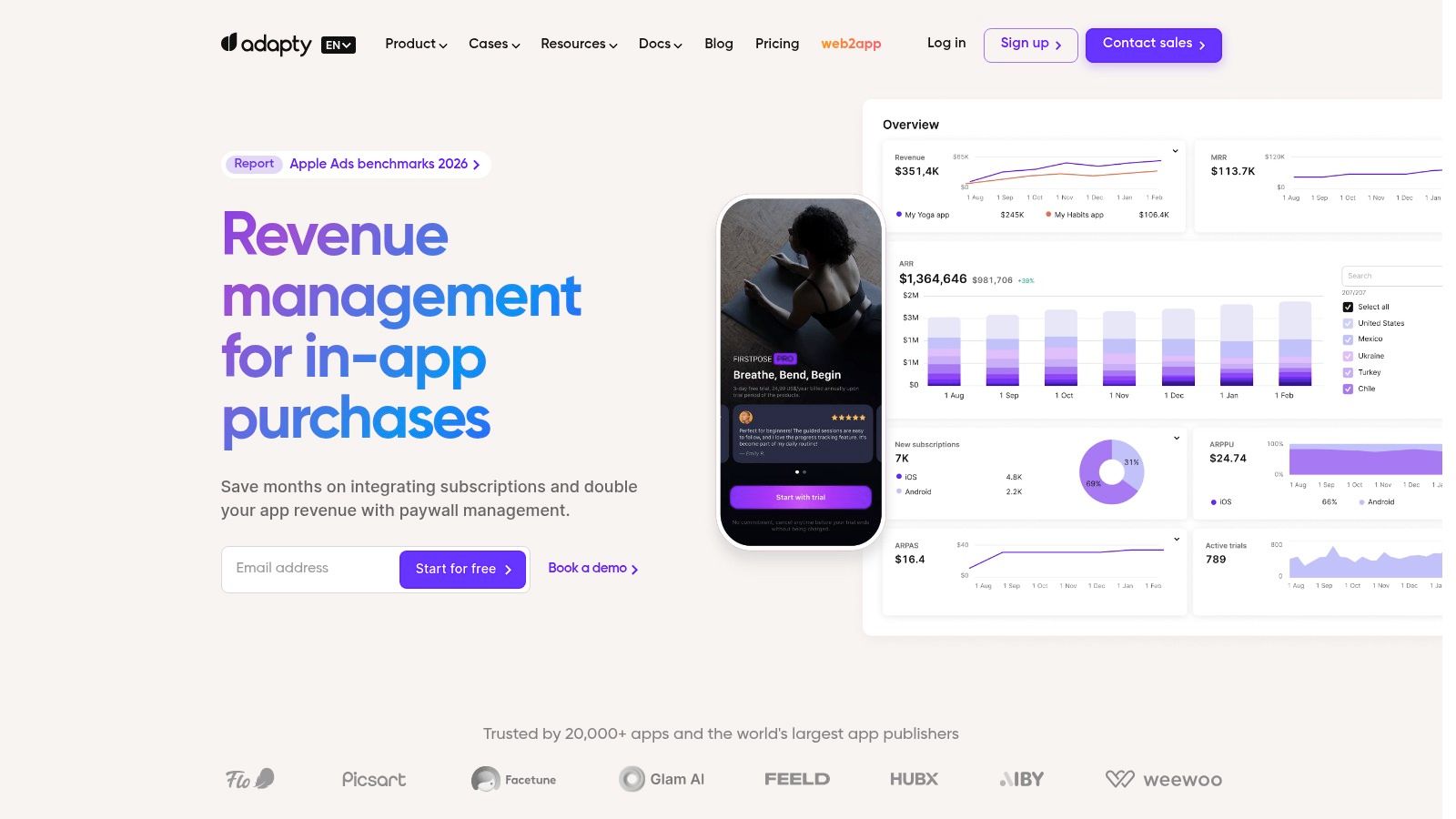
Adapty is a good fit when the monetization team wants to move faster than the app release process. Its appeal is straightforward: cross-platform subscription SDKs, remote paywall and onboarding builders, experiments, and analytics in a package that product and growth teams can use without routing every UI change through engineering.
That matters even more for React Native and Flutter teams. A single codebase can reduce development time by about 200 hours compared with building separate native apps, and a remote paywall system compounds that benefit because teams can update pricing surfaces and creatives without splitting effort across native clients.
Where Adapty works well
Adapty is strongest when your primary bottleneck is paywall iteration. If your team constantly debates layout, offer hierarchy, trial messaging, or onboarding-to-paywall sequencing, its no-code builder and experimentation workflow can remove a lot of release friction.
The platform also supports a broad set of SDK targets, which makes it practical for companies with a mixed mobile stack. That includes native apps plus cross-platform surfaces that still need store-backed subscriptions and coherent analytics.
Best for
- Fast paywall iteration: Teams that want product and growth to own more of the monetization surface
- Cross-platform monetization: Apps built across native and hybrid frameworks
Trade-offs
The biggest issue isn't product quality. It's stack overlap. If you already have an effective internal paywall renderer, remote config setup, or onboarding system, Adapty can become one more monetization surface to maintain. Growth add-ons can also expand cost as usage grows.
Website: Adapty
4. Apphud
Apphud is one of the more practical options for teams that want mobile subscription analytics and experimentation without stepping into a heavier enterprise contract too early. The feature that makes it easy to trial is observer mode. You can evaluate analytics with less commitment before turning Apphud into a deeper part of your billing and entitlement flow.
That reduces risk during evaluation, which is useful if you inherited a messy monetization stack or if engineering is skeptical of another SDK. In practice, observer-style adoption paths help teams answer a better question than "Does this tool have enough features?" The critical question is "Can we trust the data before we route access decisions through it?"
Why teams choose it
Apphud covers the core mobile needs well: receipt validation, cross-platform entitlements, analytics, pricing experiments, and paywall tooling. I also like that it tends to appeal to teams who prefer clearer fee structures over revenue-share-heavy models.
Integration heuristic: Start by validating analytics and event consistency. Only then move entitlement ownership or paywall rendering into the new platform.
Trade-offs
Apphud's ecosystem is smaller than some larger rivals, so you should verify the exact integrations your data team and CRM stack need. Also, feature access varies by plan, which means your shortlist should include a packaging review, not just a feature review.
Best for
- Low-risk evaluation: Teams that want to test analytics before a full migration
- Predictable budgeting: Teams that prefer published tiering over more variable monetization-based pricing
Website: Apphud
5. Qonversion
Qonversion is interesting because it gives teams more than one adoption path. You can use it as a fuller subscription management layer or keep it closer to analytics and observer workflows, depending on how much infrastructure you want to replace. That's a smart shape for teams with legacy billing code they don't want to rip out in one sprint.
The product is especially useful when pricing configuration itself is part of experimentation. Offerings, product configuration, and variables that inject live store pricing into paywalls all make sense for teams that run frequent offer tests and don't want hardcoded values spread across clients.
Where it fits
Qonversion works well for mixed mobile and web purchase stacks, especially when one team needs unified subscription events across channels but another team still wants some control over checkout or plan configuration. It supports iOS, Android, React Native, Flutter, Unity, and web, which makes it viable for apps with companion web purchases or game-adjacent storefronts.
Cross-platform frameworks like Flutter and React Native are recommended for projects that need expedited deployment on both iOS and Android, so it helps when the subscription layer also respects that cross-platform reality instead of assuming a purely native app.
Trade-offs
Public pricing isn't clearly listed, so expect a sales conversation. The third-party ecosystem also isn't as broad as the biggest incumbents, so check downstream tooling before you standardize on it.
Best for
- Flexible adoption: Teams that want analytics first and subscription management later
- Pricing experiments: Teams that need remote product configuration and offer testing
Website: Qonversion
6. Purchasely

Purchasely sits closer to the in-app experience side of subscription management. That's why it tends to appeal to teams that don't want billing and monetization visuals split across separate tools. Native paywall screens, in-app messaging, experiments, lifecycle events, and entitlement handling all point toward a more centralized growth workflow.
For product-led subscription apps, that's often the right abstraction. You don't just want to know whether payment succeeded. You want to control what the user saw before purchase, what they see after renewal failure, and what message appears when an entitlement changes.
Best use case
Purchasely makes the most sense when the team wants monetization UI to be operated remotely and tied to lifecycle communication. That's useful for subscription apps, but also for game teams that need event-driven offers, promotional screens, or player-specific upsell flows that react to state changes.
There's also a broader market reason these tools keep showing up. The subscription management software market was valued at USD 8.33 billion in 2025 and is projected to reach USD 20.83 billion by 2032 at a 14% CAGR. That growth reflects demand for infrastructure that can connect billing, entitlements, and runtime delivery more cleanly.
Trade-offs
Purchasely can overlap with adjacent tooling quickly. If you already use a dedicated experimentation platform, a separate messaging tool, and a custom entitlement service, you'll need to decide whether Purchasely replaces those or just adds another orchestration layer.
Website: Purchasely
7. Stripe Billing
Stripe Billing is excellent software. It just isn't a mobile subscription stack by itself. That's the core distinction many teams miss when comparing the best subscription management software across app and web products.
If you sell SaaS on the web, need hosted checkout, customer portals, usage-based billing, subscription schedules, invoice logic, and strong developer ergonomics, Stripe Billing is one of the best choices available. If you're selling in-app digital subscriptions inside iOS and Android apps, Stripe doesn't replace App Store or Google Play billing for those flows.
Where Stripe is the right answer
Stripe is the right center of gravity when your business is web-first or when web subscriptions are strategically important enough to justify a proper billing engine. It's also a solid layer for companion purchases, account upgrades, B2B plans, or usage-based add-ons that don't belong inside mobile in-app purchase systems.
Juniper Research projects that global subscription economy revenue will exceed $1.2 trillion by 2030, up from $722 billion in 2025. A lot of that growth depends on flexible multi-platform billing infrastructure, and Stripe is one of the clearest examples on the web side.
If your roadmap includes both app-store subscriptions and direct web billing, decide early which system owns customer identity and which system owns entitlements. That's where integration projects usually go sideways.
Trade-offs
Stripe's developer experience is strong, but tax, metering, and invoice logic still take engineering time. And for mobile teams, you still need another layer to reconcile store purchases and in-app access.
Best for
- Web-first subscriptions: SaaS and digital products sold outside app-store rails
- Custom billing logic: Teams that need quotes, schedules, metering, or advanced invoicing
Website: Stripe Billing
8. Paddle

A common scenario: the product team is focused on shipping pricing experiments, while finance is stuck dealing with VAT, failed payments, chargebacks, and entity setup across multiple regions. Paddle is built for that problem. Its Merchant of Record model takes on payment processing, tax collection, compliance, and recurring billing, which can remove a surprising amount of operational work from a web subscription stack.
That makes Paddle easier to justify for web-first companies than for mobile-first apps. For a SaaS team selling globally through the web, the value is obvious. For a mobile or game team, Paddle usually fits as a companion billing system for direct web purchases, not as the core layer for App Store or Google Play subscriptions.
The distinction matters. Mobile-first subscription infrastructure has to reconcile store receipts, user identity, and entitlement state across platforms. Paddle does not solve that category of problem on its own. It simplifies web commerce and back-office billing operations.
Why teams choose Paddle
Paddle is a good fit when the team wants one vendor to own checkout, tax, subscription billing, and payment compliance. That trade-off appeals to smaller SaaS companies, developer tools businesses, and teams expanding internationally before they want to build finance operations in-house.
It can also reduce stack sprawl. Instead of combining a payment processor, tax engine, invoicing layer, and parts of your compliance workflow, you put more of that responsibility in one system. If your roadmap is centered on improving retention and tracking subscription business metrics that actually affect growth, that simplification can free up engineering and ops time.
Trade-offs
Paddle is more opinionated than assembling your own billing stack. That can be a strength early on, but it also means less flexibility around edge-case billing logic, custom payment flows, or migrations from an existing Stripe-based setup.
For mobile teams, the limitation is clearer. Paddle can support web checkout and direct subscriptions, but cross-platform access still depends on how you map Paddle customers to app-store identities and how your entitlement service resolves conflicts between web and in-app purchases. If your hardest problem is subscription state inside iOS, Android, and game clients, mobile-first tools remain the better center of gravity.
Best for
- International web subscriptions: Teams that want tax, payments, and compliance handled in one platform
- Lean billing operations: Companies that prefer a more opinionated system over stitching together multiple web billing vendors
Website: Paddle
9. Chargebee
A team usually reaches Chargebee after lighter billing setups start creating work for finance, support, and engineering at the same time. Pricing logic lives in one system, invoices in another, revenue rules in spreadsheets, and every exception turns into a manual process. Chargebee fits that stage because it brings catalog management, proration, dunning, invoicing, tax support, entitlements, and revenue workflows into one billing layer.
That makes it a better fit for companies treating subscriptions as an operating system, not just a checkout flow.
Where it pays off
Chargebee works well when billing complexity is part of the product strategy. Usage-based pricing, hybrid plans, add-ons, contract terms, and finance review all fit more naturally here than in tools built mainly for app store subscriptions. Teams that monitor subscription business metrics tied to retention and revenue efficiency often want that level of control because pricing experiments affect forecasting, collections, and reporting, not just conversion.
The trade-off is architectural. Chargebee is strongest as a web-first subscription and finance platform. Mobile and game teams can use it for web billing, back-office reporting, and account lifecycle management, but it does not solve the hardest cross-platform problem by itself. If a user buys on the App Store, upgrades on Google Play, and expects access inside a game client and a web account immediately, you still need a separate entitlement strategy that can reconcile identities and purchase states across stores.
Trade-offs
Implementation usually takes real planning. Product owns packaging. Finance owns invoicing and revenue treatment. Engineering owns identity mapping, webhooks, and the downstream systems that depend on subscription state. That is manageable, but it is not a small-team, weekend setup.
Packaging can also get expensive and harder to unwind later if you adopt multiple add-ons early. Evaluate the migration path, API coverage, and reporting model before you commit, especially if your roadmap includes both direct web subscriptions and app-store purchases.
Best for
- Web-first SaaS and B2B billing: Teams that need strong control over pricing models, invoicing, dunning, and finance workflows
- Organizations with audit and reporting pressure: Companies that need subscription operations tied closely to accounting and revenue processes
- Hybrid stacks with separate mobile entitlement tooling: Teams using Chargebee as the billing system while another layer handles in-app purchase state
Website: Chargebee
10. Recurly
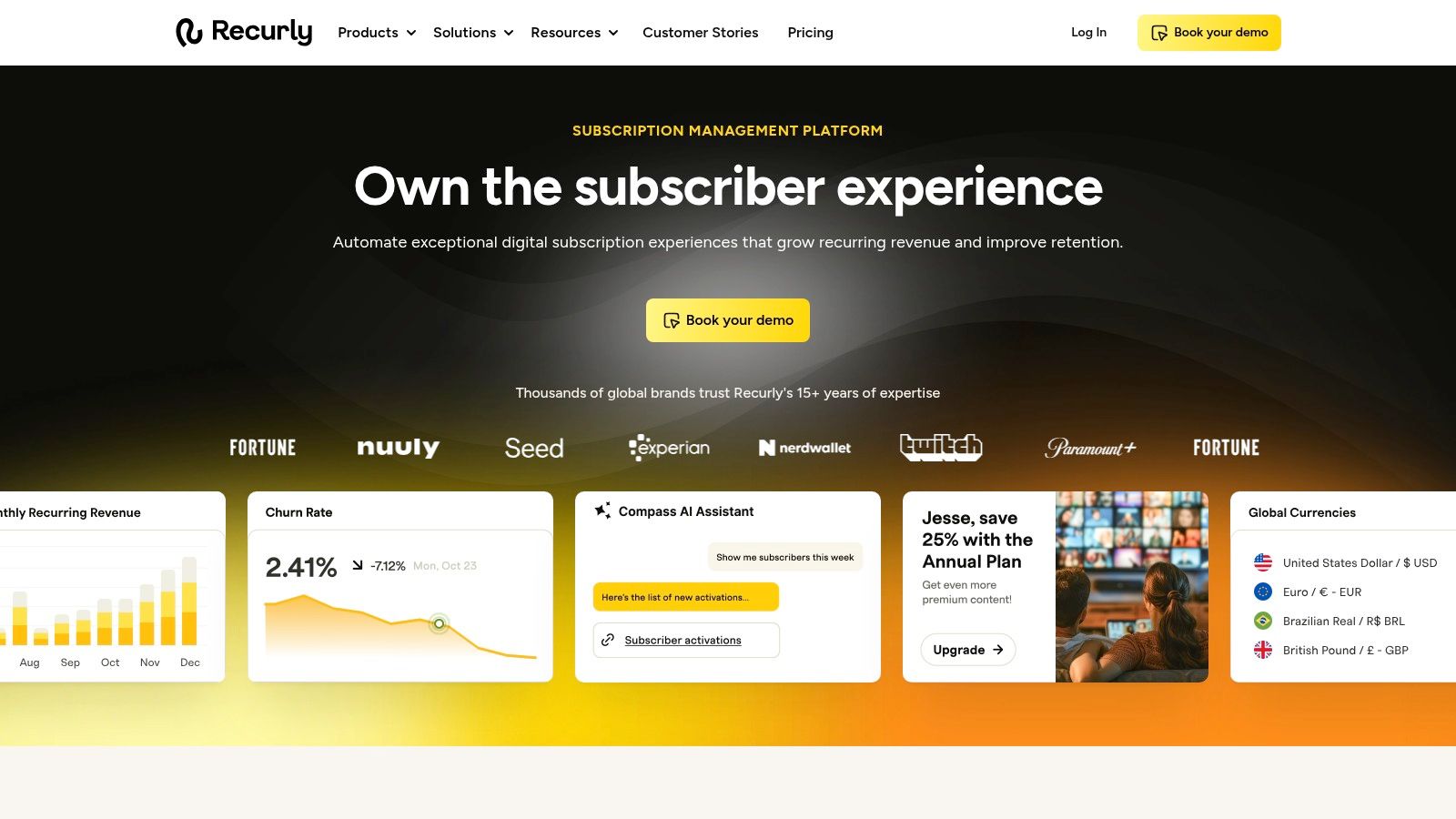
A team usually reaches Recurly after the simple billing setup starts breaking down. Finance wants cleaner invoicing and revenue treatment. Product wants more pricing flexibility. Engineering needs subscription state to stay consistent across checkout, renewals, retries, upgrades, and account changes. Recurly is built for that stage.
It handles fixed subscriptions, usage-based billing, and hybrid models well, with the kind of payment operations depth that matters once you support multiple regions, payment methods, and customer lifecycle paths. For companies running a serious web subscription business, that can justify the added implementation effort.
Where it fits
Recurly fits best when billing is part of the operating model, not just a checkout layer. Teams evaluating it are often dealing with plan migrations, failed-payment recovery, invoicing requirements, and finance workflows that need to line up with product packaging. In those environments, the trade-off is straightforward. You accept a heavier setup because replacing a weak billing foundation later is expensive.
For mobile and game teams, the line is important. Recurly is a web-first billing platform. It can support direct web subscriptions, back-office workflows, and reporting, but it does not resolve cross-platform entitlements on its own. If a player subscribes on the App Store and expects that state to carry into Android, web, and a live game client, you still need a separate entitlement layer to map identities and enforce access in real time.
That distinction matters in this category. Tools like Nuxie and RevenueCat are built around mobile purchase state and entitlement delivery. Recurly is better evaluated as the billing system that sits beside that layer, not as a replacement for it.
Trade-offs
Recurly makes more sense for teams with operational complexity than for teams chasing the fastest launch. Pricing usually includes a platform fee plus a share of billing volume, and advanced finance or retention capabilities may push you into higher tiers. That is manageable if you need the depth. It is hard to justify if your roadmap is still simple.
The other cost is implementation discipline. Engineering has to wire identity, webhooks, downstream provisioning, and reporting correctly. If your stack already includes app store subscriptions, that integration boundary gets sharper, because web billing state and mobile entitlement state are different systems and need explicit reconciliation logic.
Best for
- Mid-market and enterprise web billing: Teams with complex pricing, invoicing, and payment operations
- Hybrid subscription stacks: Companies using Recurly for web-first billing while a separate mobile layer handles app store entitlement state
- Organizations planning for billing longevity: Teams that would rather invest in a system with room for finance and lifecycle complexity than migrate again in a year
Website: Recurly
Top 10 Subscription Management Software Comparison
| Product | Core features / capabilities | 👥 Target audience | 💰 Value / Pricing notes | ✨ Unique selling points & ★ |
|---|---|---|---|---|
| Nuxie 🏆 | AI growth agent, flow editor, cross‑platform runtime, entitlements, on‑device targeting, Rive animations | Mobile apps & game teams needing fast experiments, paywalls & liveops | 💰 No revenue‑share; contact sales for pricing/SLA | 🏆 ✨ Remote publishing without app releases; provider‑agnostic analytics & entitlements; ★★★★☆ |
| RevenueCat | Unified subscription backend, paywalls, A/B testing, real‑time webhooks | Mobile teams that want a managed entitlement backend | 💰 MTR‑based pricing (scales with revenue) | ✨ Quick to implement; open‑source SDKs; strong mobile focus; ★★★★☆ |
| Adapty | Open SDKs, drag‑and‑drop paywall builder, experiments, LTV predictions | Teams iterating paywalls & pricing without releases | 💰 Templates & growth add‑ons, costs rise with scale | ✨ No‑code paywalls + AI suggestions; robust A/B tooling; ★★★★☆ |
| Apphud | Receipt validation, real‑time analytics, paywall screens, observer mode | Teams preferring fixed tiers and low‑risk evaluation | 💰 Transparent tiered plans with MTR allowances | ✨ Observer mode to trial analytics; clear pricing bands; ★★★★ |
| Qonversion | Products/offerings, entitlements, variables, SDKs across platforms | Mixed mobile + web stacks needing flexible adoption modes | 💰 Flexible modes; public pricing limited, contact sales | ✨ Live pricing variables & offerings for experiments; ★★★★ |
| Purchasely | No‑code paywalls, lifecycle messaging, entitlements, A/B testing | Teams centralizing in‑app UX and monetization flows | 💰 Contact sales; enterprise/usage pricing common | ✨ Strong on‑device UX & campaign orchestration; ★★★★ |
| Stripe Billing | Hosted Checkout, Customer Portal, usage billing, automation | SaaS and web subscription businesses (global payments) | 💰 Clear published pricing; pay‑as‑you‑go; scales well | ✨ Best‑in‑class developer ecosystem & tooling; ★★★★★ |
| Paddle | Merchant‑of‑Record, tax/compliance, localization, dunning | Sellers needing global tax & payments simplification | 💰 Pay‑as‑you‑go with MR‑fees; higher per‑transaction cost | ✨ Offloads tax/merchant complexity for international sales; ★★★★ |
| Chargebee | Subscription lifecycle, RevRec, CPQ, hosted portal, analytics | B2B/B2C firms needing finance‑grade billing & compliance | 💰 Tiered pricing + add‑ons; complex packaging for enterprise | ✨ Deep finance/compliance features; RevRec & CPQ; ★★★★ |
| Recurly | Flexible billing models, dunning, churn tools, global payments | Mid‑market to enterprise subscription businesses | 💰 Starter fee + % of billing; advanced features in higher tiers | ✨ Proven scale & churn prevention add‑ons; ★★★★ |
The Final Verdict: It's About Best Fit, Not Best Features
A common failure pattern looks like this. The mobile team ships subscriptions through App Store and Play billing, the web team adds Stripe later, and six months after launch nobody can say with confidence which system owns access. Users hit paywalls after paying. Support starts issuing manual fixes. Finance exports data into spreadsheets because product events and billing events do not line up cleanly.
That is why this decision starts with architecture, not feature count.
For mobile and game teams, the first question is whether you need a mobile-first subscription layer or a web-first billing system. Those categories solve different problems. RevenueCat, Adapty, Apphud, Qonversion, Purchasely, and Nuxie sit closer to the runtime, SDKs, paywalls, and entitlement delivery inside the product. Stripe, Paddle, Chargebee, and Recurly sit closer to invoicing, tax, collections, revenue operations, and finance controls.
Teams get into trouble when they expect one category to cover the other without extra glue code. Web-first platforms are strong at billing operations, but they do not automatically solve app-store receipt handling, cross-device access state, or in-app experimentation. Mobile-first tools reduce that integration burden, but they may leave gaps in invoicing, tax handling, contract billing, or revenue recognition if the business expands upmarket.
Cross-platform teams feel this trade-off more than anyone. A studio shipping on iOS, Android, and web needs one clear source of truth for entitlements. A team building with React Native, Flutter, Unity, Unreal, or a shared Kotlin Multiplatform core also needs SDK coverage that matches how the app is built. Tools that look similar on a comparison table can create very different long-term maintenance costs once receipt validation, identity mapping, and access sync start crossing product surfaces.
Here is the checklist I use before a team commits:
- Entitlement ownership: Which system is the source of truth for access across iOS, Android, and web?
- Runtime behavior: Can the app update access quickly after subscription changes, including offline recovery and cross-device sync?
- Experimentation scope: Are you only testing paywalls, or also onboarding, offers, win-back flows, and retention prompts?
- Framework support: Does the SDK strategy fit native, React Native, Flutter, Unity, or Unreal without custom wrappers everywhere?
- Finance depth: Do you need invoices, tax handling, revenue recognition, approvals, or custom billing schedules?
- Stack overlap: Which existing tools will this replace, and which ones will stay in the stack and add integration overhead?
- Pricing model: Does the vendor charge by revenue share, platform volume, seats, or enterprise packaging, and does that still work at your next stage?
The more important question is not which platform has the longest feature list. It is which platform removes the bottleneck your team already has.
If the bottleneck sits in web billing operations, finance controls, and global payments, start with Stripe, Paddle, Chargebee, or Recurly. If the bottleneck sits in mobile entitlements, paywall velocity, and in-app monetization experiments, start with the mobile-first group. If you need those product-side workflows connected across platforms in one system, Nuxie stands out for teams trying to unify billing, entitlements, experimentation, analytics, and in-app UX without stitching together multiple point solutions.